Behavioral Health Revenue Cycle Management: Complete 2026 Guide
Behavioral health revenue cycle management (RCM) is the end-to-end financial and administrative process that moves mental health and substance use services from insurance verification through final payment. It includes eligibility and benefit verification, behavioral-health payer routing, prior authorization, provider enrollment, clinical documentation, coding and charge capture, claim submission, payment posting, denial management, accounts-receivable follow-up, and financial reporting. Behavioral health adds operational complexity because recurring treatment, carve-out administrators, clinician credentials, time-based services, authorization limits, supervision arrangements, and level-of-care transitions can all affect whether a claim is payable.
This guide explains how behavioral health RCM works, where it differs from general medical revenue cycle management, how the front-end, mid-cycle, and back-end functions connect, which KPIs leaders should monitor, how behavioral hospitals differ from outpatient practices, what technology should support, and which Medicare and regulatory developments matter in 2026.
This is the educational and operational guide. If you are comparing vendors, outsourcing billing, evaluating pricing, or looking for direct revenue-cycle support, visit ClaraRCM’s Behavioral Health RCM Services page instead.
What Is Behavioral Health Revenue Cycle Management?
Behavioral health revenue cycle management is the process of coordinating the financial path of mental health and substance use services from the first insurance check through final account resolution. It connects patient access, insurance verification, behavioral-health benefit routing, provider enrollment, authorization, documentation, coding, claim submission, remittance processing, denials, patient responsibility, accounts receivable, and reporting.
The individual tasks resemble medical billing, but behavioral healthcare revenue cycle management depends heavily on keeping several pieces of information synchronized. The responsible payer must match the patient’s behavioral-health benefit. The clinician must be eligible to bill under the applicable network arrangement. Any required authorization must cover the correct service and date. Documentation must support the service actually billed. The claim must then route to the correct payer with the correct provider, place-of-service, modifier, authorization, and other required fields.
A claim can therefore be coded correctly and still fail because the wrong behavioral-health administrator was identified, an authorization period ended, the rendering clinician was not enrolled, or the record did not support the time or level of care reported.
Simple definition: behavioral health RCM is not just claim submission. It is the system that keeps coverage, authorization, provider eligibility, documentation, coding, payment and follow-up aligned throughout the patient’s financial journey.
How Does Revenue Cycle Management for Behavioral Health Work?
Revenue cycle management for behavioral health works in three connected phases: front-end revenue cycle, mid-cycle revenue cycle, and back-end revenue cycle. A problem created in one phase usually appears as a denial, underpayment, delayed claim or aging balance later in the cycle.
Coverage and Access
Eligibility, behavioral-health payer identification, network status, provider enrollment, patient responsibility, prior authorization and referral requirements are established before or at the start of care.
Clinical-to-Claim Conversion
Documentation, service time, provider identity, diagnosis, treatment setting, charge capture, coding, modifiers and institutional fields are reconciled before the claim is released.
Payment and Resolution
Claims are monitored through adjudication, remittances are posted, payment differences are reviewed, denials are corrected or appealed, and unresolved balances are worked before deadlines expire.
| RCM Phase | Core Functions | Typical Failure | Control |
|---|---|---|---|
| Front end | Eligibility, carve-out routing, credentialing, authorization | Care delivered under incorrect payer or authorization assumptions | Document payer, network, provider and authorization information before claim creation |
| Mid-cycle | Documentation, charge capture, coding, claim configuration | Claim does not match the documented service or payer requirement | Use pre-bill edits and documentation exceptions before submission |
| Back end | Submission, remittance, denials, payment variance, AR | Underpaid or denied accounts age without a defined next action | Segment follow-up by payer, cause, value and filing or appeal deadline |
How Is Behavioral Health RCM Different From General Medical RCM?
Behavioral health RCM uses the same basic claim infrastructure as general medical RCM, but it often adds recurring authorization, behavioral-health payer carve-outs, time-based psychotherapy documentation, clinician-specific enrollment rules, supervision arrangements, and level-of-care workflows.
| Dimension | General Medical RCM | Behavioral Health RCM |
|---|---|---|
| Payer routing | Frequently follows the medical plan’s normal payer route | Mental health or SUD benefits may be administered by a separate behavioral-health organization |
| Authorization | Often attached to a defined test, procedure or episode | May involve recurring visits, session counts, continued-stay review or level-of-care transitions |
| Provider eligibility | Depends on specialty, network and enrollment | Credential level, independent enrollment and supervision arrangements frequently require additional attention |
| Documentation | Must support the billed medical service | Psychotherapy and other time-based services require documentation sufficient to support the selected service and time threshold |
| Level of care | Varies by specialty and setting | IOP, PHP, residential, inpatient psychiatric and SUD programs add utilization-review and transition controls |
| Privacy | HIPAA and applicable state requirements | SUD workflows may also involve 42 CFR Part 2 requirements |
Those differences explain why a claim can pass a generic claim scrubber and still fail operationally. The claim itself may be syntactically valid while the underlying payer, authorization, credential, documentation or treatment-setting assumptions are wrong.
What Is Mental Health Revenue Cycle Management?
Mental health revenue cycle management is the behavioral-health RCM workflow applied specifically to outpatient therapy, psychiatry, psychological services and related professional mental-health care. It typically connects eligibility, behavioral-health payer routing, prior authorization, clinician enrollment, clinical documentation, professional coding, claim submission, remittance posting, denial management and accounts-receivable follow-up.
Mental health RCM becomes especially important in group practices because one organization may employ psychiatrists, psychologists, LCSWs, LMFTs, counselors and other professionals under different payer participation arrangements. A payer may recognize each clinician differently even when the practice shares the same tax ID, location and scheduling system.
Higher-acuity behavioral-health organizations add additional layers. Intensive outpatient programs, partial hospitalization, residential treatment, inpatient psychiatric services and SUD programs may require institutional billing, per-diem methodologies, continued-stay authorization, level-of-care documentation or separate facility and professional claim streams.
For direct service support rather than an educational explanation, see ClaraRCM Behavioral Health RCM Services.
The Seven Stages of Behavioral Health Revenue Cycle Management
A practical behavioral health revenue cycle can be organized into seven connected stages: patient access, authorization and enrollment, documentation, coding and charge capture, claim submission, denial and payment management, and accounts-receivable reporting. The exact staffing model can vary, but each stage needs a defined owner and a clear handoff.
Patient Access and Eligibility Verification
Confirm active coverage, patient responsibility, the entity administering behavioral-health benefits, network status and claim-routing information.
Verification should distinguish the medical plan from any separate mental-health or SUD administrator and record the source and date of the information obtained.
Authorization, Enrollment and Provider Eligibility
Determine whether prior authorization, referral, notification or continued review applies. At the same time, confirm that the billing entity and rendering professional are enrolled or otherwise eligible under the payer’s rules.
Authorization records should identify approved services, dates, units or visits, reference numbers and review deadlines where applicable.
Clinical Documentation
The record should identify the service delivered, rendering professional, diagnosis or clinical context, date, treatment plan relationship and documented time when the billing pathway is time based.
High-acuity settings also need documentation supporting the current level of care and continued treatment when required by the payer.
Coding and Charge Capture
Translate the documented service into the payer-accepted claim pathway, including the applicable CPT or HCPCS code, modifiers, units, provider fields, place of service and institutional information where relevant.
Code selection should follow the service actually documented rather than the scheduled appointment length or a default template.
Claim Scrubbing, Routing and Submission
Validate payer destination, member identifiers, provider information, authorization, coding, modifiers and other required fields before submission.
Front-end clearinghouse acceptance should also be monitored so rejected claims do not remain incorrectly classified as submitted.
Payment Posting and Denial Management
Post remittances accurately, review adjustment and remark codes, separate contractual adjustments from correctable payer issues and compare payments with applicable expectations.
Denials should be categorized by root cause rather than treated as isolated claims.
Accounts Receivable, Follow-Up and Reporting
Work unresolved accounts by payer, age, value, denial category, authorization issue, appeal route and filing deadline.
Reporting should feed the pattern back into the earlier stages so a repeated denial becomes a workflow correction rather than a permanent AR category.
Provider Credentialing, Enrollment, and Reimbursement in Behavioral Health RCM
Provider enrollment is part of the revenue cycle because a correct code does not make a service payable when the rendering professional or billing entity is not eligible under the payer’s rules. Behavioral-health organizations should maintain a payer-by-provider matrix showing enrollment status, effective date, network participation, location, billing arrangement and any relevant supervision requirements.
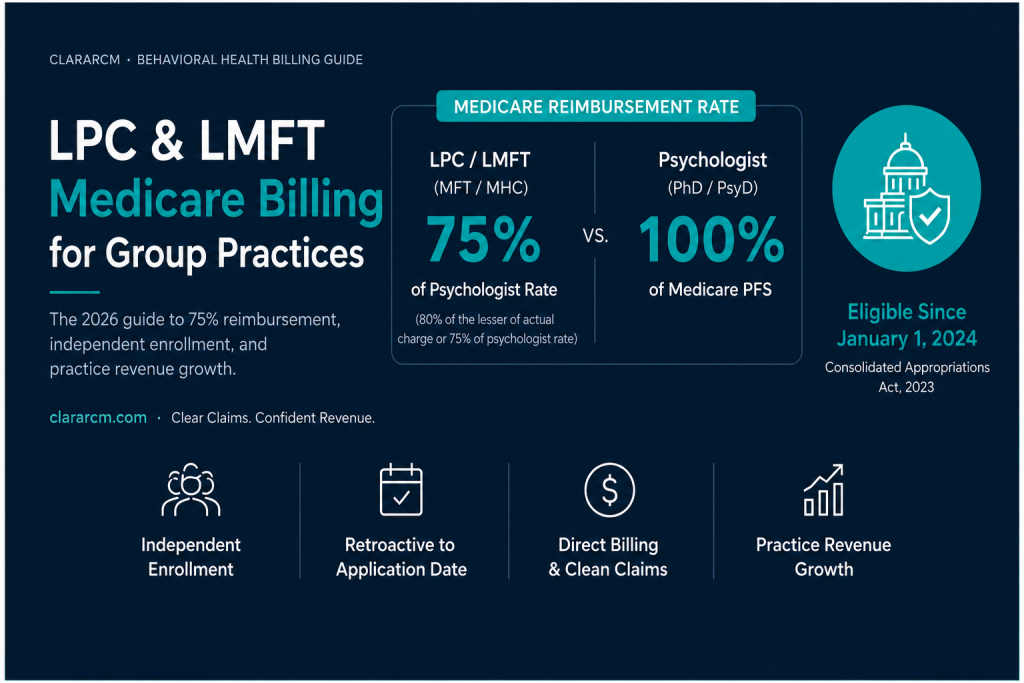
Medicare expanded independent participation to marriage and family therapists and mental health counselors beginning January 1, 2024. CMS states that Medicare Part B pays qualifying MFT and MHC services at 75% of what a clinical psychologist is paid under the Medicare Physician Fee Schedule.
| Provider Type | Revenue-Cycle Question | Operational Control |
|---|---|---|
| Psychiatrist | Is the clinician enrolled with the relevant payer and contracted at the intended location? | Confirm individual enrollment, group reassignment and payer-specific billing configuration |
| Clinical psychologist | Does the payer recognize the clinician independently and under the correct group arrangement? | Reconcile rendering NPI and contract file before claims begin |
| Clinical social worker | Does independent enrollment and scope match the payer and service? | Maintain provider-level enrollment and effective-date tracking |
| MFT / MHC / LPC-equivalent | Does the professional meet the payer’s enrollment and credential requirements? | For Medicare, verify eligibility and enrollment rather than assuming commercial network status carries over |
| Associate or supervised clinician | Does the payer permit the proposed billing arrangement? | Check state law, payer contract and supervision policy before the first billed service |
Official Medicare source: CMS confirms that MFTs and MHCs may independently enroll and bill Medicare for qualifying mental-health services and explains the 75% payment rule. See CMS: Marriage and Family Therapists & Mental Health Counselors.
For a detailed group-practice workflow, see LPC and LMFT Medicare Billing for Group Practices.
Behavioral Health Payer Routing and Carve-Outs
A behavioral health carve-out exists when mental-health or SUD benefits are administered separately from some or all of a member’s general medical benefits. The revenue-cycle team must therefore identify the entity responsible for the behavioral-health service rather than assuming that every claim belongs with the payer name shown most prominently on the insurance card.
Depending on the plan and contract, organizations such as Optum Behavioral Health, Carelon Behavioral Health, Magellan or another administrator may participate in the behavioral-health benefit structure. The exact arrangement should be verified for the patient and plan rather than inferred from the carrier brand alone.
What the eligibility team should verify
- Active coverage and effective dates
- Behavioral-health benefit administrator
- Electronic payer destination or payer ID
- Facility and rendering-provider network status
- Patient deductible, copayment and coinsurance
- Prior-authorization or notification requirements
- Session, visit or level-of-care rules when applicable
- Claim form and timely-filing requirements
High-value verification question: ask whether mental-health or substance-use benefits are administered by a separate entity and document the answer. That one step can prevent repeated routing and enrollment errors later in the cycle.
For the dedicated operational guide, see Behavioral Health Carve-Out Billing.
Revenue Cycle Management in Behavioral Hospitals
Revenue cycle management in behavioral hospitals adds institutional billing, inpatient authorization, concurrent utilization review, facility reimbursement and discharge transitions to the core behavioral-health revenue cycle. The hospital may also manage a professional claim stream for psychiatrists or other clinicians separately from the facility claim.
Before admission, the revenue-cycle and utilization-review teams may need to confirm the correct payer, network participation, pre-certification requirements, admission criteria and claim methodology. During the stay, authorization can become a day-by-day control because the payer may approve an initial period and require additional clinical information for continued coverage.
Inpatient Authorization
Record approved dates, authorization number, next review date, responsible utilization-review contact and the documentation needed for continued-stay requests.
Concurrent Review
Clinical and billing teams should work from the same approved date range so services are not billed as covered days when payer review is still unresolved.
Institutional Claims
Facility billing may involve UB-04/837I fields, bill type, revenue codes, procedure codes and the organization’s contracted payment methodology.
Professional Claims
Psychiatrist and other professional services may travel through a separate claim stream and still need to reconcile with the same patient, admission and authorization context.
Discharge and Step-Down
Transitioning from inpatient care to PHP, IOP or outpatient treatment may change the authorization, service code, claim form, rendering-provider rules and payer requirements.
Denied Days and AR
Denied inpatient days should be segmented by authorization, medical necessity, eligibility, level of care and filing status so the next recoverable action is clear.
Behavioral hospitals therefore need a shared operating record between intake, utilization review, clinical teams, health information management, coding, billing and accounts receivable. When those functions use different dates or payer assumptions, revenue can break even when the individual claim fields appear correct.
Where Behavioral Health Revenue Cycles Break Down
Many behavioral-health revenue problems begin outside the claim itself. Repeated denials are often downstream evidence of a payer-routing, authorization, enrollment, documentation or workflow problem that existed before submission.
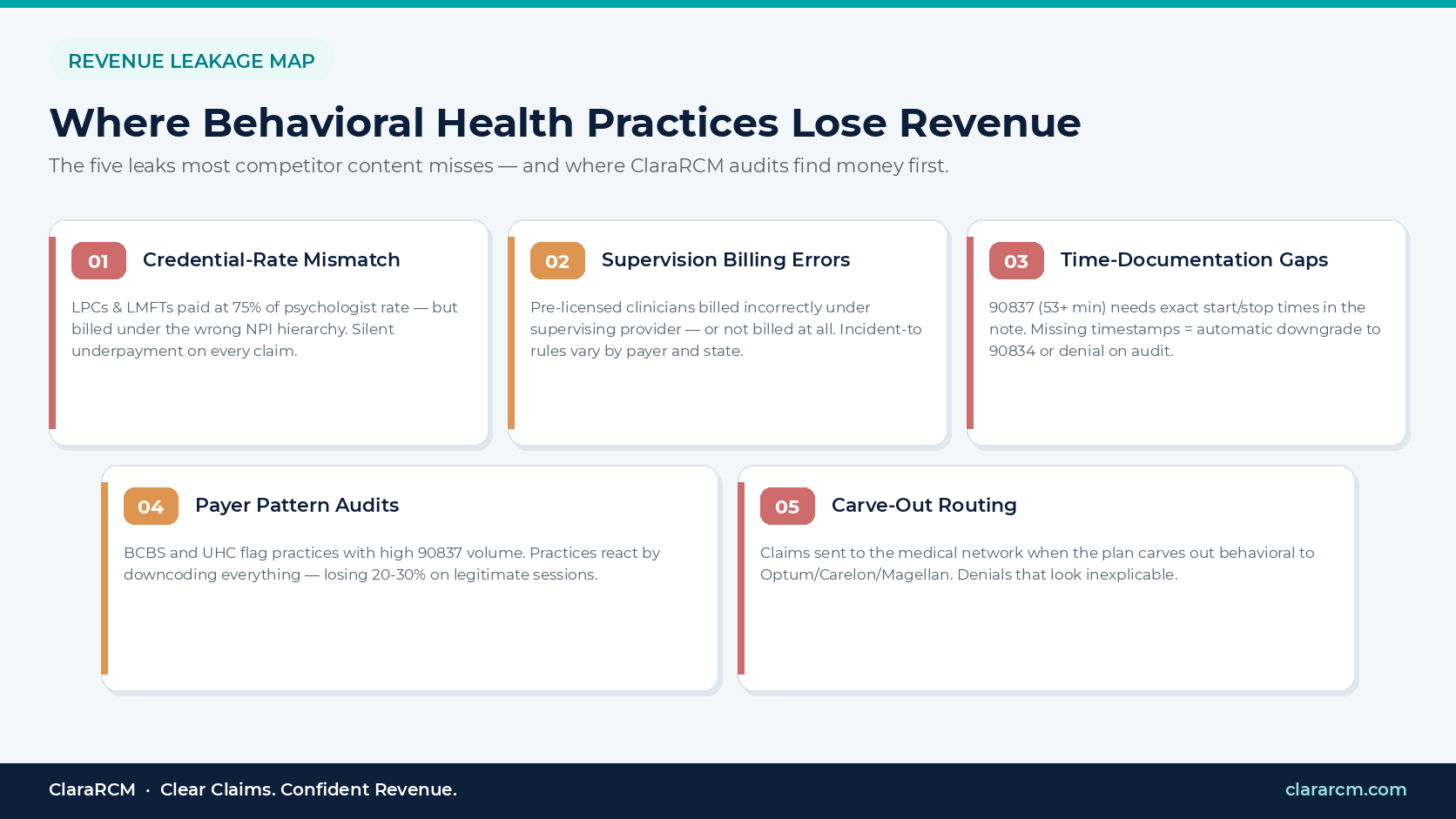
Wrong Behavioral-Health Payer
The medical plan is verified, but the behavioral-health administrator or network arrangement is not. Claims then route to an entity that is not responsible for adjudication.
Authorization Does Not Match Care
Approved dates, visits, units or level of care do not match what was actually delivered or billed.
Provider Enrollment Mismatch
The rendering professional, location or group relationship does not match the payer’s enrollment or contractual record.
Documentation and Time Conflict
The clinical note does not contain enough information to support the billed time, service, provider or treatment setting.
Denials Managed One Claim at a Time
Staff correct individual claims without identifying the payer or workflow pattern causing the same failure repeatedly.
Underpayments Close Silently
Payments are posted without comparing the allowed and paid amounts against the applicable reimbursement expectation.
Psychotherapy coding patterns need documentation support
Time-based psychotherapy codes should be selected from the documented service and applicable coding rules rather than the scheduled appointment length. A practice should not automatically downcode every long session merely because a payer reviews utilization patterns, and it should not automatically select the longest code because an appointment slot was scheduled for that duration.
See 90837 Pre-Payment Review and Audit Response and Psychotherapy Diagnosis Pairing Denials.
Same-day psychiatry and psychotherapy need the correct pathway
When psychotherapy is provided with a qualifying E/M service by an eligible professional, the billing structure may involve the E/M code plus the appropriate psychotherapy add-on code rather than a standalone psychotherapy code. Documentation must separately support the services and the applicable time requirements.
Seeing the same denial pattern repeatedly?
ClaraRCM can review the revenue-cycle cause behind recurring behavioral-health denials rather than treating each claim as an isolated problem.
Behavioral Health Revenue Cycle Management KPIs to Track
The most useful behavioral health RCM metrics are the ones that reveal where money is delayed, denied, underpaid or aging. Instead of applying one universal benchmark to every practice, track the organization’s trend over time and segment performance by payer, clinician, service line and denial cause.
| KPI | What It Measures | How to Investigate It |
|---|---|---|
| Clean claim rate | Claims accepted without front-end rejection or correction | Break down by payer, rejection reason, clinician and claim type |
| Initial denial rate | Claims denied during initial adjudication | Segment authorization, eligibility, coding, enrollment, documentation and filing causes |
| Net collection ratio | Collected amount compared with collectible reimbursement after contractual adjustments | Review by payer, service line, location and provider group |
| Days in AR | Average time balances remain outstanding | Separate payer AR from patient responsibility and review high-value aging accounts |
| AR over 90 days | Older receivables with increasing collection risk | Segment by payer, denial status, filing deadline and appeal availability |
| First-pass payment rate | Claims paid without rework | Compare across payers and provider types |
| Authorization denial rate | Revenue affected by missing, expired or mismatched authorization | Trace back to patient-level authorization records and level-of-care transitions |
| Payment variance | Difference between expected and actual payer reimbursement | Review by payer, code, provider and contract term |
A practice-wide average can hide a payer-specific problem. If one behavioral-health administrator produces most authorization denials or one commercial contract produces repeated payment variances, the useful answer is not the blended average; it is the segmented root cause.
What Should Behavioral Health Practices Look for in an RCM Tool?
A behavioral health RCM tool should help the practice control payer routing, authorization, provider eligibility, claim quality, denials, payments and accounts receivable—not simply transmit claims. The most useful software features are the ones that make revenue-cycle exceptions visible before they become aging balances.
Software does not replace revenue-cycle ownership. The system should make exceptions visible, but the organization still needs staff or an RCM partner responsible for reviewing those exceptions and closing the loop.
MHPAEA and the Behavioral Health Revenue Cycle
The Mental Health Parity and Addiction Equity Act matters to revenue-cycle teams when a plan’s mental-health or substance-use restrictions may be more restrictive than comparable medical or surgical restrictions. Prior authorization, medical-necessity standards, network arrangements and other nonquantitative treatment limitations can therefore become relevant when analyzing certain denials.
A denial is not automatically a parity violation. The team must understand the actual plan limitation, the applicable benefit classification, the plan terms and the comparable medical or surgical treatment limitation before deciding whether a parity issue exists.
The enforcement status of the 2024 MHPAEA Final Rule also requires care. In May 2025, the Departments of Labor, Health and Human Services, and Treasury announced that they would not enforce portions of the 2024 Final Rule that were new relative to the 2013 rule for failures occurring before a final decision in the related litigation, plus an additional 18 months. The Departments specifically stated that MHPAEA’s statutory obligations, as amended by the Consolidated Appropriations Act, 2021, continue to have effect.
Official federal source: read the Departments’ MHPAEA enforcement statement.
For the billing and appeal workflow, see MHPAEA Parity Appeals for Behavioral Health Claims.
Behavioral Health Revenue Cycle Management Changes to Know in 2026
Behavioral health revenue-cycle teams should review several Medicare and regulatory developments in 2026, particularly provider participation, APCM behavioral-health add-ons, telehealth requirements and parity-enforcement status.
1. MFT and MHC Medicare participation continues
Marriage and family therapists and mental health counselors have been eligible to independently enroll in Medicare since January 1, 2024. In 2026, revenue-cycle teams should continue confirming enrollment before billing Medicare and use the applicable provider classification and payment rules.
CMS states that Medicare Part B pays qualifying MFT and MHC services at 75% of the amount paid to a clinical psychologist under the Medicare Physician Fee Schedule. CMS source.
2. New APCM behavioral-health add-on codes G0568, G0569, and G0570
For calendar year 2026, CMS finalized three optional HCPCS add-on codes—G0568, G0569, and G0570—for qualifying behavioral health integration or psychiatric Collaborative Care Model services furnished with an Advanced Primary Care Management base service by the same practitioner in the same month.
These codes should not be described as a universal replacement for the existing Collaborative Care Model code family. Practices should first determine which care-management pathway they are using and then apply the current CMS billing instructions.
3. Medicare mental-health telehealth has important 2026 details
Medicare continues to maintain distinct rules for qualifying mental-health telehealth services, including services furnished to patients in their homes. Revenue-cycle teams should not reduce the policy to a simple statement that behavioral telehealth is always unrestricted.
CMS guidance for 2026 addresses an in-person visit requirement for certain mental-health telehealth services furnished in the patient’s home, with timing requirements and exceptions. CMS also permits audio-only behavioral-health services in the home in specified circumstances when the practitioner has audio-video capability and the patient is not capable of or does not consent to video.
POS 10 is used for Medicare telehealth provided in the patient’s home, while POS 02 is used for telehealth provided other than in the patient’s home.
Verify the date-of-service requirements in the current CMS Telehealth guidance before billing.
4. MHPAEA requires current-rule verification
The statutory parity obligations remain important, but billing and compliance teams should not describe the 2024 Final Rule as though every new provision is currently being federally enforced. Use the current federal enforcement statement, applicable plan terms, existing MHPAEA requirements and state rules when reviewing a potential parity issue.
Operational rule: when a regulatory change affects a claim workflow, update the payer matrix, billing template, authorization process and staff instructions together. Updating only a code list leaves the surrounding revenue-cycle controls unchanged.
How Behavioral Health Organizations Structure the RCM Function
Behavioral health organizations generally operate RCM through an internal team, a software-enabled internal workflow, an outsourced partner, or a combination of those models. The right structure depends on volume, payer complexity, staffing, service mix, authorization burden and the amount of specialized expertise needed.
| Model | Typical Structure | Operational Question |
|---|---|---|
| Internal team | Practice employs eligibility, billing, denial and AR staff directly | Does the team have enough specialty knowledge and capacity to work payer exceptions consistently? |
| Software-enabled internal team | Automation and work queues support an internal billing staff | Does the software identify problems early enough for staff to act on them? |
| Outsourced RCM | External organization owns some or all billing functions | Are ownership, reporting, access, escalation and performance responsibilities clearly defined? |
| Co-sourced model | Practice retains selected functions while an outside team manages claims, denials or AR | Are handoffs clear enough that tasks do not fall between internal and external teams? |
This pillar intentionally does not compare vendor pricing or rank behavioral-health RCM companies. For those commercial questions, see Behavioral Health RCM Services, Pricing and Vendor Guidance.
Behavioral Health Billing Resource Library
Use the guides below to go deeper into a specific stage or problem within the behavioral-health revenue cycle.
Core Mental Health Billing
Payer, Credentialing, and Revenue Strategy
SUD and Addiction Treatment
Behavioral Health Revenue Cycle Management: Frequently Asked Questions
What is behavioral health revenue cycle management?
Behavioral health revenue cycle management is the end-to-end financial and administrative process that moves mental health and substance use services from insurance verification through authorization, provider enrollment, documentation, coding, claim submission, payment posting, denial management and accounts-receivable follow-up.
How does behavioral health RCM work?
Behavioral health RCM can be organized into front-end, mid-cycle and back-end functions. The front end establishes coverage, payer routing, enrollment and authorization. The mid-cycle converts documented care into an accurate claim. The back end manages adjudication, payments, denials, patient responsibility, accounts receivable and reporting.
How is behavioral health RCM different from general medical RCM?
Behavioral health often adds recurring session authorization, separate behavioral-health payer administrators, provider-specific credentialing and enrollment, time-based psychotherapy documentation, supervision arrangements, SUD privacy requirements and level-of-care transitions. Those factors can affect payment even when the basic claim format is the same as other medical specialties.
What is mental health revenue cycle management?
Mental health revenue cycle management is the application of RCM to therapy, psychiatry, psychology and related professional mental-health services. It includes benefit verification, payer routing, clinician enrollment, authorization, documentation, coding, claims, remittance posting, denials and AR follow-up.
What are the seven stages of behavioral health RCM?
The seven stages are patient access and eligibility verification; authorization, enrollment and provider eligibility; clinical documentation; coding and charge capture; claim scrubbing and submission; payment posting and denial management; and accounts-receivable follow-up with reporting.
What KPIs should behavioral health practices track?
Useful behavioral health RCM KPIs include clean claim rate, initial denial rate, net collection ratio, days in accounts receivable, AR over 90 days, first-pass payment rate, authorization denial rate and payment variance. Practices should segment those metrics by payer and service line instead of relying only on a blended organization-wide average.
What should a behavioral health practice look for in an RCM tool?
Look for patient-level authorization tracking, behavioral-health payer routing, provider enrollment visibility, payer-specific claim scrubbing, denial root-cause reporting, expected-payment review, segmented AR worklists and integration with the clinical documentation needed to support claims and appeals.
How does RCM differ in behavioral hospitals?
Behavioral hospitals add inpatient authorization, concurrent utilization review, institutional billing, facility reimbursement, denied-day management, discharge transitions and separate professional claim streams to the standard behavioral-health revenue cycle.
Can MFTs and mental health counselors bill Medicare independently?
Yes, when they meet Medicare enrollment requirements. MFTs and mental health counselors became eligible to independently enroll and bill Medicare for qualifying mental-health services beginning January 1, 2024. CMS states that Medicare Part B pays their qualifying services at 75% of the amount paid to a clinical psychologist under the Medicare Physician Fee Schedule.
Are G0568, G0569 and G0570 replacements for the traditional CoCM codes?
No. For 2026 CMS created G0568, G0569 and G0570 as optional behavioral-health integration and psychiatric Collaborative Care Model add-on services when an applicable APCM base service is reported by the same practitioner in the same month. They should not be treated as a universal renumbering or replacement of every existing CoCM pathway.
Is every behavioral-health authorization denial a parity violation?
No. A potential MHPAEA issue requires comparison of the behavioral-health limitation with an applicable medical or surgical limitation under the relevant plan and legal framework. The denial itself does not prove a parity violation.
Find the Part of Your Revenue Cycle That Needs Attention
ClaraRCM can review your current behavioral-health billing workflow and identify where payer routing, authorization, credentialing, denials, payment posting or aging AR may need closer attention.
- Eligibility and behavioral-health payer-routing review
- Authorization and provider-enrollment review
- Denial-pattern and aging-AR review
- No patient information required in this form

Andleeb Asghar, Pharmacist
RCM Specialist & Founder , ClaraRCM
Andleeb Asghar is a pharmacist, medical billing professional, and revenue cycle management specialist with experience supporting U.S. healthcare billing operations, behavioral health billing, coding workflows, eligibility verification, denial management, accounts receivable, payment posting, provider enrollment, and end-to-end revenue cycle management.
Last updated: September 15, 2026. ClaraRCM provides medical billing and revenue cycle management support. This article is educational and is not legal, clinical, coding, or payer-contract advice. Coverage, enrollment, supervision, authorization, coding, privacy, reimbursement and telehealth requirements vary by payer, provider, state, setting, contract and date of service. Verify current requirements with CMS, the applicable code set, regulators, payer materials and qualified professional advisers before applying them to claims.