ICD-10 Diagnosis Pairing for Psychotherapy: Why Mild and Z-Code Diagnoses Get Denied
Z-codes such as Z63.0 (relationship distress) or Z56.0 (work stress) do not by themselves establish medical necessity for psychotherapy under Medicare and most commercial payers — a primary mental health diagnosis is required. Similarly, a mild-severity diagnosis like F32.0 paired repeatedly with extended 60-minute sessions creates a mismatch payers flag, unless functional impairment is documented to justify the treatment intensity. This is the psychotherapy diagnosis medical necessity denial problem most practices never see coming.
A psychotherapy diagnosis medical necessity denial doesn’t mean the therapy wasn’t needed — it means the ICD-10 code on the claim didn’t justify the service intensity to the payer’s adjudication system. Psychotherapy claims need a CPT code and an ICD-10 diagnosis that supports the session length and frequency billed. When the diagnosis is a Z-code alone, an unspecified code, or a mild-severity specifier paired with high-intensity weekly sessions, the claim fails the psychotherapy diagnosis medical necessity denial test even when the therapy was clinically appropriate and the documentation was complete. This post covers the specific pairing patterns that generate these denials and the documentation that prevents them. For the full behavioral health billing picture, see ClaraRCM’s behavioral health revenue cycle management guide, and for the audit side of this problem, see our post on what to do when a payer flags your 90837 billing.
The Medical Necessity Logic Payers Apply
Payers evaluate psychotherapy claims by asking one question: does the diagnosis severity justify the service intensity? The ICD-10 code is not just an administrative requirement — it is the payer’s primary tool for deciding whether the billed service was medically necessary. A 53-minute individual psychotherapy session (CPT 90837) is appropriate for a patient with moderate-to-severe major depressive disorder. The same code billed weekly for someone coded with only a Z-code or a mild specifier raises an automatic flag.
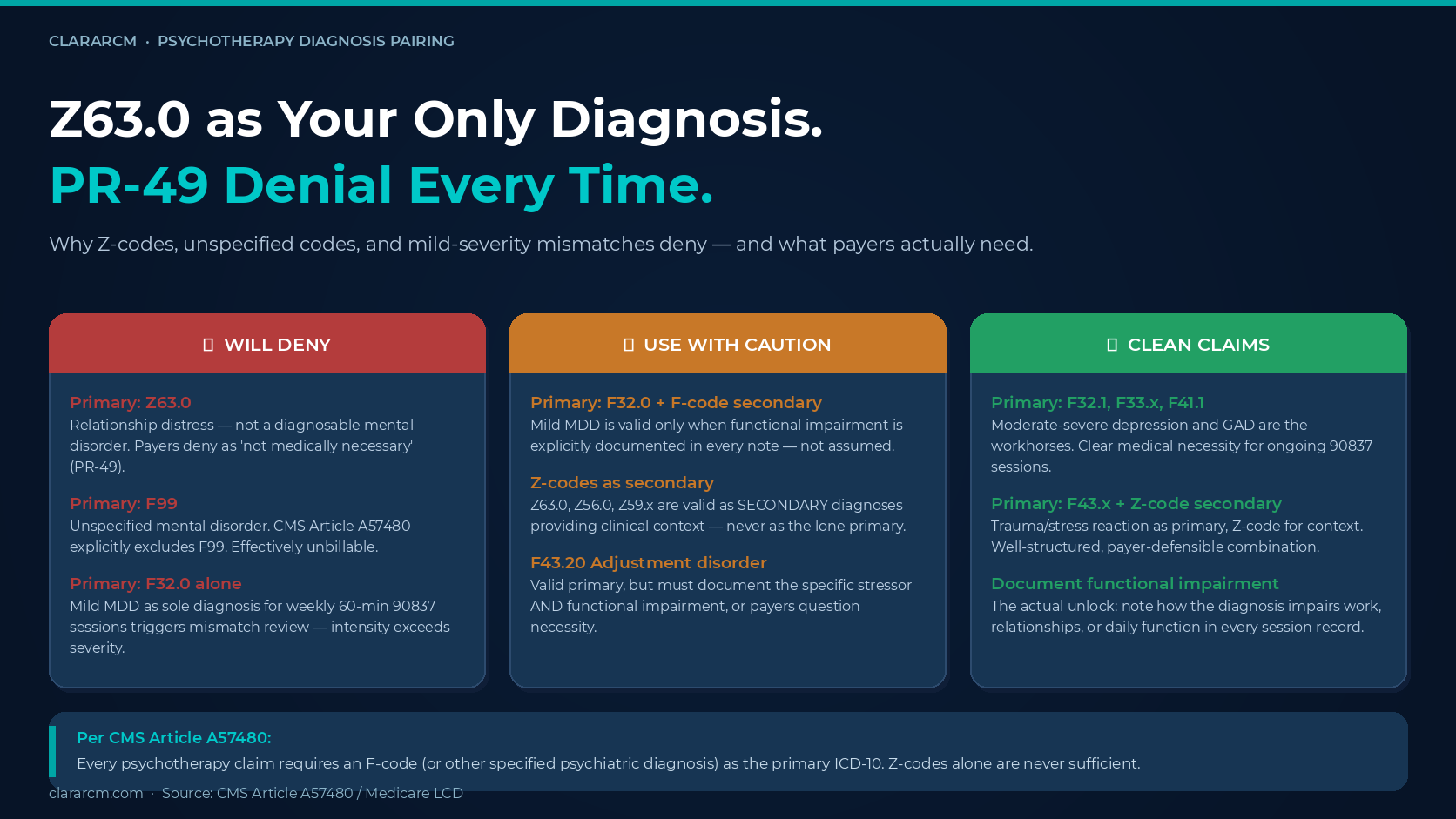
The legal framework for Medicare is CMS Article A57480, which governs what diagnoses support medical necessity for psychotherapy codes. It defines the ICD-10-CM codes that establish medical necessity for 90832, 90834, 90837, 90839, 90853, and the rest of the psychotherapy family. Z-codes do not appear on that list as primary diagnoses. F99 (unspecified mental disorder) is explicitly called out as insufficient. The payer’s system reads the primary diagnosis field first and adjudicates accordingly.
Why Z-Codes Alone Cause a Psychotherapy Diagnosis Medical Necessity Denial
Z-codes in the ICD-10-CM system describe conditions and factors that influence health but are not diagnosable mental disorders — which is exactly why they fail the medical necessity test when used as the sole primary diagnosis for psychotherapy. Z63.0 (partner relationship distress), Z56.0 (problems related to employment), Z59.x (housing instability), and similar codes describe the context of a patient’s life, not a treatable psychiatric condition.
When Z63.0 appears as the primary ICD-10 code on a psychotherapy claim, the result is a psychotherapy diagnosis medical necessity denial — most payers return it with a PR-49 code meaning “this service was not medically necessary.” That language is technically accurate under their policy: relationship distress is not a covered mental health condition; it is a life circumstance. The therapy may be clinically valuable and genuinely helpful to the patient, but the claim fails because the diagnosis doesn’t meet the benefit definition.
The fix is structural, not clinical. When a patient is dealing with relationship distress, it is almost always accompanied by a diagnosable condition — depression, anxiety, adjustment disorder, PTSD — that does meet payer criteria. That F-code belongs in the primary position. The Z-code is then appropriate and useful as a secondary diagnosis that provides clinical context and explains the therapy’s focus, but it cannot carry the claim alone.
The secondary Z-code is valuable, not wrong. Adding Z63.0 as secondary when F32.1 is primary is good clinical coding — it tells the payer why the patient is in therapy, which supports ongoing authorization. The error is only in making it primary. Z-codes as secondary diagnoses also help document the psychosocial stressors that justify continued treatment intensity. The Substance Abuse and Mental Health Services Administration (SAMHSA) recognizes psychosocial factors as critical context for mental health treatment — but payers require the underlying clinical diagnosis in the primary position first.
Severity Specificity: When F32.0 + 90837 Triggers Review
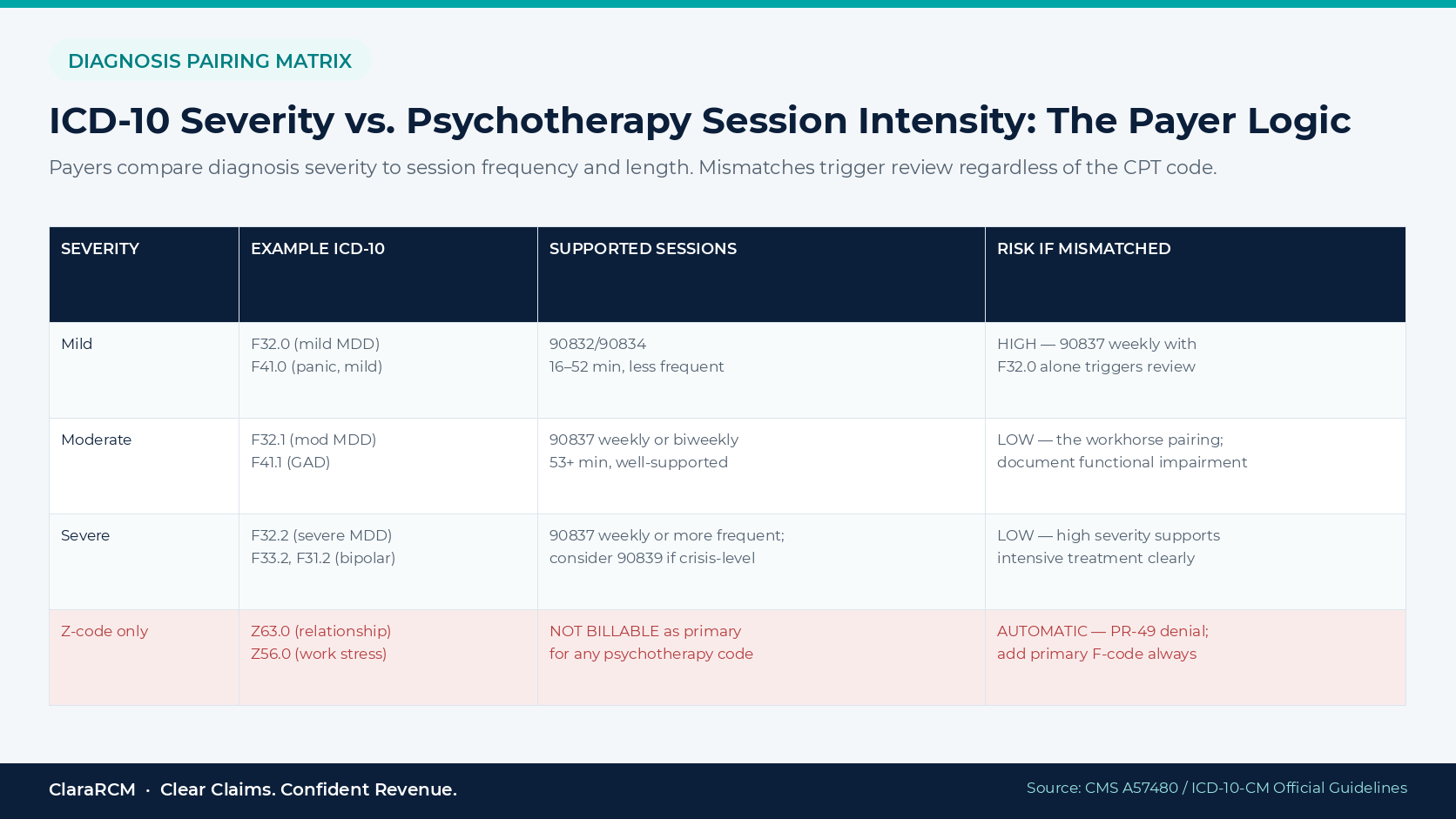
Even with a valid F-code as the primary diagnosis, a mismatch between the severity specifier and the session intensity creates a second category of denial risk that a Z-code audit often misses. The severity specifier in the ICD-10 code (mild, moderate, severe, unspecified) tells the payer how serious the condition is. The CPT code tells the payer how intensive the treatment is. When those two signals conflict, the claim draws scrutiny.
| Severity | Example ICD-10 | Supported sessions | Denial risk |
|---|---|---|---|
| Mild | F32.0 (mild MDD), F41.0 (panic, mild) | 90832/90834 (16–52 min), less frequent | HIGH — weekly 90837 with F32.0 alone triggers review without documented functional impairment |
| Moderate | F32.1 (moderate MDD), F41.1 (GAD) | 90837 weekly or biweekly, 53+ min | LOW — the workhorse pairing; document functional impairment to protect against downcoding reviews |
| Severe | F32.2, F33.2 (severe MDD), F31.2 (bipolar) | 90837 weekly or more frequent; consider 90839 for crisis-level | LOW — high severity clearly supports intensive treatment |
| Z-code only | Z63.0 (relationship), Z56.0 (work stress) | Not sufficient as primary for any psychotherapy code | AUTOMATIC — PR-49 denial; always add a primary F-code |
Rate sources: Diagnosis severity criteria per CMS Article A57480 and the ICD-10-CM FY2026 Official Guidelines. CPT 90837 rate ($167.00) per the CMS Physician Fee Schedule Look-Up Tool, 2026 national non-facility rate. Verify your geographic locality rate before billing.
The practical implication: F32.0 (mild MDD) is not wrong as a diagnosis, and it doesn’t automatically deny. But a pattern of weekly 60-minute sessions billed with only F32.0 as the primary code will eventually draw a payer pattern review asking why a mild condition requires this level of treatment. The documentation behind the code has to answer that question before the payer asks it.
Documenting Functional Impairment (The Missing Piece)
Functional impairment documentation is what bridges a mild-severity diagnosis to an intensive treatment plan — and its absence is what turns a valid clinical decision into a psychotherapy diagnosis medical necessity denial. It is the single most common documentation gap ClaraRCM finds when auditing mental health billing records. A diagnosis code describes the condition. Functional impairment documentation explains why that condition, at this moment in this patient’s life, requires this level of care.
The documentation doesn’t need to be lengthy. It needs to answer three specific questions a utilization reviewer will ask:
- What can’t the patient do because of this condition? Specific examples — can’t maintain employment, missed school, avoiding social situations, unable to manage household responsibilities — are far more defensible than general statements like “patient is experiencing significant distress.”
- How does this impairment relate to the diagnosed condition? The note should connect the functional problem directly to the ICD-10 diagnosis, not just mention both in separate paragraphs.
- Why does the treatment plan’s intensity match the impairment level? Weekly 53-minute sessions need a documented rationale — what is the therapeutic approach, what is the goal timeline, and why less-frequent or shorter sessions wouldn’t be sufficient.
When these three questions are answered in the progress note, a mild-severity diagnosis becomes defensible for intensive treatment, because the diagnosis is no longer the sole justification — the documented functional state is. The diagnosis code establishes the condition; the note establishes the medical necessity of the treatment. The Department of Labor’s mental health parity guidance also requires plans to apply the same functional-impairment documentation standards to mental health claims as they do to comparable medical claims — meaning your documentation standard is set by what the payer would accept for an equivalent medical condition.
ClaraRCM’s billing audit and cleanup services specifically review diagnosis-to-CPT pairing across the prior 90 days of claims before the first denial comes in — identifying the mismatches before a payer pattern review does. When denials have already landed, our denial management services build appeals that map the functional impairment documentation to the payer’s own medical necessity criteria, which is the only appeal structure that consistently overturns medical necessity denials rather than just resubmitting.
Frequently Asked Questions
Can You Bill Therapy With Only a Z-Code Diagnosis?
No. Z-codes describe life circumstances and psychosocial factors, not diagnosable mental health conditions. Medicare’s CMS Article A57480 explicitly requires a qualifying ICD-10 diagnosis as the primary code for psychotherapy medical necessity. When Z63.0 or similar codes appear as the sole primary diagnosis, payers return PR-49 denials. Z-codes are appropriate and valuable as secondary diagnoses providing clinical context.
Why Was My Psychotherapy Claim Denied for the Diagnosis Code?
The three most common diagnosis-related denial causes are: a Z-code in the primary position without an F-code, an unspecified code like F99 (which CMS explicitly excludes), or a mild-severity specifier paired with high-intensity weekly 90837 sessions without documented functional impairment. Checking the denial’s CARC and RARC codes identifies which pattern applies — PR-49 typically signals medical necessity; CO-4 or CO-11 often signal code pairing or coverage issues.
Does the Diagnosis Have to Match the Session Length?
Not automatically — but severity should correspond to intensity without documentation explaining the gap. A mild-severity diagnosis (F32.0) can support 90837 if the progress notes document how the condition is creating significant functional impairment that justifies weekly 53-minute sessions. Without that documentation, the mismatch between mild-coded severity and high treatment intensity is what generates utilization review flags and eventual pre-payment review.
What ICD-10 Codes Work Best for Psychotherapy Claims?
Per CMS Article A57480 and broad commercial payer policy, the strongest primary diagnoses for psychotherapy are moderate-to-severe F-codes: F32.1 (moderate major depressive disorder), F33.x (recurrent depressive disorder), F41.1 (generalized anxiety disorder), F43.x (trauma and stress-related conditions), F31.x (bipolar disorder), and F60.x (personality disorders). These carry clear medical necessity for ongoing psychotherapy without requiring additional impairment documentation to survive routine review.

Andleeb Asghar, PharmD
RCM Specialist & Founder, ClaraRCM
Andleeb Asghar is a PharmD, medical billing professional, and revenue cycle management specialist with 7+ years of experience across behavioral health billing, medical coding, denial management, accounts receivable recovery, and end-to-end revenue cycle optimization for U.S. mental health practices.
ClaraRCM provides revenue cycle and medical billing support. This content is for educational purposes and is not legal, clinical, or payer-contract advice.