
MIPS and Value-Based Care Billing Services: Quality, PI, IA, Cost, and QPP Strategy
MIPS billing services help eligible clinicians navigate the Merit-based Incentive Payment System under the Quality Payment Program — selecting quality measures, attesting to Promoting Interoperability objectives, documenting improvement activities, and managing the cost category to optimize the final MIPS composite score that determines a positive or negative Medicare Part B payment adjustment. In 2026, the MIPS performance threshold is 75 points, clinicians who do not report face a mandatory −9% payment adjustment on 2028 Medicare Part B claims, and clinicians who exceed the exceptional performance threshold can receive up to +9%. ClaraRCM manages MIPS billing strategy, measure selection, data submission, and QPP compliance for eligible clinicians across all 50 states.
ClaraRCM provides MIPS and value-based care billing services for physician practices, group practices, and health systems participating in the Quality Payment Program. Our team manages measure selection, performance data, attestation, submission, and QPP audit support to protect your Medicare payment adjustment.
Updated July 2026 for QPP Performance Year 2026 weights, thresholds, exceptional performance criteria, and CMS final rule updates.
Get a Free MIPS Strategy Review
Our team reviews your current MIPS participation status, measure selection, score gap, and QPP risk — at no charge.
MIPS and Value-Based Care Billing: QPP Participation, Measure Selection, and Payment Adjustment
MIPS billing is the process of reporting performance data across four weighted categories — Quality (30%), Promoting Interoperability (25%), Improvement Activities (15%), and Cost (30%) — to CMS through the Quality Payment Program portal or a qualified registry. The composite MIPS score determines whether eligible clinicians receive a positive payment adjustment, a negative adjustment, or no adjustment on Medicare Part B payments two years forward. Most eligible clinicians must participate or face mandatory penalties; voluntary reporters who exceed the exceptional performance threshold qualify for additional positive adjustments.
The MIPS program operates under the QPP framework established by MACRA. Eligible clinicians include physicians, physician assistants, nurse practitioners, clinical nurse specialists, and certified registered nurse anesthetists who exceed the low-volume threshold — currently defined as more than $10,000 in Medicare Part B allowed charges and more than 100 Medicare Part B patients in the determination period. Practices below the threshold are excluded from MIPS but may opt in voluntarily.
ClaraRCM's MIPS billing services cover the full QPP reporting lifecycle: eligibility determination, measure selection, performance data tracking, registry or direct EHR submission, attestation support, and post-submission audit response. Our medical coding support team connects clinical documentation to MIPS measure numerator and denominator compliance, and our revenue cycle management services integrate MIPS strategy with your practice's billing workflow. See also CMS Quality Payment Program for official participation requirements.
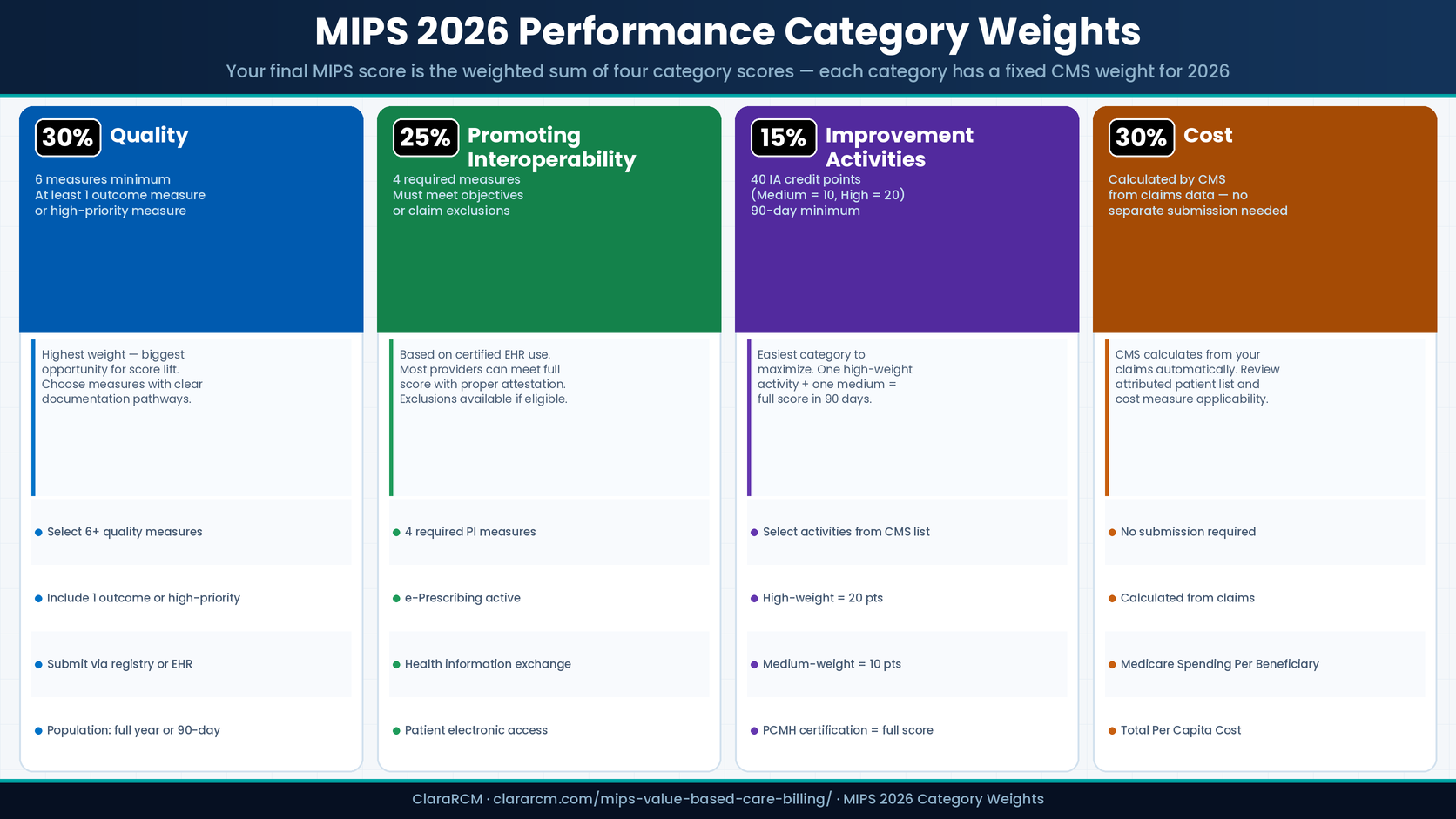
MIPS 2026 performance category weights: Quality (30%), Promoting Interoperability (25%), Improvement Activities (15%), Cost (30%). The composite score determines your 2028 Medicare Part B payment adjustment. Source: ClaraRCM, based on CMS QPP 2026 final rule.
| MIPS Category | 2026 Weight | What ClaraRCM Manages |
|---|---|---|
| Quality | 30% | Select 6+ measures, track numerator and denominator, submit via registry or EHR, include at least 1 outcome or high-priority measure |
| Promoting Interoperability | 25% | Attest to 4 required PI measures, document e-prescribing, health information exchange, patient access, and security review |
| Improvement Activities | 15% | Select activities totaling 40 points (medium = 10, high = 20) and attest to 90-day minimum participation |
| Cost | 30% | No submission required — CMS calculates from claims. We review attributed patient list, measure applicability, and care coordination impact |
MIPS 2026 Score to Payment Adjustment: What Each Score Range Means for Your Revenue
Your 2026 MIPS composite score determines your 2028 Medicare Part B payment adjustment. The adjustment applies to every Part B claim you submit in 2028 — a −9% penalty on a $2M Medicare Part B practice is $180,000 in lost revenue. Understanding where your score lands on this scale is the starting point for any MIPS strategy. Last updated: July 2026.
| Score Range | Status | 2028 Adjustment | Revenue Impact (example: $1M Part B) | ClaraRCM Action |
|---|---|---|---|---|
| 0 Points | Excluded or non-reporter | −9% | −$90,000 on $1M Part B | Immediate enrollment, retroactive correction if within window |
| 1–18 Points | Below threshold — partial penalty | −9% to −1% | Up to −$90,000 scaled by score | Identify missing measures, audit submission gaps, correct data |
| 18 Points | At threshold — payment neutral | 0% | No change — break-even only | Score lift strategy to move into positive adjustment range |
| 19–74 Points | Above threshold — positive adjustment | Up to +9% | +$19,000 to +$90,000 scaled | Maximize Quality and IA categories; review Cost attribution |
| 75+ Points | Exceptional performance tier | Up to +9%* | Full +$90,000 on $1M Part B* | Maintain exceptional tier; document all measure performance |
*Subject to CMS budget neutrality calculations. Actual adjustment amounts vary based on aggregate MIPS performance across all eligible clinicians. Verify current thresholds at qpp.cms.gov.
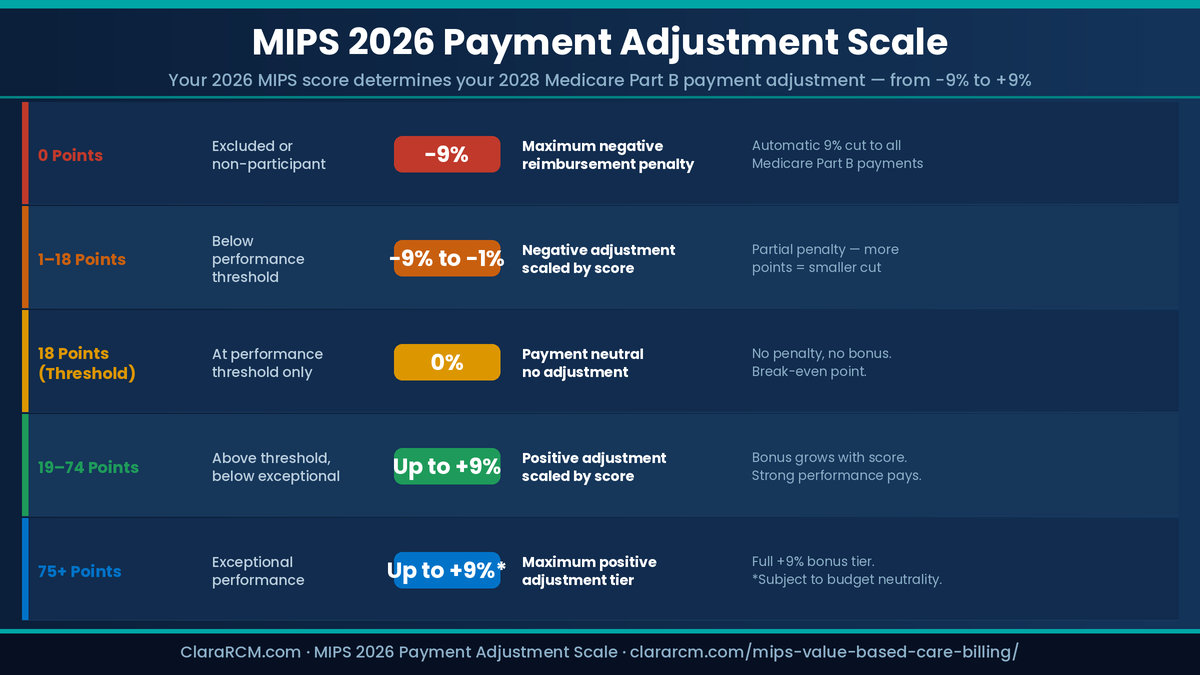
MIPS 2026 payment adjustment scale: score range, status, adjustment percentage, and revenue impact by band. Non-reporters face −9% on all 2028 Part B payments. Exceptional performers reach up to +9%. Source: ClaraRCM, based on CMS QPP 2026 data.
MIPS 2026 Score Estimator and Payment Adjustment Calculator
Enter your estimated performance scores for each category to project your composite MIPS score and the resulting 2028 Medicare Part B payment adjustment.
2026 weights: Quality 30% · PI 25% · IA 15% · Cost 30%
This tool uses 2026 CMS MIPS category weights (Quality 30%, PI 25%, IA 15%, Cost 30%) and the current performance threshold of 75 points. Actual scores depend on measure selection, data completeness, attribution, and CMS final calculations. Verify at qpp.cms.gov.
Send Your MIPS Score to ClaraRCM
Our team will review your estimated score, identify improvement opportunities in each category, and outline a strategy to protect your 2028 payment adjustment.
How ClaraRCM Manages MIPS Billing and QPP Strategy: 4 Steps
Eligibility and Enrollment Review
We confirm MIPS eligibility status, review the low-volume threshold, identify group vs individual reporting options, and determine whether an Advanced APM exclusion applies. See our provider credentialing services for enrollment support.
Measure Selection and Score Strategy
We select quality measures with the highest performance potential for your specialty, identify Improvement Activities eligible for high-weight credit, verify PI measure requirements, and project a target composite score above the exceptional performance threshold.
Data Tracking and Submission
We track numerator and denominator performance throughout the year, submit Quality and IA data via a qualified registry or direct EHR, attest to PI objectives, and file all required QPP data before the March 31 submission deadline through our medical coding support team.
Score Review and Audit Support
After CMS publishes final scores, we review the score report, identify any discrepancies, file targeted review requests if warranted, and provide audit documentation support. Our billing audit services extend to QPP compliance documentation.
MIPS vs Advanced APM: Which QPP Track Applies to Your Practice?
The Quality Payment Program has two tracks. Most eligible clinicians participate in MIPS. A smaller subset qualify as Qualifying APM Participants (QPs) through an Advanced Alternative Payment Model and are exempt from MIPS but receive a separate 5% incentive payment. Understanding which track applies changes your entire reporting and billing strategy.
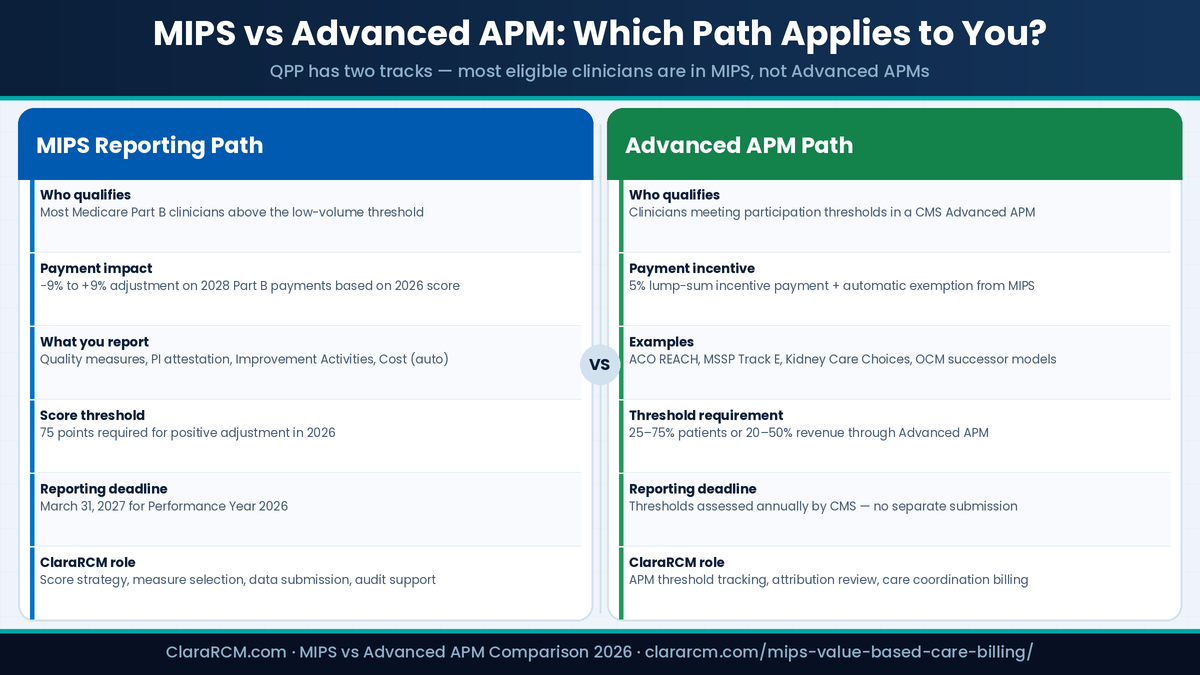
MIPS vs Advanced APM: who qualifies, payment impact, reporting requirements, and thresholds for each QPP track in 2026. Most eligible clinicians participate in MIPS, not an Advanced APM. Source: ClaraRCM, based on CMS QPP 2026 guidance.
| Factor | MIPS Track | Advanced APM Track |
|---|---|---|
| Who qualifies | Most Medicare Part B clinicians above the low-volume threshold | Clinicians meeting patient or revenue thresholds in a CMS-designated Advanced APM |
| Payment impact | −9% to +9% adjustment on 2028 Part B payments based on 2026 composite score | 5% lump-sum incentive on 2028 Part B payments; exempt from MIPS adjustment |
| What you report | Quality, Promoting Interoperability, Improvement Activities, Cost (4 categories) | APM-specific quality and cost metrics defined by the model — no separate MIPS submission |
| Examples | Any eligible clinician not in a qualifying Advanced APM | ACO REACH, MSSP Track E, Kidney Care Choices, Oncology Care Model successors |
| Deadline | March 31, 2027 for Performance Year 2026 data | No separate submission — CMS assesses thresholds from claims and APM data |
| ClaraRCM support | Full MIPS billing strategy, measure selection, submission, and score review | APM threshold tracking, attribution review, and care coordination billing support |
MIPS Billing Results: Before ClaraRCM vs After ClaraRCM
| MIPS Area | Before ClaraRCM | After ClaraRCM |
|---|---|---|
| Measure selection | Default measures selected without analyzing performance data or specialty benchmarks | Measures selected for highest score potential relative to specialty performance |
| Quality data tracking | Numerator and denominator tracked manually, often incomplete at submission | Automated tracking with monthly performance reports per measure |
| PI attestation | PI objectives partially attested; exclusions not claimed where eligible | Full PI attestation with all eligible exclusions documented and applied |
| Improvement Activities | IA points left on the table — medium-weight activities selected when high-weight were available | 40 IA points achieved within 90 days using highest-weight eligible activities |
| Cost category | Cost category impact not reviewed until post-submission | Attributed patient list reviewed; care coordination and cost measure impact analyzed |
| Composite score | Score below exceptional performance threshold; positive adjustment sub-optimal | Score optimized to reach or exceed exceptional performance tier |
| Audit response | QPP audit requests handled without documentation protocol | Measure documentation packaged and stored for immediate audit response |
ClaraRCM outcomes reflect aggregate client results. Individual MIPS scores and payment adjustments depend on specialty, measure selection, clinical documentation, payer mix, care coordination, and CMS final score calculations.
Why Eligible Clinicians Choose ClaraRCM for MIPS Billing Services
Specialty-Specific Measure Selection
We select Quality measures with the highest performance achievability for your specialty — not default measures that score low for your patient population.
Full-Year Performance Monitoring
We track numerator and denominator compliance monthly so score gaps are identified and corrected before submission, not discovered in the CMS score report.
PI and IA Optimization
We maximize Promoting Interoperability attestation and select Improvement Activities that achieve 40 IA points with minimum documentation burden — often fully complete within 90 days.
Cost Category Review
We review attributed patient lists, identify applicable cost measures, and assess care coordination practices that affect your Cost category score — the one category you cannot directly control but can influence.
Integrated RCM Support
MIPS strategy integrates with your billing workflow through ClaraRCM's revenue cycle management, denial management, and coding support teams.
Audit-Ready Documentation
Every measure attestation, PI objective, and IA activity is documented for CMS audit response — packaged and stored so that a QPP audit request can be answered within days, not weeks.
MIPS Billing Across Medical Specialties
ClaraRCM manages MIPS billing for eligible clinicians across all major specialties. Each specialty has its own optimal measure set and QPP strategy.
RCM Services That Support MIPS Eligible Clinicians
Medical Coding Support
Connect clinical documentation to MIPS quality measure numerator and denominator compliance — coding accuracy directly affects your Quality category score.
Learn more →Revenue Cycle Management
Integrate MIPS strategy with your full billing workflow — clean claims support the Cost category by ensuring accurate attribution and care coordination documentation.
Learn more →Provider Credentialing
Maintain accurate PECOS and payer enrollment to ensure eligible clinicians are correctly identified in CMS systems for MIPS eligibility determination.
Learn more →Billing Audit & Cleanup
Prepare documentation packages for QPP targeted review requests and CMS audit responses — measure attestation, PI objectives, and IA activity records organized for rapid response.
Learn more →MIPS Billing Questions: QPP, Scores, Adjustments, Reporting, and Exclusions
What is MIPS billing?
MIPS billing is the process of reporting performance data across four categories — Quality, Promoting Interoperability, Improvement Activities, and Cost — to CMS under the Merit-based Incentive Payment System. The resulting composite score determines whether an eligible clinician receives a positive payment adjustment, a negative adjustment, or no adjustment on Medicare Part B payments two years after the performance year. MIPS is the primary track of the Quality Payment Program established by MACRA.
Who has to participate in MIPS in 2026?
MIPS participation is required for eligible clinicians who exceed the low-volume threshold — currently defined as more than $10,000 in Medicare Part B allowed charges and more than 100 Medicare Part B patients in the applicable determination period. Eligible clinician types include physicians, physician assistants, nurse practitioners, clinical nurse specialists, and certified registered nurse anesthetists. Clinicians below the low-volume threshold are excluded from MIPS but may opt in voluntarily. Clinicians who qualify as QPs through an Advanced APM are also excluded. Verify your status at qpp.cms.gov.
What is the MIPS performance threshold for 2026?
The MIPS performance threshold for Performance Year 2026 is 75 points. Clinicians who score at or above 75 points receive a positive payment adjustment on their 2028 Medicare Part B payments. Clinicians who score above the exceptional performance threshold receive the maximum positive adjustment of up to +9%. Clinicians who score below 75 points receive a negative adjustment scaled to their score, and clinicians who do not report at all receive the maximum negative adjustment of −9%.
What are the four MIPS performance categories and their 2026 weights?
The four MIPS performance categories and their 2026 weights are: Quality (30%) — requires reporting at least 6 measures including at least 1 outcome or high-priority measure; Promoting Interoperability (25%) — requires attesting to 4 required PI measures tied to certified EHR use; Improvement Activities (15%) — requires 40 IA credit points from eligible activities over a minimum 90-day period; and Cost (30%) — calculated automatically by CMS from Medicare claims data with no separate submission required.
What happens if you do not report MIPS in 2026?
Eligible clinicians who do not report MIPS for Performance Year 2026 will receive the maximum negative payment adjustment of −9% applied to all Medicare Part B claims in 2028. This penalty applies automatically — CMS does not require a separate notification. For a practice with $1 million in annual Medicare Part B allowed charges, a −9% adjustment represents $90,000 in reduced reimbursement across 2028.
What is the MIPS reporting deadline for Performance Year 2026?
The submission deadline for MIPS Performance Year 2026 data is March 31, 2027. Data must be submitted through a qualified registry, direct EHR submission, a QCDR, or the QPP portal by that date. CMS does not grant extensions for standard MIPS submission. Hardship exceptions and reweighting requests must be submitted separately and have their own earlier deadlines — typically in the fall of the performance year.
What is the difference between MIPS and an Advanced APM?
MIPS and Advanced APMs are the two tracks of the Quality Payment Program. MIPS applies to most eligible clinicians and results in a payment adjustment of −9% to +9% based on a composite performance score. Advanced APMs are specific CMS payment models where qualifying participants (QPs) receive a 5% incentive payment and are automatically exempt from MIPS reporting and adjustment. Qualifying as a QP requires meeting patient or revenue participation thresholds within a CMS-designated Advanced APM such as ACO REACH or MSSP Track E.
How does the Cost category affect my MIPS score?
The Cost category carries a 30% weight in the 2026 MIPS composite score and is calculated entirely by CMS from Medicare claims data — clinicians do not submit Cost category data separately. CMS uses two primary cost measures: Medicare Spending Per Beneficiary (MSPB) and Total Per Capita Cost (TPCC), along with episode-based cost measures applicable to certain specialties. While you cannot directly control the Cost category score, you can influence it by reviewing your attributed patient list, improving care coordination, reducing unnecessary utilization, and ensuring accurate coding of care coordination services through RPM and CCM billing.
Can a small or solo practice succeed in MIPS?
Yes — solo and small practices have the same access to positive MIPS adjustments as large groups, and CMS offers specific support for small practices including a 6-point bonus added to the Quality category score, access to small practice support contractors, and simplified reporting options. Solo and small practices (15 or fewer clinicians) may also qualify for hardship exceptions that reweight categories where reporting is administratively burdensome. ClaraRCM manages MIPS billing for solo and small practices across all 50 states, handling measure selection, data tracking, and submission to minimize administrative burden while maximizing score.
Is outsourcing MIPS billing worth the cost?
Outsourcing MIPS billing is typically cost-effective when you compare the service fee against the revenue at risk from a suboptimal score. For a practice with $1 million in Medicare Part B charges, the difference between a −9% and a +9% adjustment is $180,000 in a single year. Most practices find that the cost of ClaraRCM's MIPS billing services is a fraction of the revenue protected or gained by moving from a below-threshold or neutral score to a positive or exceptional performance adjustment. Our free MIPS strategy review includes a score gap analysis and estimated revenue impact at no charge.