LPC & LMFT Medicare Billing for Group Practices: The 75% Rate, Enrollment, and Claims
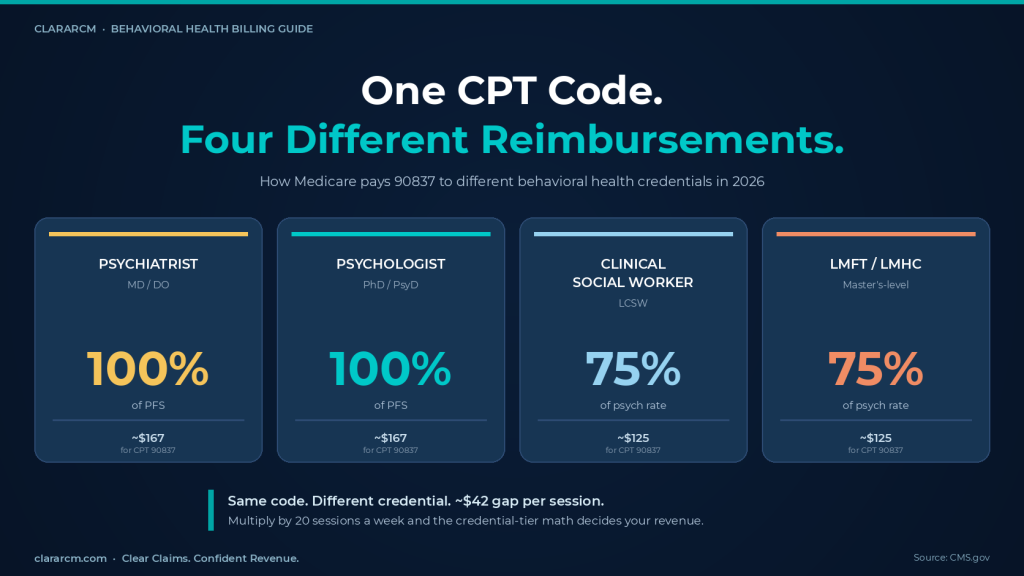
LPC LMFT Medicare billing for a group practice requires two connected enrollments: the clinician enrolls individually and reassigns Medicare benefits to the enrolled group. Medicare recognizes qualifying marriage and family therapists and mental health counselors as independent Part B practitioners for services furnished on or after January 1, 2024. Payment is generally calculated at 80% of the lesser of the actual charge or 75% of the clinical psychologist fee-schedule amount, while the group must keep the rendering clinician, reassignment, taxonomy, service location, and claim configuration aligned.
The opportunity created by Medicare recognition of MFTs and MHCs is bigger than simply adding a payer logo to a clinician profile. For a group practice, the operational work includes confirming qualification, completing individual enrollment, connecting the clinician to the group, loading the correct rates, holding or releasing claims at the right time, and preventing services from being billed under the wrong professional. This ClaraRCM guide explains the group-practice workflow without turning the article into another generic Medicare enrollment checklist.
This post supports our broader behavioral health revenue cycle management guide and our mental health and behavioral health billing services for U.S. practices.
Who Qualifies for LPC and LMFT Medicare Billing?
A license title alone does not determine Medicare eligibility. Medicare applies federal qualification standards to MFTs and MHCs, while the practitioner must also be legally authorized to furnish the service under the law of the state where it is delivered. State titles vary, so an LPC, LMHC, LCPC, or similarly titled counselor may fall within Medicare’s MHC category only when the education, supervised-experience, examination, and licensure requirements are satisfied.
| Qualification area | Marriage and family therapist | Mental health counselor | Group-practice verification |
|---|---|---|---|
| Education | Qualifying master’s or doctoral degree in marriage and family therapy or a related field meeting Medicare criteria | Qualifying master’s or doctoral degree in mental health counseling or a related field meeting Medicare criteria | Retain transcripts and degree documentation used in the enrollment file |
| Supervised experience | At least two years or 3,000 hours of post-master’s supervised clinical experience | At least two years or 3,000 hours of post-master’s supervised clinical experience | Confirm the experience is post-degree and supported by acceptable records |
| Licensure | Licensed or certified as an MFT by the state where services are furnished | Licensed or certified under the applicable state counseling category | Match the service location, state authority, NPI taxonomy, and Medicare enrollment |
| Independent enrollment | Eligible to enroll and directly bill Medicare | Eligible to enroll and directly bill Medicare | Complete individual enrollment before relying on group reassignment |
Primary-source basis: CMS states that the MFT and MHC Medicare benefit began January 1, 2024, and publishes the federal qualification and billing requirements on its dedicated MFT/MHC guidance page. Practices should confirm the clinician’s exact state license category rather than assuming every counselor title maps automatically to Medicare’s MHC definition.
The 75% Medicare Rate Math for LPCs and LMFTs
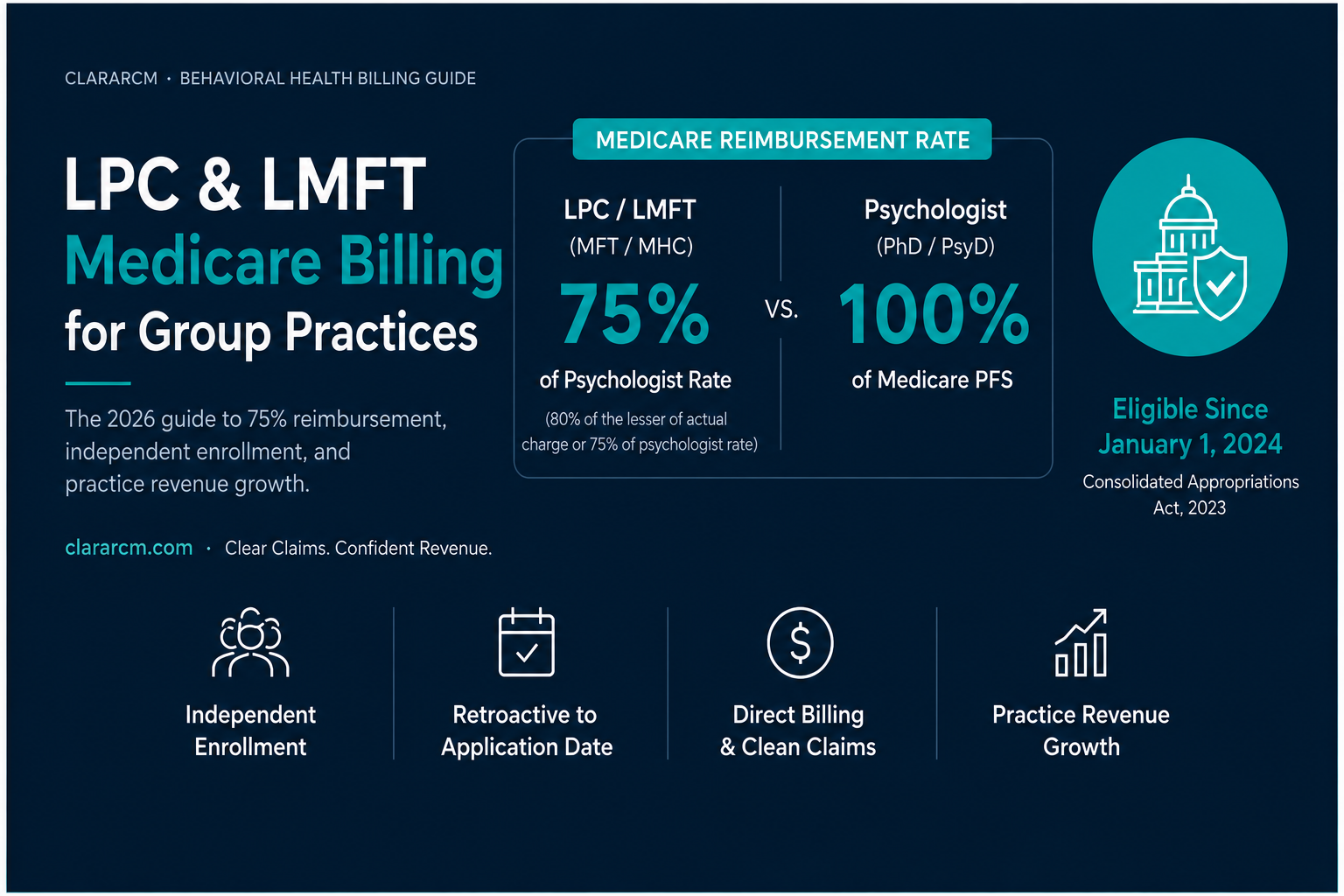
Medicare does not simply pay an LPC or LMFT “75% of the billed charge.” The payment formula starts with the lesser of the practitioner’s actual charge or 75% of the amount determined for a clinical psychologist under the Medicare Physician Fee Schedule. Medicare then generally pays 80% of that allowed amount, subject to deductible, coinsurance, participation status, locality, place of service, and other claim-level rules.
A safer worked example
Suppose the applicable psychologist fee-schedule amount for a service is represented as P. The MFT/MHC comparison amount is 0.75 × P. If the practitioner’s actual charge is higher than that amount, the lower 75%-of-psychologist figure controls the allowed calculation. Medicare’s program payment is then generally 80% of the allowed amount, with the beneficiary or secondary payer responsible for applicable cost sharing.
This formula is more reliable than publishing one national dollar figure. Physician Fee Schedule amounts vary by geographic locality and facility status, and they change when CMS updates the annual fee schedule. Before setting a budget or clinician compensation model, look up the exact code under the current year, locality, and non-facility or facility setting.
Do not build compensation from a headline rate. The amount shown in an online article may be a national estimate, a different locality, a facility rate, or an amount before the 80% Medicare payment calculation. Group-practice forecasts should use the actual allowed amount from the CMS PFS Look-Up Tool and the practice’s expected payer mix.
How LPC LMFT Medicare Group-Practice Enrollment Works
A group cannot replace the clinician’s individual enrollment. The practitioner must enroll as an eligible individual Medicare supplier, and the enrolled clinician must reassign the right to receive Medicare payment to the group when the organization will submit and collect the claims. CMS permits enrollment through internet-based PECOS or the applicable paper enrollment forms.
- Confirm the clinician meets Medicare’s MFT or MHC definition. Verify education, supervised experience, active state licensure, legal name, NPI, taxonomy, and practice locations before the application is submitted.
- Confirm the organization is enrolled correctly. The clinic or group practice needs an active Medicare enrollment and billing structure appropriate for receiving reassigned benefits.
- Submit the individual practitioner enrollment. Physicians and non-physician practitioners use PECOS or CMS-855I to enroll and report their Medicare practice information.
- Complete reassignment to the group. The individual authorizes the group to bill Medicare and receive payment for covered services the clinician personally furnishes.
- Load the clinician into the billing system. Add the rendering NPI, taxonomy, payer ID, effective service locations, group linkage, contracted status, fee schedule, and claim-edit rules.
- Validate before releasing claims. Confirm the Medicare enrollment record and reassignment are active for the applicable date and location rather than assuming application submission alone makes claims payable.
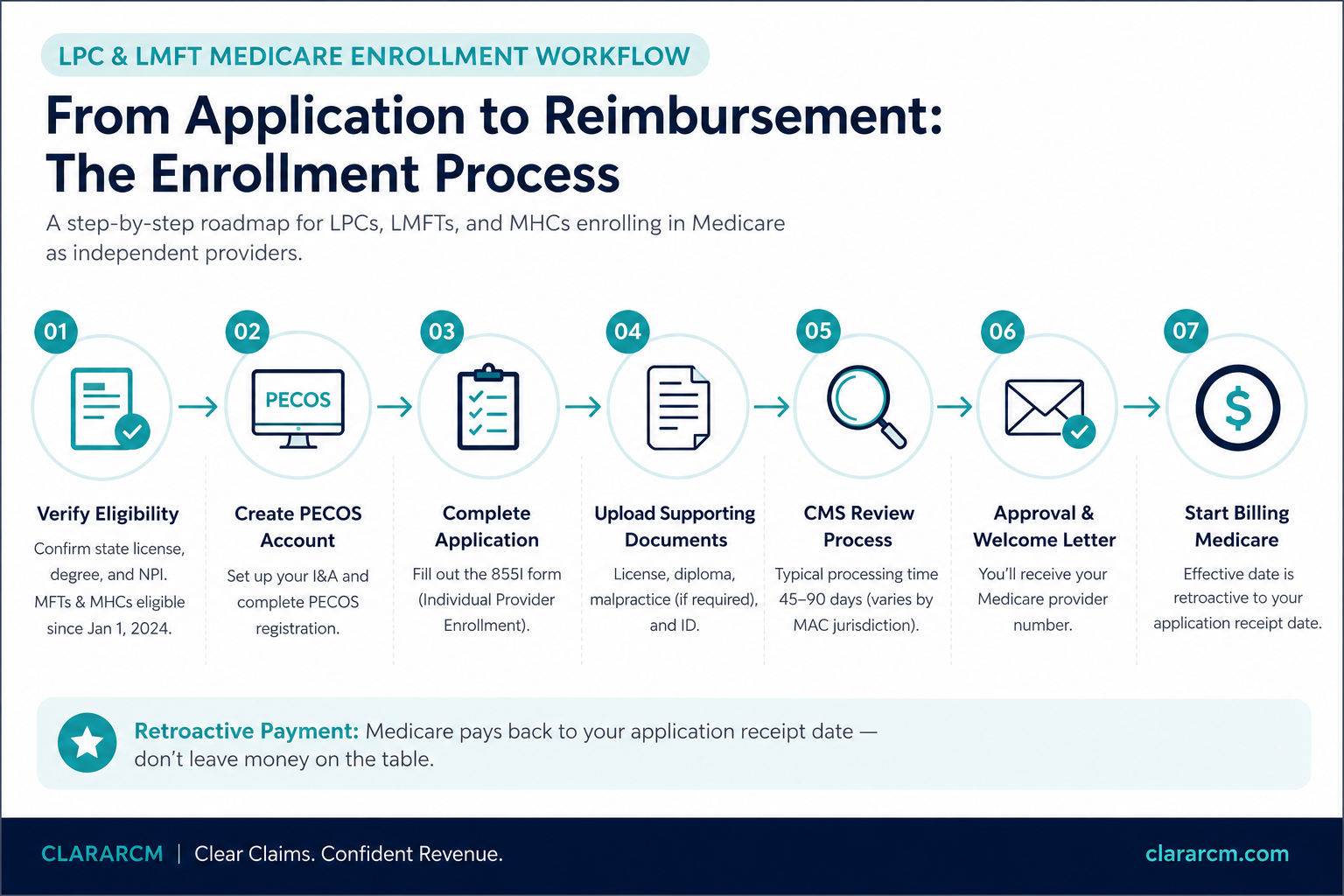
Operational rule: Do not convert a clinician to Medicare-ready status in the EHR based only on a PECOS submission receipt. Create separate statuses for application submitted, development request received, approved, reassignment active, payer file loaded, test claim accepted, and payment verified.
Effective Dates, Retrospective Billing, and the Claim-Hold Decision
The effective date is not always the approval-letter date, but it should never be guessed. Medicare enrollment effective-date rules for physicians and eligible non-physician practitioners generally reference the later of the filing date of an approvable enrollment application or the date the practitioner first began furnishing services at the enrolled location. Limited retrospective billing may be available under Medicare enrollment rules, but the exact date depends on the approved record and applicable circumstances.
For a group practice, the safe workflow is to obtain the approval notice, verify the individual enrollment and group reassignment, identify the approved effective date for each location, and then release eligible held claims. Calling all of this “retroactive to the application receipt date” is too broad because an incomplete or non-approvable filing, a later start-of-service date, or a missing reassignment can change the payable window.
| Enrollment stage | Recommended claim action | Main risk |
|---|---|---|
| Application not submitted | Do not represent the clinician as independently Medicare-enrolled | Services may fall outside the eventual payable period |
| Application submitted | Track potentially billable services separately; do not assume approval | Incomplete application, wrong location, or unmet qualification |
| Development request pending | Respond by the stated deadline and preserve documentation | Rejection or delayed filing date if the application is not corrected |
| Individual approved, reassignment unclear | Verify the group relationship before group billing | Payment or claim-routing failure |
| Enrollment and reassignment active | Release claims within timely-filing limits using the approved dates and locations | Wrong rendering NPI, location, or date range |
Timely filing remains a separate issue. Even when an enrollment effective date supports an earlier date of service, the claim must still meet Medicare’s claim-submission rules. A group that waits passively for approval without maintaining a clean hold queue can lose otherwise payable claims to missing documentation, incorrect dates, or filing-limit problems.
What LPCs and LMFTs Can and Cannot Bill Medicare
Medicare covers MFT and MHC services for the diagnosis and treatment of mental illness when the service is within the practitioner’s state-authorized scope and would otherwise be covered if furnished by a physician or as incident to a physician service. That does not make every psychiatric or medical code available to every therapist.
| Billing category | Group-practice interpretation | Compliance action |
|---|---|---|
| Standalone psychotherapy | Common psychotherapy services may be billable when coverage, time, documentation, and scope requirements are met | Bill the actual rendering clinician and document service time and medical necessity |
| Psychiatric diagnostic services | Coverage depends on the specific code, practitioner type, scope, and payer guidance | Validate the code against current Medicare and MAC guidance before loading it |
| E/M services | Therapist enrollment does not confer physician-style E/M billing authority | Do not map counseling visits automatically to office E/M codes |
| Psychotherapy add-on codes with E/M | Add-on psychotherapy codes are designed for use with a qualifying E/M service | Do not use them as substitutes for standalone psychotherapy when the clinician cannot bill the base E/M service |
| Services outside state scope | Medicare enrollment does not override state law | Apply state licensure and location rules to every service |
The practical error is often an EHR permission problem. A copied psychiatrist or psychologist fee schedule may expose E/M codes, add-on psychotherapy codes, or diagnostic services that are not appropriate for the MFT/MHC clinician. Build provider-type code permissions deliberately instead of relying on a universal behavioral health charge list.
The related supervision problem is covered separately in ClaraRCM’s planned guide to behavioral health supervision billing, incident-to rules, and pre-licensed clinicians. Independently enrolled MFTs and MHCs should not be confused with interns or associates who do not yet meet Medicare enrollment requirements.
The Skilled Nursing Facility Consolidated-Billing Exception
Services furnished by MFTs and MHCs were added to the categories excluded from SNF consolidated billing effective January 1, 2024. This means qualifying professional services may be separately payable rather than bundled into the SNF’s consolidated bill, subject to the applicable Medicare billing rules.
The exception does not mean every service performed in a nursing facility is automatically payable. The group still needs to confirm the resident’s coverage status, the practitioner’s enrollment, the service’s medical necessity, the correct place of service, the rendering and billing provider information, and whether the code itself falls within the practitioner’s covered scope.
CMS change: Medicare updated its manuals to add MFT and MHC services to the practitioner services excluded from SNF consolidated billing beginning January 1, 2024. Practices serving SNF residents should build a dedicated claim workflow instead of treating these visits like ordinary office claims.
LPC LMFT Medicare Billing Group Practice Implementation Checklist
The enrollment approval is only one step; the revenue result depends on implementation. Before the first claim is released, the practice should verify every element below.
- Federal MFT or MHC qualification documented and state license active.
- Individual NPI legal name, taxonomy, address, and license data consistent across records.
- Individual Medicare enrollment approved for the correct practice location.
- Reassignment to the group active and visible in the enrollment record.
- Rendering NPI and billing-group NPI configured correctly in the clearinghouse and EHR.
- Medicare payer record uses the correct provider type and effective dates.
- Fee schedule modeled from current CMS locality and place-of-service data.
- Code permissions limited to services the clinician may legally and programmatically furnish.
- Held claims reviewed against effective dates and timely-filing limits before release.
- Remittance tested for allowed amount, adjustment reason codes, deductible, coinsurance, and secondary crossover.
- Credentialing roster, CAQH profile, payer directory, and internal provider roster updated consistently.
- SNF encounters routed through the correct professional billing workflow when applicable.
ClaraRCM supports this workflow through provider credentialing, eligibility and benefits verification, claim submission, and denial management. The objective is not merely to obtain an approval letter; it is to make the clinician payable under the right group, location, code set, and date range.
LPC & LMFT Medicare Billing for Group Practices: FAQs
Can an LPC or LMFT bill Medicare through a group practice?
Yes, when the practitioner meets Medicare’s MFT or MHC qualification standards, enrolls individually, and reassigns Medicare benefits to the enrolled group. The group then bills with its billing information while identifying the clinician who actually rendered the service.
How much does Medicare pay LPCs and LMFTs?
CMS calculates MFT and MHC payment at 80% of the lesser of the actual charge or 75% of the clinical psychologist fee-schedule amount. The final dollar amount varies by code, year, locality, place of service, participation status, deductible, coinsurance, and other claim factors.
Does the group enroll the therapist, or must the therapist enroll individually?
The therapist must complete individual Medicare enrollment. When the group will submit claims and receive payment, the clinician must also reassign benefits to that organization. Group enrollment alone does not make an un-enrolled clinician independently billable.
Can the group bill claims dated before the Medicare approval letter?
Possibly, but only for dates supported by the approved enrollment effective date, any applicable retrospective-billing rules, the active reassignment and service location, and Medicare timely-filing requirements. The practice should verify the approved record instead of assuming every service after application submission is payable.
Can a pre-licensed therapist bill Medicare under an enrolled LMFT or LPC?
Pre-licensed associates and interns do not become independent Medicare suppliers merely because a supervisor is enrolled. Whether any supervised service can be billed depends on the Medicare incident-to framework, practitioner and service requirements, state law, employment and supervision facts, and current payer guidance. Practices should not submit these claims without a documented compliance pathway.
Are LMFT and MHC services included in SNF consolidated billing?
CMS added MFT and MHC practitioner services to the categories excluded from SNF consolidated billing effective January 1, 2024. Covered professional services may therefore be separately payable, but the claim must still meet enrollment, coverage, coding, documentation, and place-of-service rules.

Andleeb Asghar, PharmD
RCM Specialist & Founder, ClaraRCM
Andleeb Asghar is a PharmD, medical billing professional, and revenue cycle management specialist with 7+ years of experience across behavioral health billing, medical coding, clean-claim submission, payer compliance, eligibility verification, denial management, accounts receivable recovery, payment posting, provider enrollment, billing audits, and end-to-end revenue cycle optimization for U.S. healthcare practices. She reviews ClaraRCM content for clinical terminology, coding context, regulatory accuracy, payer considerations, and clear communication for practice leaders.
ClaraRCM provides revenue cycle and medical billing support. This content is educational and is not legal, clinical, enrollment-contractor, or payer-contract advice. Medicare rules, fee-schedule amounts, and contractor instructions can change; verify the current CMS and MAC requirements for each clinician and claim.