Flagged for 90837 Pre-Payment Review: What to Do When a Payer Audits Your Therapy Codes
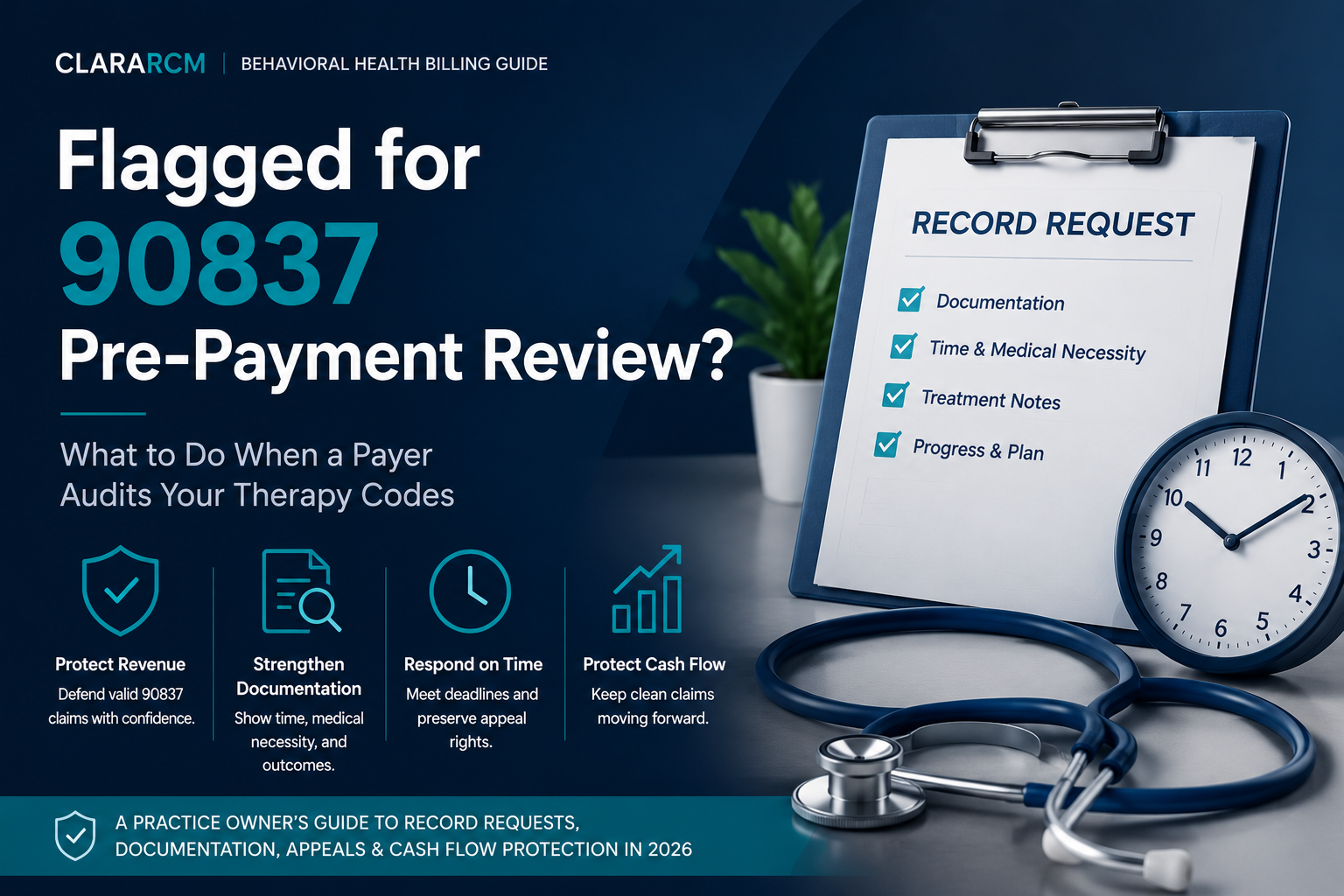
A 90837 pre-payment review audit means the payer has paused payment and is checking whether each 60-minute psychotherapy claim is supported before releasing reimbursement. The safest response is not blanket downcoding. Preserve the deadline, isolate the affected claims, submit complete records, document psychotherapy time and medical necessity clearly, and track every determination so the practice can correct patterns without surrendering valid revenue.
A record request for CPT 90837 can turn a healthy behavioral health practice into a cash-flow emergency within weeks. ClaraRCM created this operational guide for practice owners, clinical directors, and billing teams that need to answer a payer review without compromising compliant 53-minute-and-longer psychotherapy claims. It supports the broader framework in our behavioral health revenue cycle management guide and connects audit response directly to denial management and revenue protection.
What Does a 90837 Pre-Payment Review Audit Mean?
A 90837 pre-payment review is a claim-control process in which a payer requests clinical documentation and decides coverage before paying the psychotherapy claim. It differs from a post-payment audit because the immediate risk is delayed cash rather than repayment of money already received, although an expanded review may later examine historical claims.
Quotable definition: A 90837 pre-payment review audit is a payer review that holds a 60-minute psychotherapy claim until the medical record demonstrates the billed time, medical necessity, covered service, and compliant provider documentation.
Source context: According to the Centers for Medicare & Medicaid Services, psychotherapy is time-based and documentation is expected to show start-and-stop times or total psychotherapy time. CMS coverage articles also require the service to be medically necessary and furnished within the practitioner’s scope and Medicare rules.
How Does Payer Pattern Analysis Flag 90837 Claims?
Payers can compare a practice’s code mix, frequency, provider patterns, diagnoses, utilization, and documentation results against internal benchmarks. A high share of 90837 may attract attention, but no universal public threshold applies across every payer, product, state, or contract.
Practices should therefore avoid repeating an industry-observed percentage as though it were an official rule. The defensible question is not, “Did our 90837 share cross a magic number?” It is, “Can every selected claim independently support at least 53 minutes of psychotherapy, ongoing medical necessity, and the treatment delivered?”
| Possible review signal | What the payer may examine | What the practice should verify |
|---|---|---|
| Heavy 90837 utilization | Whether extended sessions are routinely supported | Actual psychotherapy time, treatment intensity, functional impairment, and individualized rationale |
| Repeated code pattern | Whether notes appear templated or automatically coded | Patient-specific interventions, response, progress, and plan changes |
| Diagnosis–intensity mismatch | Whether the diagnosis and record support prolonged treatment | Symptoms, impairment, risk, complexity, and why the session duration was reasonable |
| Provider outlier | Whether one clinician differs sharply from peers | Scheduling, specialty, case mix, documentation habits, and coding education |
Diagnosis-related scrutiny should be addressed carefully rather than by changing diagnoses to fit a code. Our separate guide to psychotherapy diagnosis pairing denials explains how medical necessity, severity, and functional impairment should align without unsupported upcoding.
What Should a Practice Do in the First 48 Hours?
In the first 48 hours, preserve the payer notice, calendar the deadline, identify every affected claim, assign one response owner, and stop uncontrolled record submission. A rushed response assembled by several people often creates inconsistent records, duplicate uploads, missed deadlines, and avoidable disclosure.
- Read the notice line by line. Identify the payer, product, claim range, requested record elements, submission method, deadline, and appeal or reconsideration language.
- Create an affected-claim register. Track patient, date of service, clinician, amount, request date, submission date, decision, denial reason, and follow-up date.
- Separate pre-payment holds from ordinary denials. Do not mix review claims with eligibility, authorization, credentialing, or coding edits.
- Appoint one response lead. Clinical notes may come from clinicians, but one compliance or billing owner should control the final packet.
- Preserve the original record. Never overwrite or backdate a signed note. Any permitted late entry or addendum must be clearly identified and follow policy.
Do not alter the medical record to make the claim look stronger. Correcting an obvious clerical issue through a transparent, dated addendum may be permitted under applicable policy, but rewriting history creates a much larger audit risk.
What Documentation Helps a 90837 Claim Survive Review?
A defensible 90837 record should establish the patient, date, qualified rendering provider, psychotherapy time, clinical problem, medical necessity, intervention, patient response, progress, and plan. The note must show why psychotherapy was delivered and why the documented duration was reasonable for that encounter.
| Record element | Strong documentation | Audit weakness |
|---|---|---|
| Psychotherapy time | Start/stop times or clearly stated total psychotherapy time supporting 53+ minutes | “60-minute session” copied automatically without reliable time support |
| Medical necessity | Current symptoms, functional impairment, treatment goal, and need for the encounter | Diagnosis listed with no explanation of current impairment or treatment need |
| Intervention | Named modality or intervention and what the clinician actually did | “Supportive therapy provided” with no patient-specific detail |
| Patient response | Engagement, reaction, insight, barriers, risk change, or measurable progress | Identical response language across multiple dates or patients |
| Treatment plan link | Session work connected to active goals and next steps | No relationship between the note and ongoing plan of care |
| Authentication | Timely signature, credentials, date, and compliant electronic authentication | Unsigned note, unclear author, or signature added after the request without explanation |
CMS documentation standard: CMS Medicare coverage guidance states that because psychotherapy is time-based, the record is expected to document start-and-stop times or total psychotherapy time. When psychotherapy is provided with an E/M service, the psychotherapy time must be separately identifiable and must not include the E/M time.
How Can a Practice Protect Cash Flow During Pre-Payment Review?
Cash-flow protection requires measuring the held revenue, accelerating clean unaffected claims, preventing avoidable new errors, and forecasting the review backlog weekly. Pre-payment review becomes dangerous when the practice waits for payer decisions without changing its operating plan.
- Do not stop all 90837 billing automatically. Continue submitting claims supported by actual services and payer rules.
- Audit new notes before claim release. A short concurrent review prevents the payer sample from filling with repeat defects.
- Work unrelated denials aggressively. Eligibility, authorization, routing, and credentialing denials should not age while the audit consumes staff attention.
- Prioritize clean-claim speed. ClaraRCM’s claim submission services and accounts receivable follow-up can protect other revenue channels while review claims remain pending.
What Is the Correct 90837 Audit Response Workflow?
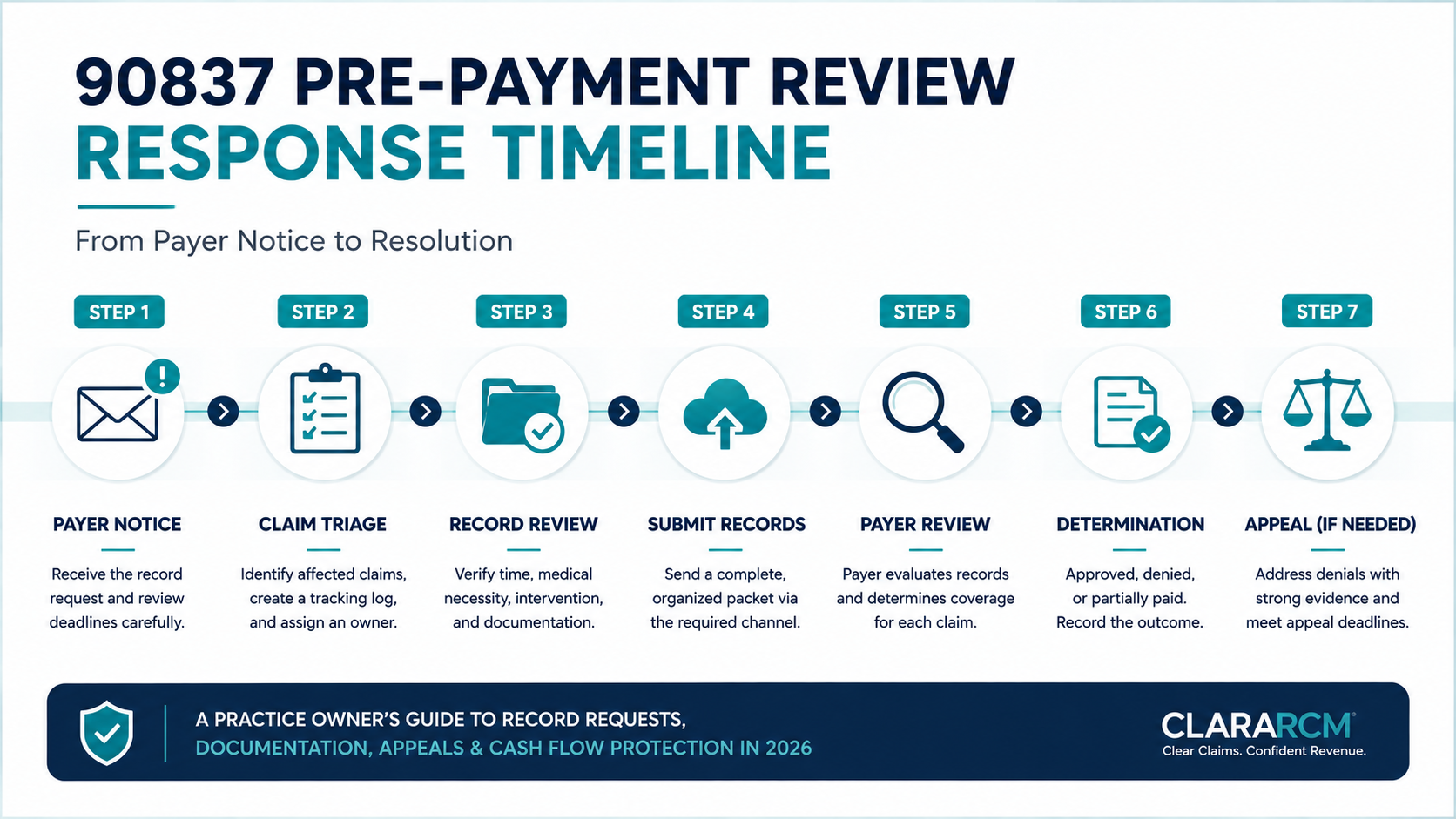
The correct workflow is notice intake, claim triage, record validation, controlled submission, determination tracking, root-cause analysis, and timely appeal. Each stage needs an owner and evidence trail so the practice can prove what was sent and respond consistently.
- Intake the request. Save the complete notice and record the deadline exactly as stated.
- Validate claim facts. Confirm patient, payer product, eligibility, authorization, provider enrollment, place of service, code, modifiers, and dates.
- Review the clinical record. Check time, medical necessity, intervention, response, plan linkage, signature, and consistency with the claim.
- Build a clean packet. Include only requested and relevant records, label them clearly, and protect unrelated patient information.
- Submit through the required channel. Save portal confirmation, fax proof, tracking, or other evidence of timely delivery.
- Track the decision. Log paid, denied, partially paid, or pending outcomes and the exact rationale.
- Appeal supported denials. Address the stated reason directly and attach the specific evidence that resolves it.
Where review results reveal recurring documentation or workflow defects, a broader billing audit and cleanup should examine the full population rather than only the payer’s sample.
Should a Practice Stop Billing 90837 or Downcode Every Session?
No—blanket downcoding is not a compliant audit-defense strategy when the service actually met 90837 requirements. Code selection should follow the service and documented time, not fear of review; deliberately reporting a shorter service than was performed can distort records, reduce legitimate revenue, and hide the workflow problem that caused the audit.
The correct response is targeted. Claims that support at least 53 minutes and medical necessity remain 90837. Encounters that support 38–52 minutes belong under 90834, and those supporting 16–37 minutes belong under 90832, subject to applicable coding rules. The practice should educate clinicians and correct charge capture prospectively rather than making unsupported retrospective changes.
Operational rule: defend valid 90837 claims, correct invalid claims, and change the process that produced the mismatch. Do not make every future patient absorb a shorter session merely because a payer opened a review.
What Happens If the Payer Expands the Review or Demands Recoupment?
An expanded review or recoupment demand requires immediate analysis of the contract, notice dates, claim sample, extrapolation method, appeal level, and applicable deadlines. Lookback periods are not universal; they vary by payer, product, contract, state law, and whether the payer alleges error, overpayment, fraud, or another basis.
Do not state a single “standard” lookback window in an appeal unless the governing document supports it. Reconcile every claim in the demand, compare the payer rationale against the actual record, preserve appeal rights, and escalate legal or compliance questions to qualified counsel when necessary.
ClaraRCM’s denial management services organize documentation, underpayment, denial, appeal, and AR work into one claim-level audit trail so the practice can respond without losing control of daily billing.
90837 Pre-Payment Review Audit: Frequently Asked Questions
Why did my practice get flagged for 90837 pre-payment review?
A payer may review 90837 claims after utilization, code-mix, provider, diagnosis, or documentation patterns differ from its internal expectations. A review notice does not by itself prove incorrect billing; each claim should be tested against the documented time, medical necessity, payer policy, and contract.
What documentation does a payer need for a 90837 claim?
A strong record identifies the patient, date, rendering clinician, psychotherapy time, current clinical need, intervention, patient response, progress, plan, and authenticated signature. CMS guidance expects start-and-stop times or total psychotherapy time because psychotherapy codes are time-based.
Should therapists stop billing 90837 during a payer audit?
No. Therapists should continue selecting the code supported by the service and record. The practice should add concurrent documentation review and correct unsupported claims rather than automatically downcoding every extended session.
How long does a 90837 pre-payment review last?
There is no universal duration. Timing depends on the payer program, number of claims, record quality, response deadlines, and whether the payer continues, narrows, or expands the review.
Can a payer recoup older 90837 payments after a pre-payment review?
Yes, a payer may open a post-payment review or issue an overpayment demand, but the permissible lookback and appeal process depend on the payer, product, contract, state law, and stated basis. The practice should verify the governing rule instead of assuming one nationwide deadline.
Can ClaraRCM help organize a psychotherapy audit response?
ClaraRCM can support claim inventory, documentation checklists, denial tracking, payer follow-up, appeal workflow, AR reporting, and billing-process correction. Legal interpretations and formal legal representation should be handled by qualified counsel.

Andleeb Asghar, PharmD
RCM Specialist & Founder, ClaraRCM
Andleeb Asghar is a PharmD and revenue cycle management specialist with 7+ years of experience in behavioral health billing, coding context, denial management, accounts receivable recovery, payer compliance, provider enrollment, and billing audits for U.S. healthcare practices.
ClaraRCM provides revenue cycle and medical billing support. This content is educational and is not legal, clinical, coding, or payer-contract advice. Verify current payer instructions, contracts, and applicable law before responding to an audit.