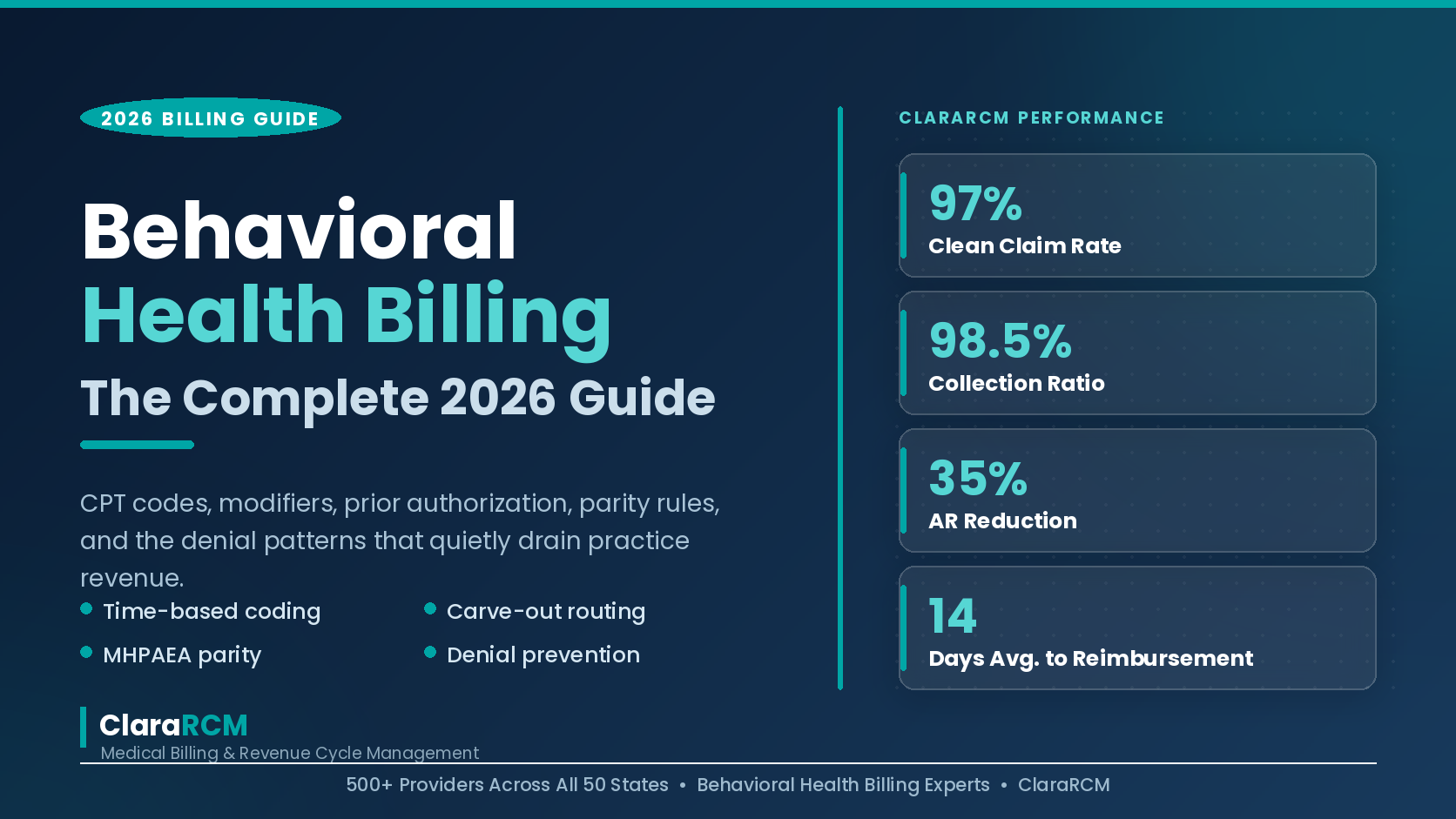
Behavioral Health Billing: The Complete 2026 Guide
Behavioral health billing is the revenue cycle process used to document, code, submit, and collect payment for therapy, psychiatry, substance use disorder care, ABA, and program-based services. It depends on time-supported codes, provider credentials, payer routing, authorization, medical necessity, and service-specific modifiers, so a claim can be technically accepted yet still deny or pay below the correct contracted tier.
Behavioral health practices often discover that a clean clearinghouse acceptance report is not the same as correct payment. A claim can pass front-end edits, reach the correct payer, and still be reduced because the rendering credential, modifier, authorization span, diagnosis pairing, or documented time does not support the billed service. ClaraRCM created this guide for practice owners, administrators, therapists, psychiatrists, ABA organizations, and program leaders who need an operational view of behavioral health claims processing in 2026.
This article is a spoke in our behavioral health revenue cycle management guide. The pillar owns the full end-to-end RCM framework, while this page owns the primary explanation of codes, modifiers, payer rules, authorization, denial prevention, and outsourcing decisions. Practices seeking hands-on support can also review ClaraRCM's behavioral health billing services for therapy and psychiatry practices.
What Is Behavioral Health Billing?
Behavioral health billing converts documented therapy, psychiatry, SUD, ABA, and related services into payer-compliant claims and collected revenue. It covers benefits verification, authorization, coding, submission, payment posting, denial resolution, patient billing, and review of whether paid claims match contracted allowances.
The term is broader than therapy billing. It can include diagnostic evaluations, medication management, psychotherapy, psychological testing, screening, collaborative care, crisis care, ABA, and program services. Payment depends on the service, clinician credential, documented time or units, setting, payer, and claim type.
A reliable workflow starts before the first visit. Verify the behavioral administrator, rendering-provider network status, patient cost share, authorization, telehealth coverage, visit limits, and any carve-out. ClaraRCM's behavioral health eligibility and benefits verification process captures these fields before treatment.
Operational definition: A claim is complete only after the correct payer adjudicates it, the contractual allowance posts correctly, patient responsibility is assigned, and any variance is resolved.
Why Does Behavioral Health Billing Differ From Medical Billing?
Behavioral health billing differs from general medical billing because time, credentials, carve-outs, continuing authorization, privacy, and parity can all affect payment. A claim may be clinically valid and technically accepted yet still route incorrectly, deny, or pay at the wrong credential tier.
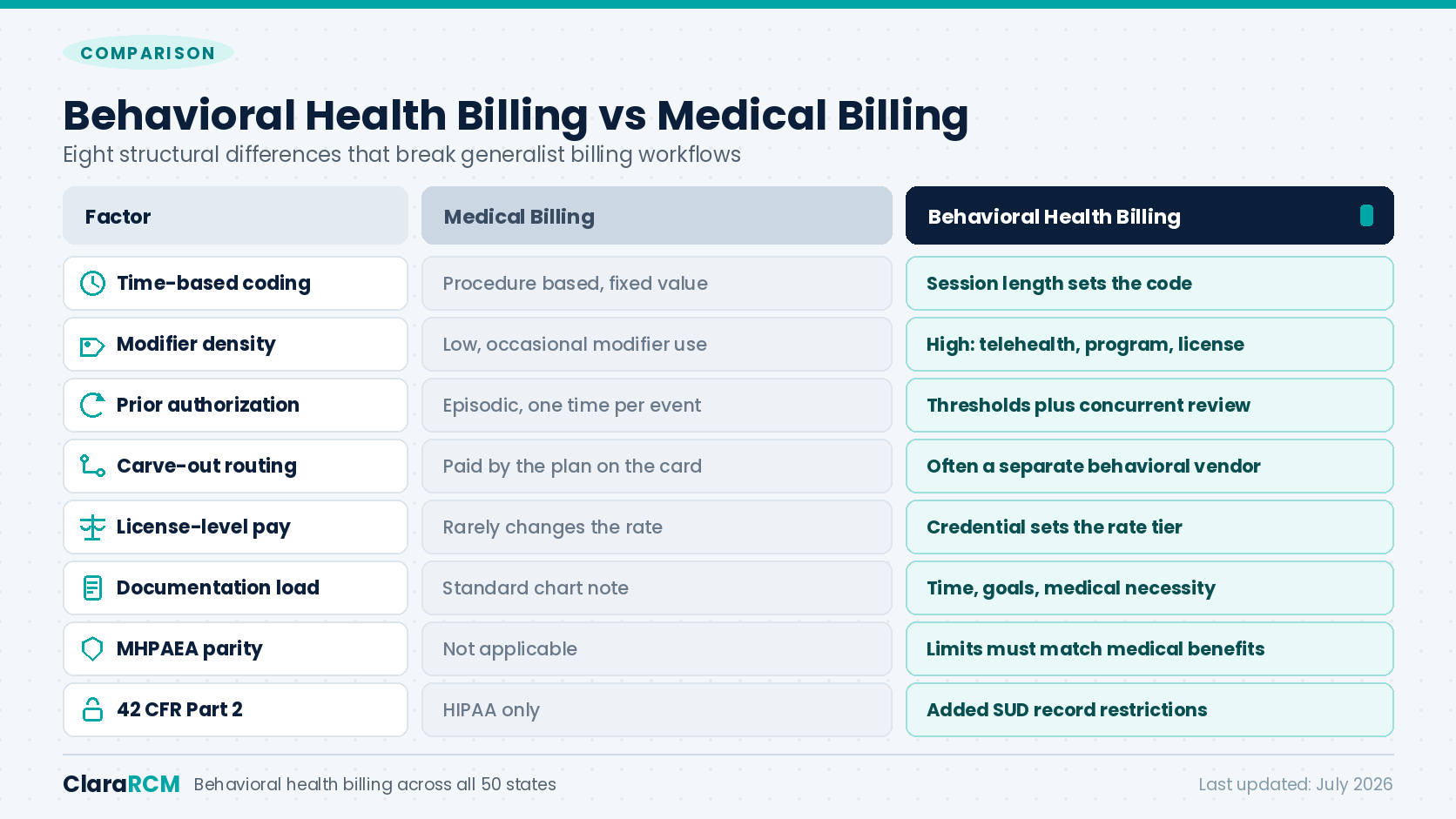
| Area | General Medical Billing | Behavioral Health Billing | Main Risk |
|---|---|---|---|
| Codes | Service, complexity, units, setting | Often exact time plus clinician role | Wrong time band or add-on |
| Routing | Usually card-listed plan | May route to a separate MBHO | Wrong payer or network |
| Authorization | Procedure or episode based | Visits, units, dates, and concurrent review | Expired or mismatched approval |
| Credentials | Specialty and enrollment | License, supervision, taxonomy, modifiers | Silent lower-tier payment |
| Documentation | Medical necessity and code | Also time, progress, modality, continuing need | Prepayment review or denial |
| Law | HIPAA and benefit rules | May also involve Part 2 and MHPAEA | Privacy or unequal limits |
Privacy update for 2026: HHS states that 42 CFR Part 2 protects qualifying SUD records. Federal civil enforcement of updated requirements began February 16, 2026. Review HHS Part 2 guidance and ClaraRCM's 42 CFR Part 2 billing guide.
Which CPT and HCPCS Codes Are Used in Behavioral Health Billing?
Behavioral health billing uses CPT codes for evaluations, psychotherapy, testing, collaborative care, and ABA, while HCPCS codes cover additional Medicare, Medicaid, and program services. Code selection must match the documented service, rendering credential, time or units, setting, and payer policy.
Last updated: July 29, 2026. This category map does not replace the licensed CPT codebook or payer manual. Verify current information through the AMA behavioral health coding guide and CMS HCPCS updates.
| Code or Family | Typical Service | Primary Billing Control |
|---|---|---|
| 90791 | Diagnostic evaluation without medical services | Complete assessment and treatment recommendation |
| 90792 | Diagnostic evaluation with medical services | Qualified professional and supported medical component |
| 90832, 90834, 90837 | Individual psychotherapy | Actual psychotherapy time and individualized note |
| 90833, 90836, 90838 | Psychotherapy with E/M | Separate E/M support plus psychotherapy time |
| 90846, 90847 | Family psychotherapy | Attendance and patient-focused treatment purpose |
| 90853 | Group psychotherapy | Individual note for each billed participant |
| 90839, 90840 | Crisis psychotherapy | Urgency, stabilization work, and time |
| 96127 | Brief emotional or behavioral assessment | Instrument, score, and clinical action |
| 99484 | General behavioral health integration | Monthly time and care-management elements |
| 99492 to 99494; G2214 | Collaborative care management | Team roles, registry, consultant, and time |
| 97151 to 97158 | Adaptive behavior services | Units, role, supervision, and authorization |
| HCPCS H and S families | Program and payer-defined services | Payer manual, modifiers, units, and claim type |
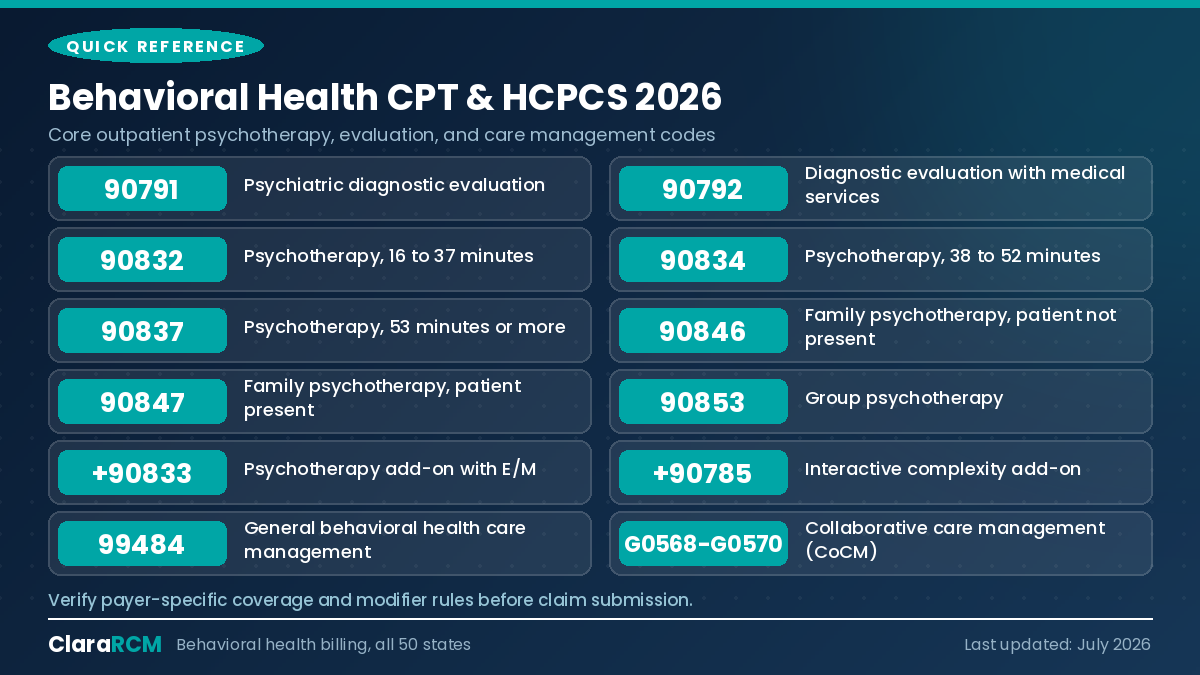
CMS identifies 90832, 90834, and 90837 for psychotherapy without medical E/M, and 90833, 90836, and 90838 as psychotherapy add-ons to a supported E/M service. ClaraRCM's behavioral health coding support checks the note, provider, code, units, diagnosis, and payer rules before submission.
Which Behavioral Health Modifiers Matter Most?
Behavioral health modifiers communicate delivery method, clinician level, group format, program type, or a distinct service, but their use is payer-specific. Common examples include 95, FQ, HO, HN, HP, HQ, 59, and HF.
| Modifier | Common Meaning | Verify Before Use |
|---|---|---|
| 95 | Real-time audio-video telemedicine | Eligible code, payer, and POS |
| FQ | Audio-only in defined federal contexts | Provider type and current program rule |
| HO | Master's degree level | Credential mapping and fee tier |
| HN | Bachelor's degree level | Allowed role and supervision |
| HP | Doctoral degree level | Payer requirement and credential |
| HQ | Group setting | Base code and payer edit |
| 59 | Distinct procedural service | Separate-service support and NCCI rule |
| HF | Substance abuse program | Program, base code, and payer mandate |
A License-Level Modifier Error May Pay Instead of Denying
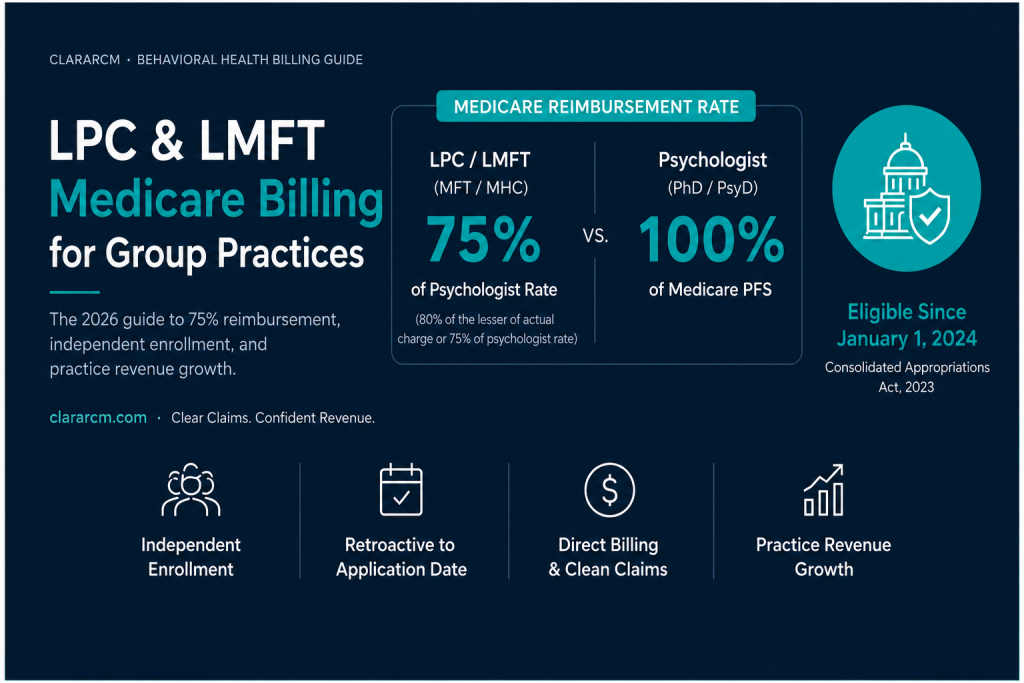
If a payer expects HO, HP, HN, or another credential indicator, the claim may price at a lower tier instead of denying. Compare every paid allowance with the contract by payer, code, place of service, and rendering credential.
Last updated: July 29, 2026. CMS says modifier 59 should identify a distinct service only when documentation and edits support separate reporting. Check CMS modifier 59 guidance, the current payer manual, and ClaraRCM's guide to modifier HF versus HE.
What Is the Behavioral Health Carve-Out Problem?
A behavioral health carve-out occurs when a health plan delegates mental health or substance use benefits to a separate managed behavioral health organization. The patient may present a UnitedHealthcare, Anthem, Aetna, or another medical card, while claims, credentialing, authorization, and appeals are handled by a different administrator.
The result is a claim that can appear to have a credentialing, eligibility, or noncovered-service problem when it was simply sent to the wrong entity. Intake staff should ask who administers outpatient mental health, psychiatry, ABA, SUD, and facility behavioral services, because different categories can route differently under the same member plan. The payer ID, portal, authorization number, network contract, electronic remittance enrollment, and appeal address should all match the behavioral administrator. ClaraRCM's full behavioral health carve-out billing guide explains the routing workflow for Optum, Carelon, Magellan, and similar arrangements.
How Does MHPAEA Affect Behavioral Health Claims in 2026?
MHPAEA generally prevents covered plans and issuers from applying financial requirements or treatment limits to mental health and SUD benefits that are more restrictive than comparable medical and surgical limits. Billing teams should examine unusual authorization, network, reimbursement, visit-limit, and medical-necessity rules for possible parity concerns.
Current status, July 29, 2026: Federal Departments stated that they will not enforce new portions of the 2024 final rule during related litigation, plus 18 months after a final decision. The MHPAEA statute, 2013 rule, and CAA 2021 comparative-analysis duties still remain.
A denial alone does not prove a parity violation. Identify the exact limitation, benefit classification, payer rationale, and comparable medical or surgical rule. Appeal the claim defect, then request the applicable nonquantitative treatment limitation analysis when the restriction itself appears unequal.
Review the federal enforcement statement, the DOL parity fact sheet, and ClaraRCM's MHPAEA appeal framework.
What Are the Top Behavioral Health Claim Denials?
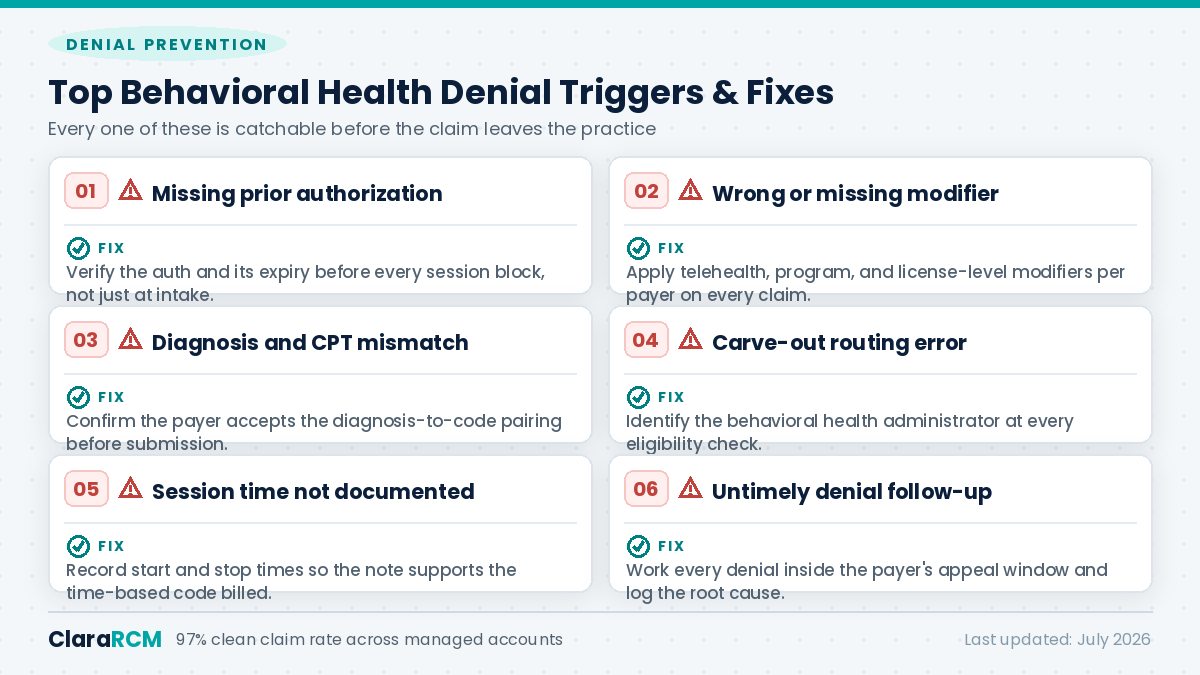
Common behavioral health denials involve modifier or diagnosis mismatches, missing data, duplicates, coordination of benefits, timely filing, medical necessity, noncovered services, wrong-payer routing, and absent authorization. The CARC identifies a category, while the remark code, portal, contract, and original claim reveal the fix.
| CARC | Common Root Cause | First Action |
|---|---|---|
| 4 | Code and modifier conflict | Check note, credential, code, and payer rule |
| 11 | Diagnosis inconsistent with service | Review documented diagnosis and policy |
| 16 | Missing or invalid claim data | Read all remark codes and correct the field |
| 18 | Duplicate or wrong resubmission type | Check frequency code and payer control number |
| 22 | Coordination of benefits issue | Update COB and submit in payer order |
| 29 | Timely filing expired | Gather acceptance and misrouting evidence |
| 50 | Medical necessity not supported | Appeal to the criterion with clinical evidence |
| 96 | Service, code, provider, or setting excluded | Confirm benefit and covered pathway |
| 109 | Wrong payer or contractor | Identify the behavioral administrator |
| 197 | Authorization absent or mismatched | Compare approval with every claim field |
The group code may be CO, PR, OA, or PI, so do not treat every CARC as contractual automatically. Verify descriptions in the official X12 CARC list.
Track denials by payer, provider, code, modifier, diagnosis, authorization, and workflow owner. ClaraRCM's behavioral health denial management connects recovery to prevention. Also review psychotherapy diagnosis pairing denials and 90837 pre-payment review.
How Does Behavioral Health Billing Change by Practice Type?
Behavioral health billing changes by practice type because each model uses different credentials, codes, authorization controls, claim forms, and documentation. The claim-edit library should match the actual service model rather than a generic medical billing workflow.
Solo Therapy
Control time bands, telehealth, diagnosis support, patient estimates, and follow-up.
Group Practice
Track payer effective dates, credentials, supervision, taxonomy, locations, and fee tiers.
Psychiatry
Separate diagnostic, E/M, psychotherapy add-on, testing, and medication workflows.
ABA
Match units, professional or technician roles, supervision, authorization, and POS.
IOP or PHP
Control program codes, revenue codes, attendance, level of care, and concurrent review.
CMHC
Separate professional, facility, crisis, care-management, and grant-supported activity.
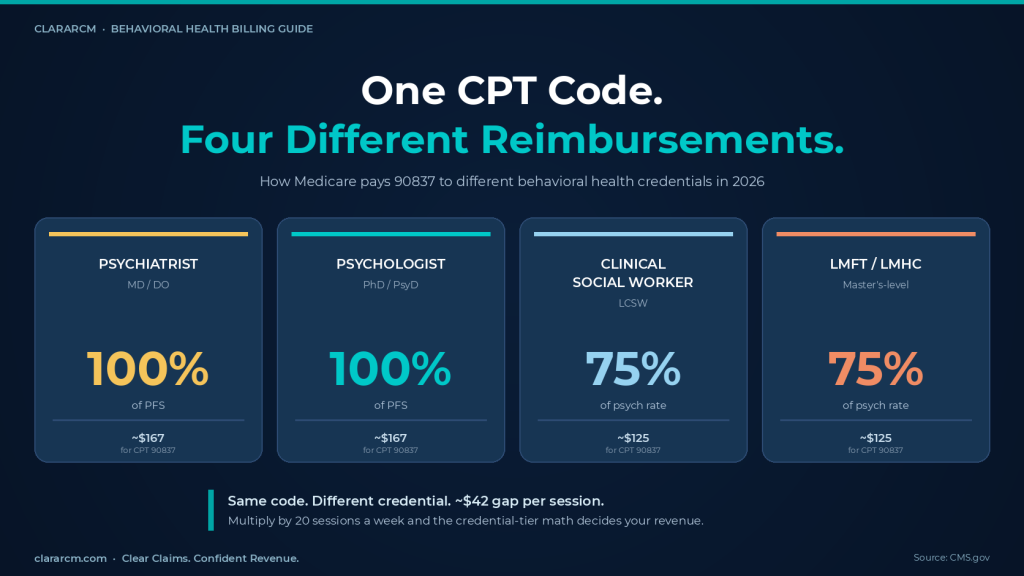
For associate and supervised clinicians, see behavioral health supervision billing. To monitor credential-tier payment, use ClaraRCM's guide to behavioral health fee schedules.
Should Behavioral Health Billing Stay In-House or Be Outsourced?
Keep billing in-house when the practice can sustain payer expertise, coverage, follow-up, payment review, compliance, and accountability at a reasonable total cost. Outsourcing is stronger when complexity, turnover, authorization volume, denials, or aging exceed internal capacity.
| Area | In-House | Outsourced | Require |
|---|---|---|---|
| Control | Direct staff oversight | Service-level management | Access, escalation, and data ownership |
| Expertise | Depends on a small team | Broader payer exposure | Named specialists and payer playbooks |
| Continuity | Turnover risk | Backup coverage | Documented queues and handoffs |
| Economics | Salary, tools, training | Percentage or fixed fee | Total cost measured against collections |
| Accountability | Internal reporting | Contracted reporting | Denial, AR, collection, and variance KPIs |
Software improves edits, submission, posting, and tasks, but it does not resolve ambiguous payer rules, clinical necessity, appeals, or contract underpayments. Ask who owns every exception after automation runs.
Before changing teams, audit 60 to 90 days of claims, payments, denials, authorization gaps, and aging. ClaraRCM's behavioral health billing audit establishes that baseline, while our mental health billing services provide ongoing support.
Which Behavioral Health Billing Benchmarks Should a Practice Track?
Track clean claims, initial denials, days in AR, net collection, authorization leakage, and paid-claim variance by payer and credential. ClaraRCM uses internal operating targets of at least 95% clean claims, less than 8% initial denials, and fewer than 35 days in AR.
Accepted without front-end correction.
Count the first adjudication, even if later paid.
Segment payer, patient, denial, and authorization balances.
Use collectible allowed amounts, not charges.
Track preventable services outside approval.
Compare paid allowance with the expected contract.
These are management targets, not federally established national averages. Define every denominator and excluded claim before comparing results. A high clean claim rate can still hide held claims, and fast payment can still hide lower-tier pricing.
Review the five largest payers by volume, denial, time to payment, net collection, variance, and AR over 90 days, then repeat by credential. ClaraRCM's behavioral health AR follow-up segments balances by root cause and deadline.
More in the Behavioral Health Billing Cluster
Continue with ClaraRCM's live guides for routing, reimbursement, denials, supervision, Medicare enrollment, and parity.
Behavioral Health Revenue Leak Estimator
Estimate the monthly value exposed to denials and collection gaps. The annual leak uses the larger exposure instead of adding overlapping losses twice.
Enter four monthly practice metrics
Use expected allowed revenue per encounter rather than your gross charge. Do not enter patient names, diagnoses, or other protected health information.
Your estimated revenue exposure
This is a directional estimate for planning and audit prioritization. It is not a prediction of recoverable revenue.
Review needed
Your result will appear here.
Send the estimate to ClaraRCM
ClaraRCM will review the numbers and identify the first billing workflow to audit. Do not include patient information.
Request received. Thank you.
ClaraRCM has received your behavioral health billing estimate and contact details. You can also choose a convenient time for a direct conversation.
Book a 30-minute callFrequently Asked Questions About Behavioral Health Billing
What is behavioral health billing?
Behavioral health billing is the process of converting documented therapy, psychiatry, SUD, ABA, and related services into payer-compliant claims and collected payments. It includes benefits verification, authorization, coding, claim submission, payment posting, denial work, patient billing, and underpayment review.
Why is behavioral health billing so complicated?
Behavioral health billing combines time-based codes, clinician credential rules, benefit carve-outs, authorization limits, medical-necessity documentation, telehealth requirements, and payer-specific modifiers. A claim can therefore be accepted by the clearinghouse but still deny, route incorrectly, or pay below the contracted credential tier.
What CPT codes are most commonly used in behavioral health billing?
Common code families include 90791 and 90792 for diagnostic evaluations, 90832, 90834, and 90837 for individual psychotherapy, 90833, 90836, and 90838 for psychotherapy with E/M, and 90853 for group psychotherapy. Psychiatry, screening, collaborative care, testing, ABA, crisis, and program services use additional CPT or HCPCS codes that must match the documented service and payer policy.
What is a good denial rate for a behavioral health practice?
ClaraRCM uses an initial denial rate below 8% as an internal operating target, not as a federally established national average. The practice should also track denial overturn rate, dollars denied, root cause, payer, credential, and time to resolution because a low count can still hide high-value or repeated losses.

Andleeb Asghar, PharmD
RCM Specialist & Founder, ClaraRCM
Andleeb Asghar is a Pharmacist, medical billing professional, and revenue cycle management specialist with experience in behavioral health billing, payer credentialing, denial management, coding review, and end-to-end RCM for U.S. practices.
Last updated: July 29, 2026. ClaraRCM provides medical billing and revenue cycle management support. This article is educational and is not legal, clinical, coding, or payer-contract advice. CPT is maintained by the American Medical Association, and payer policies, HCPCS files, modifiers, coverage rules, authorization requirements, fee schedules, and federal guidance can change. Verify the current code set, payer manual, contract, and applicable law before submitting or appealing claims. Company performance figures and benchmark targets are not guarantees of individual results.