MHPAEA Parity Law Appeals for Addiction Treatment Claims
A parity violation occurs when an insurer applies stricter limits, higher cost-sharing, or tougher prior authorization rules to addiction treatment claims than it applies to comparable medical or surgical claims. The Mental Health Parity and Addiction Equity Act (MHPAEA) requires insurers to treat these benefits comparably, and denial letters citing arbitrary session or day limits are a common red flag — making a mental health parity act appeal one of the strongest levers for overturning denied addiction claims.
Every source on addiction treatment billing mentions parity denials as a pain point. Almost none explains how to actually use the law in an appeal — and in 2026, the regulatory picture has a twist that makes most older guidance stale. This guide from ClaraRCM covers what MHPAEA enforceably requires right now, how to spot a violation on a denial letter, and how to write the appeal. For the full denial landscape beyond parity, start with our guide to why SUD and MOUD claims get denied .
What MHPAEA Actually Requires From Payers
MHPAEA prohibits health plans that cover mental health and substance use disorder benefits from limiting those benefits more restrictively than comparable medical or surgical benefits. According to the U.S. Department of Labor , the comparison runs across two kinds of limits: quantitative treatment limitations — countable things like visit limits, day limits, copays, and deductibles — and nonquantitative treatment limitations (NQTLs) — process-based limits like prior authorization requirements, concurrent review, network composition standards, and out-of-network reimbursement methodologies.
Two more pieces matter for appeals. First, the comparison happens within benefit classifications — inpatient in-network compared to inpatient in-network, outpatient to outpatient — so a plan can’t justify a residential SUD limit by pointing at its outpatient medical rules. Second, under the Consolidated Appropriations Act, 2021, plans must perform and document a comparative analysis of every NQTL they apply to mental health and SUD benefits, and produce it on request. That document either justifies the limit or it doesn’t exist in defensible form — and either way, requesting it strengthens an appeal.
One thing to get right in 2026: the Departments issued a new MHPAEA final rule in September 2024, then announced in May 2025 that they will not enforce its new provisions while litigation and a rewrite play out. The statute itself, the 2013 final rule, and the CAA 2021 comparative-analysis requirement all remain fully enforceable — and the Department of Labor reaffirmed in January 2026 that parity remains an active enforcement priority, naming unjustified treatment exclusions, inaccurate provider directories, unreasonable limits on care, and burdensome claims processes as focus areas. Appeals should cite the statute and the 2013 rule, not the paused 2024 rule.
How to Spot a Parity Violation on a Denial Letter
The tell is a limit that the plan would never apply to comparable medical care: an arbitrary session cap, a day limit on residential treatment, authorization demanded for every single visit, or concurrent review that restarts every few days. The denial letter rarely says “parity” anywhere — it says “exceeds plan limits,” “not medically necessary beyond X days,” or “authorization required for continued treatment.” The violation lives in the comparison, not the wording.
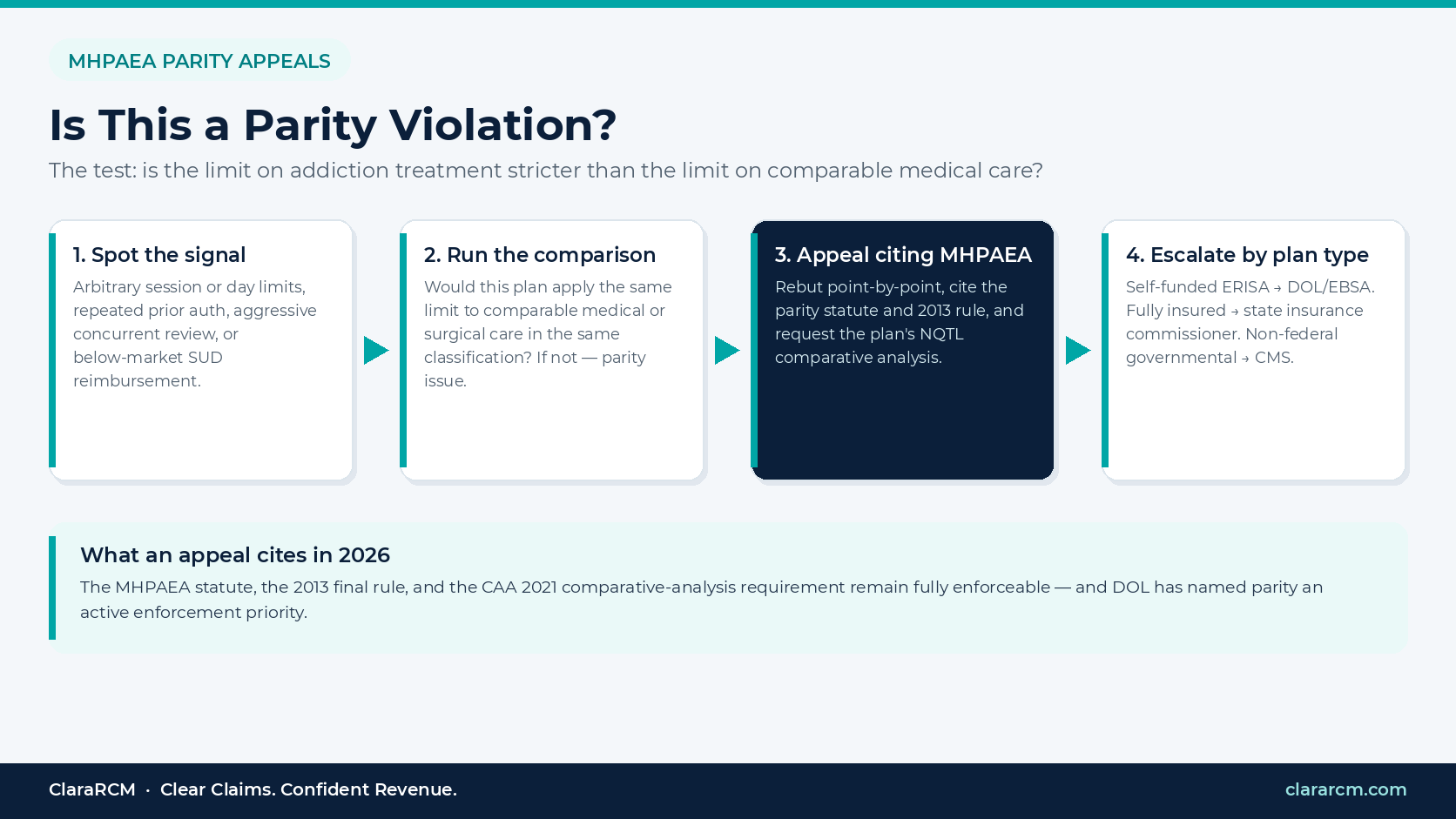
The signals that most often survive scrutiny as genuine parity issues:
- Arbitrary numeric limits — a fixed number of SUD sessions or residential days per year, when comparable medical rehabilitation carries no equivalent cap.
- Authorization asymmetry — session-by-session prior authorization for outpatient SUD care while comparable outpatient medical care requires none.
- Aggressive concurrent review — continued-stay reviews every 48–72 hours for SUD treatment when medical admissions of similar intensity are reviewed far less often.
- Reimbursement and network gaps — SUD providers reimbursed by a methodology that systematically pays below the plan’s comparable medical rates, or networks so thin that in-network SUD care is functionally unavailable.
Writing an Appeal That Cites MHPAEA Directly
A parity appeal makes three moves: it names the limit, runs the comparison on paper, and demands the plan’s own comparative analysis. Generic hardship framing loses; a structured comparison the reviewer can’t un-see wins.
- Name the limitation precisely. Identify the exact limit applied — the session cap, the day limit, the authorization requirement — and quote the denial letter’s own language.
- Run the classification comparison in writing. State the benefit classification, then ask the question the plan must answer: what comparable medical or surgical benefit in this classification carries this limit? Cite MHPAEA and its 2013 implementing regulations as the standard.
- Request the NQTL comparative analysis. Ask the plan to produce the comparative analysis for the limitation at issue, as required under MHPAEA as amended by the CAA, 2021. Plans that cannot produce a defensible analysis frequently reverse on appeal rather than expose the gap.
- Attach the clinical foundation. Parity is the legal frame; medical necessity is still the clinical one. Include the ASAM level-of-care documentation so the appeal wins on either ground — the full structure is covered in our guide to appealing denied SUD and MOUD claims .
- Set a response deadline and track it. File inside the payer’s appeal window, log the submission, and calendar the escalation date before the payer’s response is due.
When to Escalate to a State Insurance Commissioner
Escalation follows the plan type: fully insured plans answer to the state insurance commissioner, self-funded employer plans answer to the U.S. Department of Labor, and self-funded non-federal governmental plans answer to CMS. Filing with the wrong regulator wastes the strongest card an appeal has, so identify the plan type first — it’s printed on the member ID card or available from the employer’s benefits office.
Escalate when the internal appeal is denied without a substantive parity answer, when the plan refuses or fails to produce its comparative analysis, or when the same limitation keeps generating denials across multiple patients — a pattern regulators weight far more heavily than a single claim. State insurance departments accept provider and consumer complaints against fully insured plans, and the Department of Labor’s benefits advisors handle ERISA plan complaints. According to CMS , plans and issuers must make their comparative analyses available to federal or applicable state authorities on request — which is exactly what an escalation triggers.
For behavioral health organizations, parity problems rarely travel alone — they show up alongside credential-tier rate issues and carve-out routing errors. ClaraRCM’s mental health and behavioral health billing services and denial management services handle the full pattern: spotting the parity signal in the denial data, building the appeal, and escalating on schedule when the payer doesn’t move.
Frequently Asked Questions
What Is a Parity Violation in Addiction Treatment Billing?
A parity violation is when a health plan limits addiction treatment benefits more restrictively than comparable medical or surgical benefits in the same classification — through stricter session or day limits, heavier prior authorization, more aggressive concurrent review, or reimbursement methodologies that systematically disadvantage SUD providers.
How Do You Appeal a Denial Under MHPAEA?
Name the exact limitation from the denial letter, run the written comparison against comparable medical benefits in the same classification, cite MHPAEA and its 2013 implementing regulations, and request the plan’s NQTL comparative analysis required under the CAA, 2021. Attach ASAM level-of-care documentation so the appeal also stands on medical necessity.
What Does the Mental Health Parity Act Require Insurers to Do?
Plans that cover mental health and substance use disorder benefits cannot apply financial requirements, visit limits, or process-based limitations to those benefits that are more restrictive than the predominant limits applied to substantially all comparable medical and surgical benefits. Plans must also perform and document comparative analyses of their nonquantitative treatment limitations and produce them on request.
Is the 2024 MHPAEA Final Rule Being Enforced?
Not currently. The Departments announced in May 2025 that they will not enforce the provisions that were new in the 2024 final rule while litigation and a regulatory rewrite proceed. The MHPAEA statute, the 2013 final rule, and the CAA 2021 comparative-analysis requirement all remain fully enforceable — appeals should cite those.

Andleeb Asghar, PharmD
RCM Specialist & Founder, ClaraRCM
Andleeb Asghar is a PharmD, medical billing professional, and revenue cycle management specialist with 7+ years of experience across medical billing, medical coding, clean-claim submission, payer compliance, eligibility verification, denial management, accounts receivable recovery, payment posting, provider enrollment, billing audits, and end-to-end revenue cycle optimization for U.S. healthcare practices. She medically reviews ClaraRCM content for clinical terminology, coding context, regulatory accuracy, payer considerations, and clear communication for healthcare providers and practice leaders.
ClaraRCM provides revenue cycle and medical billing support. This content is for educational purposes and is not legal, clinical, or payer-contract advice.