Why SUD and MOUD Claims Get Denied (and How to Appeal Them)
SUD and MOUD claims are most often denied for four reasons: missing ASAM level-of-care documentation, lapsed or missing prior authorization, conflicts between 42 CFR Part 2 confidentiality rules and payer documentation requests, and incorrect bundled or buy-and-bill coding. Most of these denials are preventable with complete documentation submitted at the time of the initial claim — and most are appealable when the appeal maps the clinical record to the payer’s own criteria.
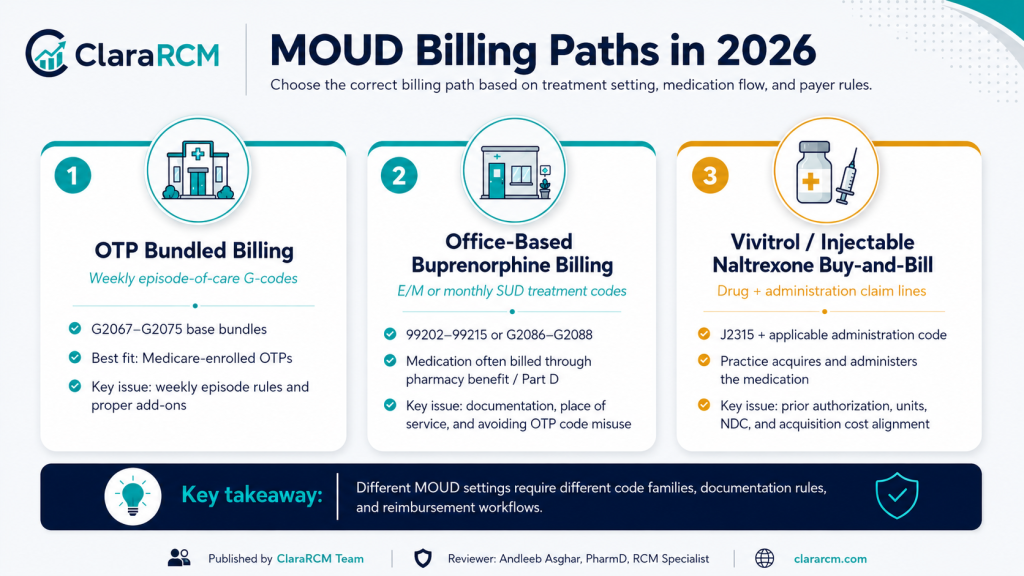
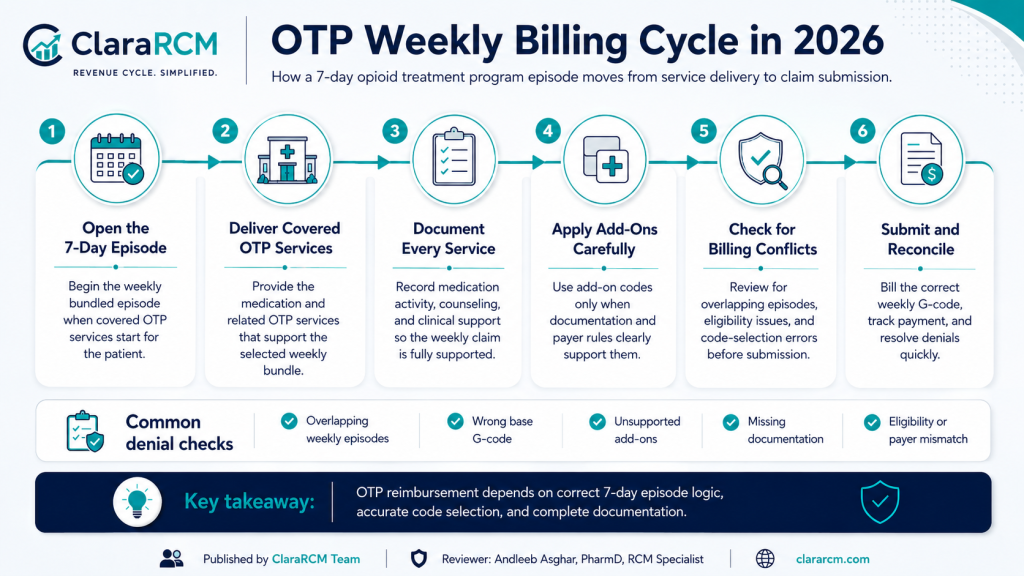
Addiction treatment claims fail differently than general medical claims. The documentation standard is higher, the confidentiality rules are stricter, and the coding is setting-dependent in ways payers check automatically. This guide covers the four SUD claim denial reasons that account for most lost revenue, and the appeal structure that recovers it. For how the underlying billing paths work, start with ClaraRCM’s MOUD Billing Guide 2026 .
The Top 4 SUD/MOUD Denial Triggers
Four failure points sit behind most denied addiction treatment claims: the level-of-care justification, the authorization span, the confidentiality-documentation conflict, and the code-to-setting match. Each one fails at a different stage of the revenue cycle, which is why practices that fix only their coding still see denials — and practices that fix only their authorizations still lose appeals.
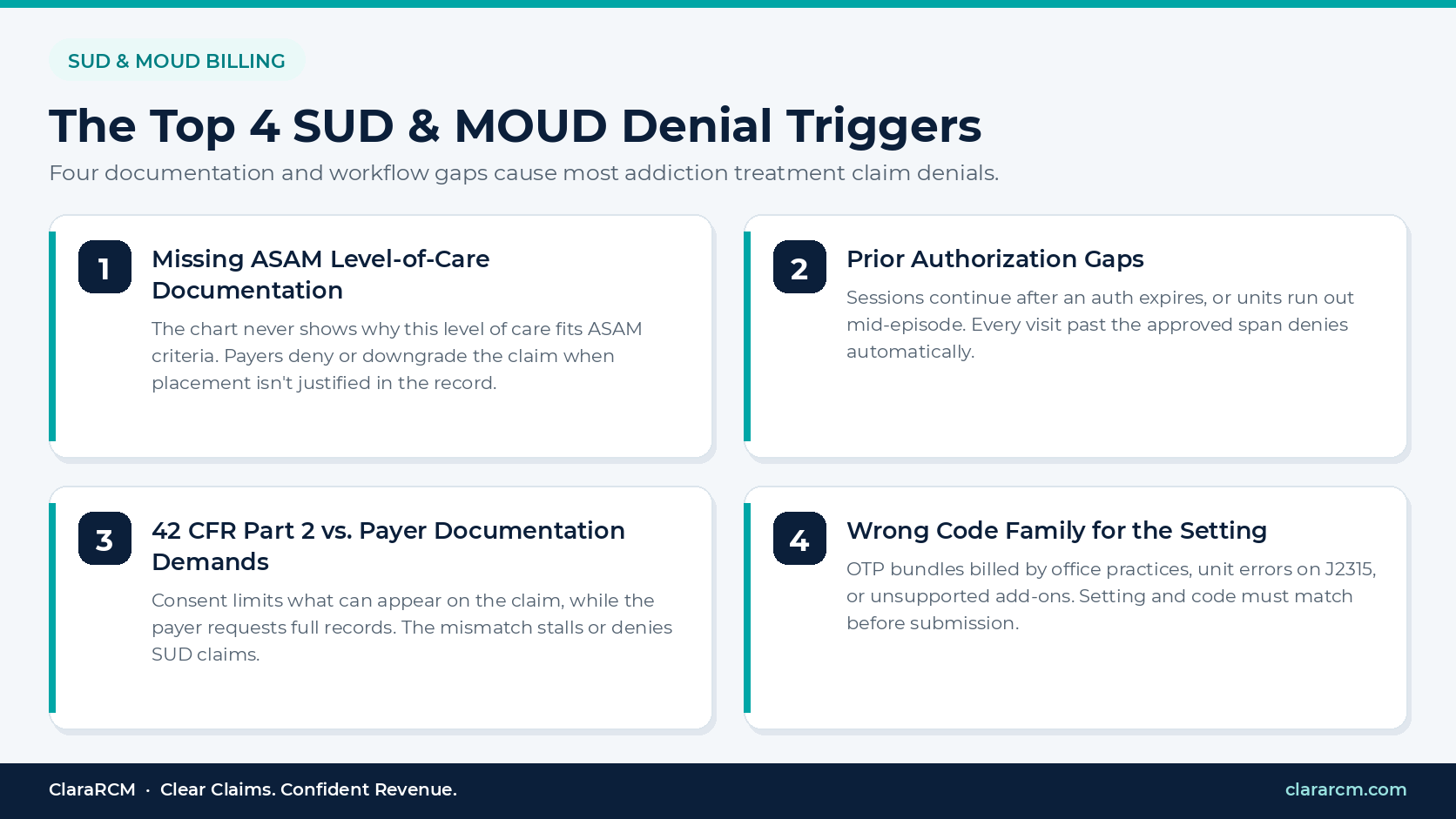
The fourth trigger — coding — is covered in depth across this cluster: OTP bundles billed outside an OTP or with overlapping episode dates (see how OTP weekly bundled billing works ), and unit errors on injectable naltrexone claims (see the Vivitrol J2315 billing walkthrough ). The three remaining triggers are documentation problems, and they deserve their own sections.
Missing ASAM Level-of-Care Documentation
Payers deny or downgrade SUD claims when the clinical record never establishes why the billed level of care fits the patient — and the standard most payers apply is the ASAM Criteria. The American Society of Addiction Medicine’s ASAM Criteria , now in its Fourth Edition, is the most widely used framework for matching patients to levels of addiction care, and payer medical policies routinely reference it when adjudicating residential, intensive outpatient, and outpatient SUD claims.
The denial pattern looks like this: the treatment was appropriate, the care was delivered, but the chart documents what was done without documenting why this level — no dimensional assessment, no placement rationale, no re-assessment when the level of care continued. The payer’s reviewer can’t map the record to the criteria, so the claim denies for medical necessity or gets downgraded to a lower level of care.
The prevention is structural: the assessment that justifies placement belongs in the record before the claim goes out, and continued-stay documentation needs a refreshed rationale, not a copied one. When the denial has already landed, that same assessment becomes the spine of the appeal — mapped point-by-point to the payer’s published criteria.
Prior Authorization Gaps
Authorization denials in addiction treatment are usually span problems, not approval problems: care continued after the approved units or dates ran out. SUD treatment is episodic and payer authorizations are finite, so a patient approved for a set span who keeps progressing through treatment quietly crosses the line where every additional visit denies automatically.
Three habits close the gap. First, log the authorization’s exact span — units, visits, and dates — at intake, not just the approval number. Second, set the renewal trigger before the span ends, with enough lead time for the payer’s review timeline. Third, verify the authorization requirement itself at every benefit check: eligibility and benefits verification is where authorization surprises get caught before they become denials. Injectable medications carry their own layer — an injection administered outside the authorization’s dates denies no matter how clean the coding is.
42 CFR Part 2 vs. Payer Documentation Demands
42 CFR Part 2 restricts how substance use disorder treatment records can be disclosed, which limits what billing staff can release to a payer without the patient’s Part 2-compliant consent — and that tension is a denial risk unique to SUD billing. A payer requests records to support a claim; the program can’t release them without proper consent; the claim pends and then denies for insufficient documentation. Nobody made a coding error — the confidentiality framework and the documentation demand collided.
The rules governing that collision were just modernized. According to the U.S. Department of Health and Human Services , the 2024 Part 2 final rule — which required full compliance by February 16, 2026 — now permits a single patient consent covering future uses and disclosures for treatment, payment, and health care operations. For billing teams, that single TPO consent is the operational fix: obtained properly at intake, it covers the payer disclosures that claims and appeals require, without a new consent for every records request. As of 2026, HHS’s Office for Civil Rights also actively enforces Part 2, so the consent workflow has to be right in both directions — enough consent to support the claim, and no disclosure beyond what the consent covers.
The full compliance picture — what Part 2 restricts, what can appear on a claim or EOB, and how the 2026 changes reshape billing workflows — is covered in our dedicated guide to 42 CFR Part 2 and medical billing .
How to Structure a Successful Appeal
A winning SUD appeal is built in five steps: read the full denial code, gather the ASAM documentation, map the clinical facts to the payer’s own criteria, add parity language where the limits look unequal, and file inside the deadline. Generic hardship letters lose; point-by-point rebuttals against the payer’s published policy win.
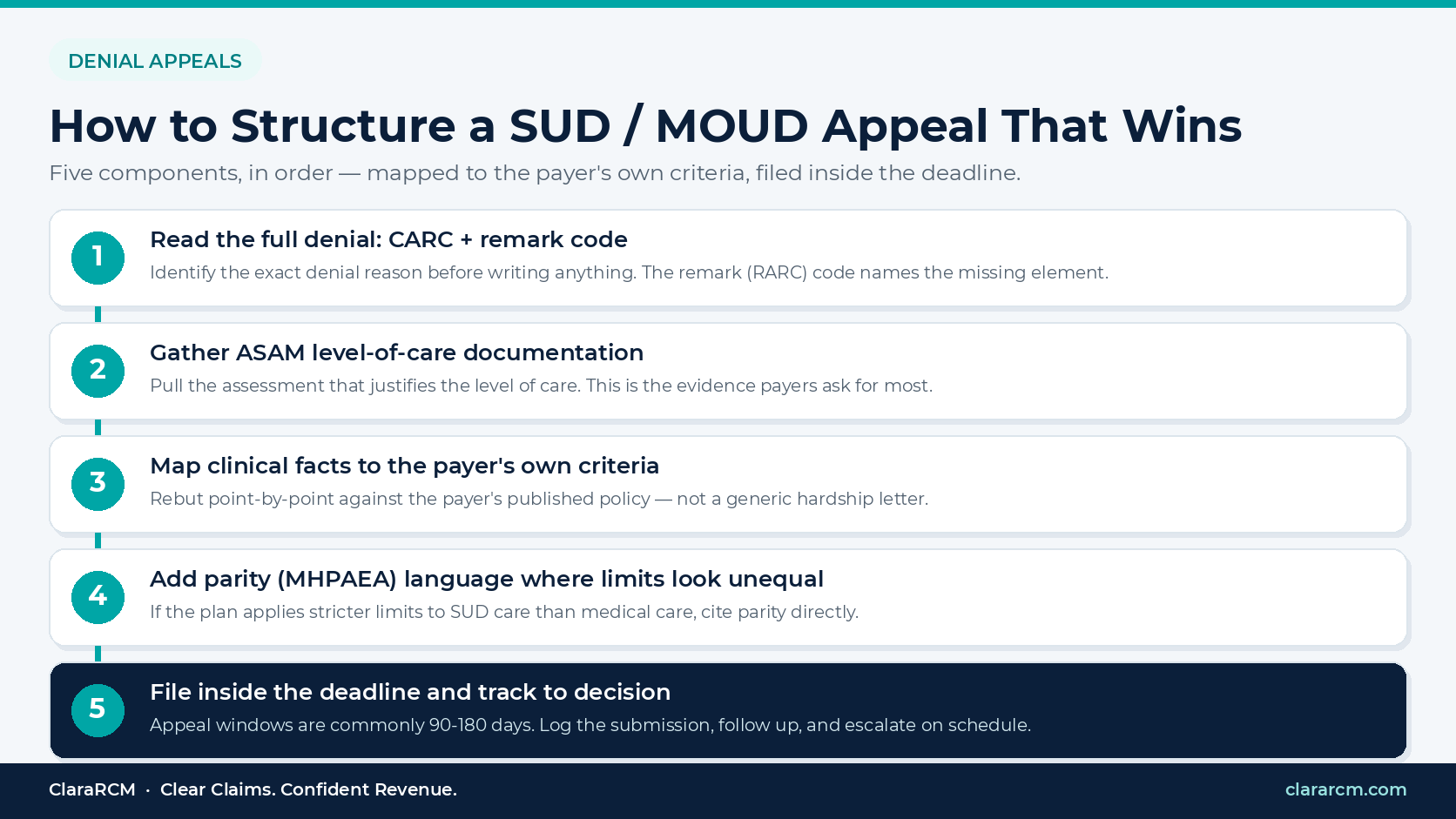
- Read the complete denial — reason code plus remark code. The remark code names the missing element, and the appeal that answers the wrong question loses automatically.
- Gather the ASAM level-of-care documentation. The dimensional assessment and placement rationale are the evidence payers ask for most in SUD medical-necessity reviews.
- Map the clinical facts to the payer’s own criteria. Pull the payer’s published medical policy and rebut it point by point — their criteria, your documentation, one line at a time.
- Add parity language where the limits look unequal. When a plan applies stricter session limits, day limits, or authorization hurdles to addiction treatment than to comparable medical care, the Mental Health Parity and Addiction Equity Act is the appeal’s strongest lever — our guide to MHPAEA parity appeals for addiction treatment claims covers how to spot a violation and cite the law directly.
- File inside the deadline and track to decision. Appeal windows are set by the payer contract — commonly in the 90-to-180-day range — and an appeal filed on day one beats an identical appeal filed in the final week. Log the submission, calendar the payer’s response deadline, and escalate on schedule.
This is also where a revenue cycle partner earns its keep. ClaraRCM clients average a 35% reduction in accounts receivable and a 98.5% collection ratio — numbers built on exactly this workflow: denials triaged by cause, appeals built on the payer’s own criteria, and every deadline tracked through ClaraRCM’s denial management services and accounts receivable follow-up .
Frequently Asked Questions
Why Do Addiction Treatment Claims Get Denied?
The four leading causes are missing ASAM level-of-care documentation, care that continued past the authorized span, conflicts between 42 CFR Part 2 confidentiality rules and payer documentation requests, and coding that doesn’t match the treatment setting — such as OTP bundles billed outside an OTP or unit errors on injectable naltrexone claims.
What Documentation Prevents SUD Claim Denials?
The ASAM dimensional assessment and placement rationale documented before the claim goes out, a refreshed continued-stay rationale for ongoing care, the authorization span logged with exact units and dates, and a Part 2-compliant patient consent covering payer disclosures for treatment, payment, and operations.
How Do You Appeal a Denied Substance Use Disorder Claim?
Read the full denial and remark codes, gather the ASAM level-of-care documentation, and rebut the payer’s published medical policy point by point with the clinical record. Cite the Mental Health Parity and Addiction Equity Act when the plan’s limits are stricter than comparable medical benefits, and file within the payer’s appeal window — commonly 90 to 180 days.
Did 42 CFR Part 2 Change in 2026?
Yes. The 2024 final rule modifying Part 2 required full compliance by February 16, 2026, according to HHS. It permits a single patient consent for future treatment, payment, and health care operations disclosures, and HHS’s Office for Civil Rights now enforces Part 2 with HIPAA-style penalties — making consent workflows a compliance priority in both directions.

Andleeb Asghar, PharmD
RCM Specialist & Founder, ClaraRCM
Andleeb Asghar is a PharmD, medical billing professional, and revenue cycle management specialist with 7+ years of experience across medical billing, medical coding, clean-claim submission, payer compliance, eligibility verification, denial management, accounts receivable recovery, payment posting, provider enrollment, billing audits, and end-to-end revenue cycle optimization for U.S. healthcare practices. She medically reviews ClaraRCM content for clinical terminology, coding context, regulatory accuracy, payer considerations, and clear communication for healthcare providers and practice leaders.
ClaraRCM provides revenue cycle and medical billing support. This content is for educational purposes and is not legal, clinical, or payer-contract advice.