42 CFR Part 2 and Medical Billing: What Changes for Your Claims
42 CFR Part 2 billing compliance governs how federally assisted substance use disorder programs use and disclose patient-identifying SUD records during claims, payment, and payer review. As of 2026, a valid written consent may authorize future disclosures for treatment, payment, and health care operations, but billing teams still must limit what they send, protect counseling notes, honor revocations, and follow the required Part 2 disclosure notice rules.
Part 2 does not make SUD billing impossible or automatically prohibit diagnosis codes on claims. It requires a controlled workflow: valid consent, limited claim data, privacy review for record requests, and documentation of every disclosure. The updated rule became fully enforceable on February 16, 2026, making outdated consent forms and automatic chart attachments a direct compliance and reimbursement risk.
What Part 2 Actually Restricts
Part 2 protects patient-identifying SUD records created or maintained by federally assisted programs that provide SUD education, prevention, treatment, rehabilitation, or research. According to the current HHS Part 2 guidance , the rule applies safeguards to the identity, diagnosis, prognosis, and treatment information in those records and limits their use in legal proceedings against the patient without consent or a qualifying court order.
Under 42 CFR 2.31 , one written consent may authorize future treatment, payment, and health care operations disclosures. It may identify classes of recipients such as treating providers and health plans, but it must include the required Part 2 elements, redisclosure language, revocation instructions, signature, and date. SUD counseling notes remain separately protected, so a payer’s request for a “complete chart” is not permission to send every therapy narrative or unrelated treatment detail.
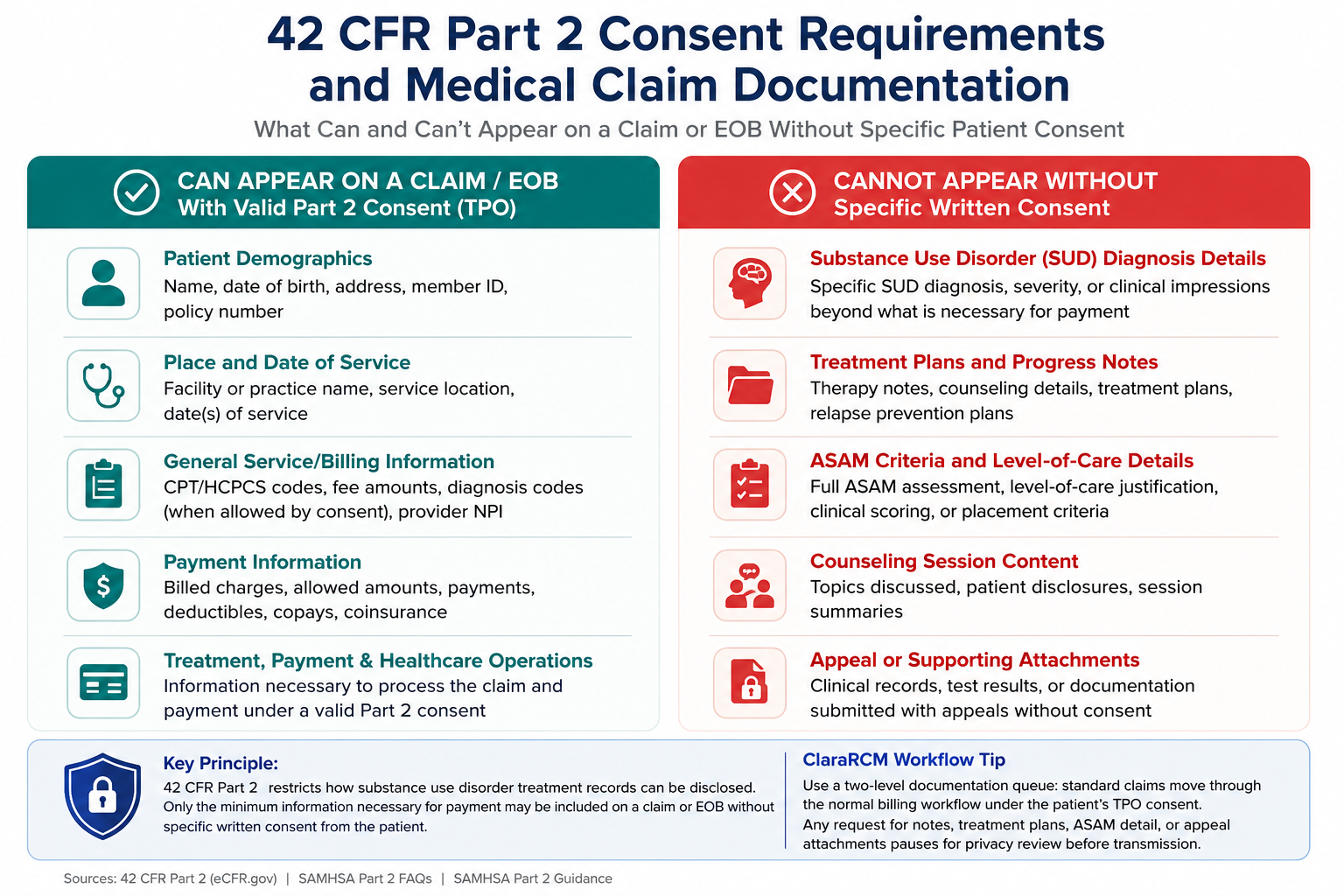
| Usually appropriate when covered by valid consent | Should not be sent automatically |
|---|---|
| Required diagnosis, procedure, HCPCS, revenue, modifier, and place-of-service data | Full counseling notes or detailed therapy narratives |
| Dates of service, provider identifiers, authorization numbers, and claim control data | Unrelated SUD history that does not support the billed service |
| Targeted clinical documentation requested to establish medical necessity | The entire chart when a focused record would answer the payer’s question |
| A clear explanation of the consent scope and the required Part 2 notice when records are disclosed | Records after a consent revocation, except where the organization already relied on the consent |
2026 compliance point: HHS states that the updated Part 2 rule has been effective since April 16, 2024, with full compliance required by February 16, 2026. OCR can investigate complaints, require corrective action, and impose civil money penalties for noncompliance.
Where Part 2 Conflicts With Standard Payer Documentation Demands
The conflict appears when a payer asks for more information than the claim needs, while the Part 2 program is responsible for disclosing only what the valid consent and federal rules permit. General medical billing teams may treat a broad record request as routine. In SUD billing, that same habit can expose counseling detail, family information, or unrelated treatment history that should never have left the program.
1. The Consent Is Missing or Outdated
An old consent may not authorize future payment disclosures or contain the required redisclosure language, blocking an otherwise valid claim.
2. The Payer Requests the Entire Chart
Ask for the exact medical-necessity issue and send a focused record instead of exporting every SUD note in the EHR.
3. Counseling Notes Are Attached
A general TPO consent does not authorize routine attachment of SUD counseling notes to claims or appeals.
4. The EOB Reveals Sensitive Care
A valid claim may still generate an EOB to the policyholder. Explain this risk during intake and use confidential-communications options when available.
Part 2 does not categorically ban SUD diagnosis codes on claims. With valid payment consent, the program may submit the codes and data needed to adjudicate the service. When a payer asks for too much, request the exact policy criterion, provide targeted support, and document why broader records were unnecessary. ClaraRCM’s denial management services help SUD programs build that defensible appeal trail.
How to Stay Compliant Without Losing the Claim
The safest workflow is to obtain the correct Part 2 consent at intake, configure claims to transmit only required data, and route every supplemental-record request through a documented privacy review. Compliance and reimbursement should be handled as one process, not as competing goals.
- Confirm applicability. Identify which locations, services, and records belong to a federally assisted Part 2 program.
- Replace legacy consent forms. Use a compliant TPO consent with permitted recipients, redisclosure language, refusal consequences, revocation instructions, signature, and date.
- Separate claim data from counseling content. Send only required codes, dates, provider details, authorization data, and focused clinical support.
- Control payer requests. Obtain the denial reason, send the smallest targeted record, and retain the consent, disclosure log, and confirmation.
- Attach the required notice. Include the federal confidentiality statement and a copy or clear explanation of the consent scope.
- Track revocations and breaches. Notify billing and records teams promptly, and follow the breach-notification duties enforceable since February 16, 2026.
ClaraRCM workflow tip: Build a two-level documentation queue. Standard claims move through the normal billing workflow under the patient’s TPO consent. Any request for notes, treatment plans, ASAM detail, or appeal attachments pauses for privacy review before transmission.
The goal is to make every disclosure intentional, documented, and proportional to the payer’s need. ClaraRCM’s MOUD and addiction medicine billing services support consent-aware claims, focused documentation, and denial follow-up without treating the SUD chart like an ordinary medical record.
Frequently Asked Questions
What Is 42 CFR Part 2?
42 CFR Part 2 is the federal confidentiality rule for patient-identifying substance use disorder records created or maintained by federally assisted Part 2 programs. It controls when those records may be used, disclosed, redisclosed, or used in legal proceedings against a patient.
How Does 42 CFR Part 2 Affect Medical Billing?
Part 2 requires a valid disclosure pathway before SUD information is sent for payment and limits the scope of records billing teams should transmit. In 2026, one compliant consent may cover future treatment, payment, and health care operations, but counseling notes and overbroad chart disclosures still require special handling.
Can Substance Use Disorder Diagnosis Codes Appear on an Insurance Claim?
Yes. Part 2 does not categorically ban SUD diagnosis codes from claims. A Part 2 program may submit the information required for payment when the disclosure is covered by valid consent, but it should not include unrelated history or counseling detail that the payer does not need.
Does a Patient Need to Sign a New Part 2 Consent for Every Claim?
No. The current rule permits one properly written consent for future treatment, payment, and health care operations. The consent must contain the required Part 2 elements, and the program must stop future disclosures if the patient revokes it in writing, except for actions already taken in reliance on the consent.

Andleeb Asghar, PharmD
RCM Specialist & Founder, ClaraRCM
Andleeb Asghar is a PharmD, medical billing professional, and revenue cycle management specialist with 7+ years of experience across medical billing, medical coding, clean-claim submission, payer compliance, eligibility verification, denial management, accounts receivable recovery, payment posting, provider enrollment, billing audits, and end-to-end revenue cycle optimization for U.S. healthcare practices. She medically reviews ClaraRCM content for clinical terminology, coding context, regulatory accuracy, payer considerations, and clear communication for healthcare providers and practice leaders.
ClaraRCM provides revenue cycle and medical billing support. This content is for educational purposes and is not legal, clinical, or payer-contract advice. Organizations should have qualified legal and privacy professionals review their Part 2 policies, consent forms, and disclosure workflows.