CHI and PIN Codes: Billing for Non-Medical SUD Care Needs
Community Health Integration billing codes and Principal Illness Navigation codes reimburse structured care-management work that helps patients overcome non-medical barriers affecting diagnosis and treatment. For patients with substance use disorder, CHI may address unmet needs such as housing, transportation, food access, or personal safety, while PIN supports navigation for one serious, high-risk condition. In 2026, eligible physicians and practitioners may bill these services, and CMS clarified that clinical social workers, marriage and family therapists, and mental health counselors may bill CHI or PIN services they personally perform for mental-illness treatment.
Non-medical needs can directly disrupt addiction treatment. A patient may miss medication appointments because transportation is unreliable, lose access to recovery services after housing instability, or struggle to follow a treatment plan because food insecurity and unsafe living conditions take priority. Medicare created Community Health Integration (CHI) and Principal Illness Navigation (PIN) services to pay for defined care-management work that connects these barriers to the patient’s medical treatment plan.
The billing opportunity is real, but the codes are not general social-work codes. Each service must follow an eligible initiating visit, address a need that materially affects diagnosis or treatment, meet consent and supervision requirements, and be documented in the medical record. ClaraRCM helps addiction medicine and behavioral health organizations separate billable navigation from non-covered community assistance and build workflows that support clean claims.
What Community Health Integration Billing Codes and PIN Codes Actually Cover
CHI addresses unmet social or environmental needs that significantly limit a practitioner’s ability to diagnose or treat a medical problem, while PIN coordinates care for one serious, high-risk condition expected to last at least three months. The services are related but not interchangeable: CHI starts with the barrier affecting care, while PIN starts with the complexity and risk of the condition.
CHI: G0019 and G0022
Community Health Integration may include person-centered assessment, care planning, care coordination, health-system navigation, patient self-advocacy support, and connection to community resources when an unmet upstream driver is interfering with medical care.
PIN: G0023 and G0024
Principal Illness Navigation supports a patient with one serious, high-risk condition requiring a disease-specific care plan, ongoing coordination, education, access support, caregiver involvement, or frequent treatment adjustments.
PIN Peer Support: G0140 and G0146
PIN peer-support codes are designed for navigation furnished by trained peer-support personnel. For behavioral health and SUD programs, the peer must meet applicable state requirements or recognized peer-support training standards.
How SUD Patients May Qualify
CMS specifically identifies substance use disorder as an example of a serious, high-risk condition that may qualify for PIN when the remaining eligibility and medical-necessity requirements are met.
CMS source: CMS identifies G0019 and G0022 as the CHI code family and G0023, G0024, G0140, and G0146 as the PIN and PIN peer-support code families. Review the current CMS CHI, PIN, and health-related social needs billing FAQs before implementation because payment policies and annual fee schedule amounts may change.
Who Is Eligible to Bill CHI and PIN Codes in 2026?
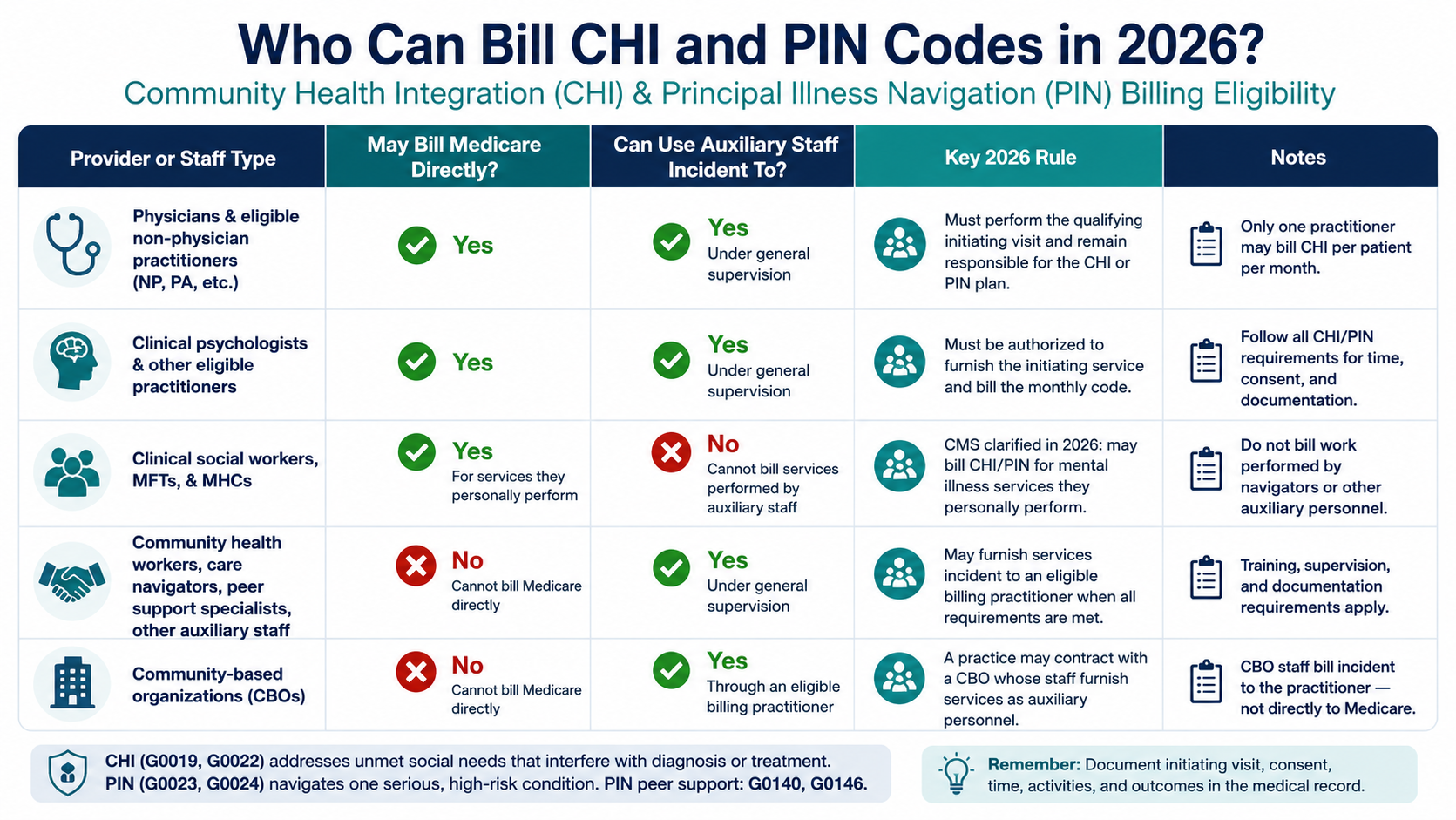
The billing professional must be a physician or practitioner who can furnish the qualifying initiating visit and must be the same practitioner responsible for the subsequent CHI or PIN service. Auxiliary personnel may perform much of the navigation work under general supervision, but they cannot enroll and bill Medicare directly for these codes.
| Provider or Staff Type | May Bill Medicare Directly? | Key 2026 Rule |
|---|---|---|
| Physicians and eligible non-physician practitioners | Yes | The billing practitioner must perform the initiating visit and remain responsible for the CHI or PIN plan. |
| Clinical psychologists and other eligible practitioners | Yes, when all service requirements are met | The practitioner must be authorized to furnish the initiating service and bill the monthly code. |
| Clinical social workers, MFTs, and MHCs | Yes, for services personally performed | CMS clarified for 2026 that these professionals may directly bill CHI and PIN they personally perform for the diagnosis or treatment of mental illness. |
| Community health workers, care navigators, peer-support specialists, and other auxiliary personnel | No direct Medicare billing | Their work may be billed incident to an eligible practitioner when supervision, training, documentation, and all other requirements are met. |
| Community-based organizations | No direct Physician Fee Schedule billing | A practice may contract with a qualifying organization whose staff furnish services as auxiliary personnel under the eligible billing practitioner. |
Important 2026 correction: MFTs and MHCs are not categorically excluded from CHI and PIN. According to CMS’s 2026 clarification, they may bill Medicare directly for qualifying CHI and PIN services they personally perform for mental-illness treatment. However, MFTs, MHCs, and clinical social workers cannot bill CHI or PIN services performed by auxiliary personnel incident to their professional services because they do not have the required statutory incident-to billing authority.
This distinction changes the staffing model. A physician, nurse practitioner, physician assistant, or another practitioner with applicable incident-to authority may use trained auxiliary personnel to furnish services under general supervision. An MFT or MHC may personally perform and bill qualifying services, but cannot delegate the monthly work to a navigator and then bill it as incident to the therapist’s services.
Documentation Requirements for CHI and PIN Billing
A compliant record must connect the initiating visit, the qualifying need or condition, the care plan, the time and activities furnished, and the patient’s consent. Generic statements such as “resources discussed” or “care coordination completed” are not enough to demonstrate why the service was medically necessary or what the care team actually did.
1. Document the Initiating Visit
The practitioner who will bill CHI or PIN must perform the initiating visit. For CHI, the visit must identify one or more unmet upstream drivers that significantly limit diagnosis or treatment. For PIN, the visit must establish a treatment plan for one serious, high-risk condition. CMS allows certain E/M visits, qualifying annual wellness visits, psychiatric diagnostic evaluation code 90791, and specified health behavior assessment and intervention services to serve as initiating visits when all requirements are met.
2. Record Consent and Cost-Sharing Disclosure
CHI requires advance consent, which may be written or verbal when it is documented in the medical record. The patient must be informed that cost sharing applies and that only one practitioner per month may bill CHI. PIN consent must be obtained before or when services begin and renewed annually; a new consent is also needed when the billing practitioner changes.
3. Connect Activities to the Plan of Care
Record the amount of time spent, who performed the service, the activities completed, the barrier or condition addressed, the community or clinical resources contacted, the patient’s response, and the next planned action. The billing practitioner must review and verify the documentation even when auxiliary personnel enter the note.
4. Document the Upstream Driver
Housing instability, food insecurity, transportation barriers, financial strain, unsafe living conditions, and social isolation may support CHI when they materially affect the practitioner’s ability to diagnose or treat the patient. CMS notes that ICD-10-CM Z55–Z65 codes may be used to communicate these upstream drivers, but reporting a Z code alone does not create separate payment.
5. Prevent Duplicate Time
CHI and PIN may be furnished alongside other care-management services only when the same staff time and work are not counted more than once. Maintain separate time logs and clearly distinguish social-needs integration, serious-condition navigation, chronic care management, behavioral health integration, or other services furnished during the month.
ClaraRCM workflow tip: Build a monthly CHI/PIN checklist that requires the initiating-visit date, consent status, billing practitioner, staff member, qualifying barrier or condition, minutes, completed activities, outcome, and next action. Claims should pause when the initiating visit, practitioner identity, consent, or time documentation is missing.
Documentation failures, incorrect practitioner attribution, and overlapping time are common reasons care-management claims are rejected or later recouped. ClaraRCM’s denial management services help practices identify these workflow gaps before they become a recurring payer pattern.
Frequently Asked Questions
What Are CHI and PIN Billing Codes?
Community Health Integration codes G0019 and G0022 reimburse structured work addressing unmet social needs that interfere with diagnosis or treatment. Principal Illness Navigation codes G0023 and G0024 support navigation for one serious, high-risk condition, while G0140 and G0146 describe qualifying PIN peer-support services.
Who Can Bill Community Health Integration and Principal Illness Navigation Codes?
Physicians and practitioners who are authorized to furnish the required initiating visit may bill CHI and PIN when all Medicare requirements are met. Auxiliary personnel may perform services incident to an eligible billing practitioner under general supervision, but they cannot bill Medicare directly.
Can a Mental Health Counselor or Marriage and Family Therapist Bill CHI or PIN?
Yes. CMS clarified for 2026 that MHCs and MFTs may bill CHI and PIN services they personally perform for the diagnosis or treatment of mental illness. They cannot bill services performed by auxiliary personnel incident to them because they lack the applicable statutory incident-to billing authority.
Do CHI and PIN Codes Require an Initiating Visit?
Yes. The practitioner who will bill the monthly CHI or PIN service must furnish a qualifying initiating visit that identifies the relevant upstream driver or establishes the plan for the serious, high-risk condition. The initiating visit is billed separately when its own requirements are met.

Andleeb Asghar, PharmD
RCM Specialist & Founder, ClaraRCM
Andleeb Asghar is a PharmD, medical billing professional, and revenue cycle management specialist with 7+ years of experience across medical billing, medical coding, clean-claim submission, payer compliance, eligibility verification, denial management, accounts receivable recovery, payment posting, provider enrollment, billing audits, and end-to-end revenue cycle optimization for U.S. healthcare practices. She medically reviews ClaraRCM content for clinical terminology, coding context, regulatory accuracy, payer considerations, and clear communication for healthcare providers and practice leaders.
ClaraRCM provides revenue cycle and medical billing support. This content is for educational purposes and is not legal, clinical, coding, or payer-contract advice. Verify current CMS, MAC, state, and payer requirements before billing.