Telehealth Billing for Buprenorphine and Methadone Treatment in 2026
Telehealth billing rules for buprenorphine and methadone treatment generally require audio-video technology, but Medicare permits audio-only billing for specific OTP telehealth codes — G2076, G2077, and G2080 — when video isn’t available to the patient or the patient doesn’t consent. That exception applies to intake add-on billing, periodic assessments, and additional counseling, and the audio-only telehealth buprenorphine billing rules are backed by permanent DEA and SAMHSA prescribing flexibilities finalized in 2025.
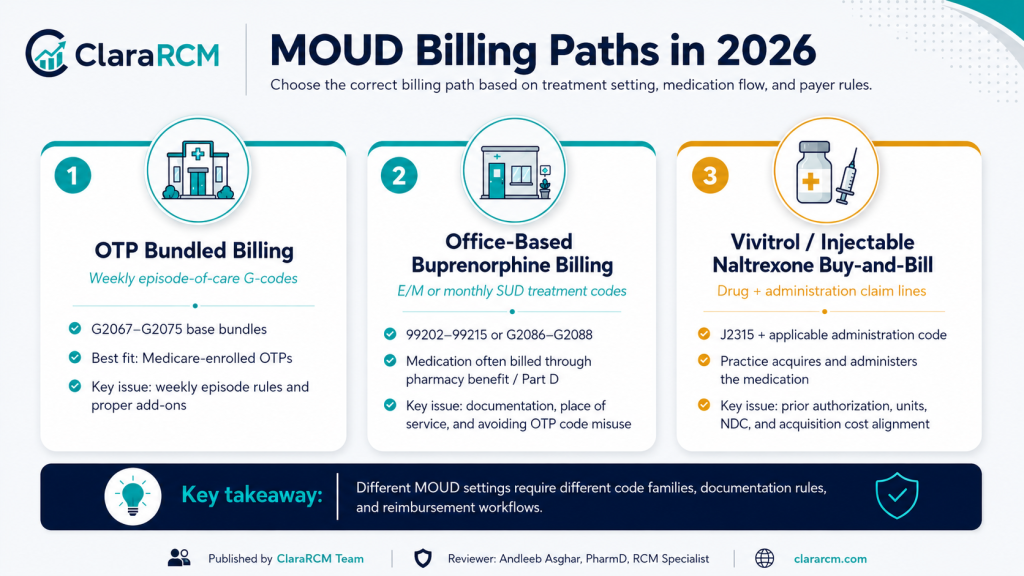
Telehealth billing for opioid use disorder treatment sits on two rule layers — the DEA and SAMHSA prescribing rules that decide what a provider can do remotely, and the CMS billing rules that decide how that visit gets paid. In 2026 both layers are more permissive than they’ve ever been, but every modifier still matters. This guide covers the current audio-video and audio-only rules for buprenorphine and methadone treatment furnished by OTPs. For the full picture of every MOUD billing path, start with ClaraRCM’s MOUD Billing Guide 2026 .
Audio-Video vs. Audio-Only Billing Rules
The service determines the code; the technology determines the modifier. Under the CMS OTP Billing & Payment guidance , OTPs use place of service 58 on every telehealth claim and report one of three telecommunications add-on codes with the correct modifier to signal how the visit was delivered.
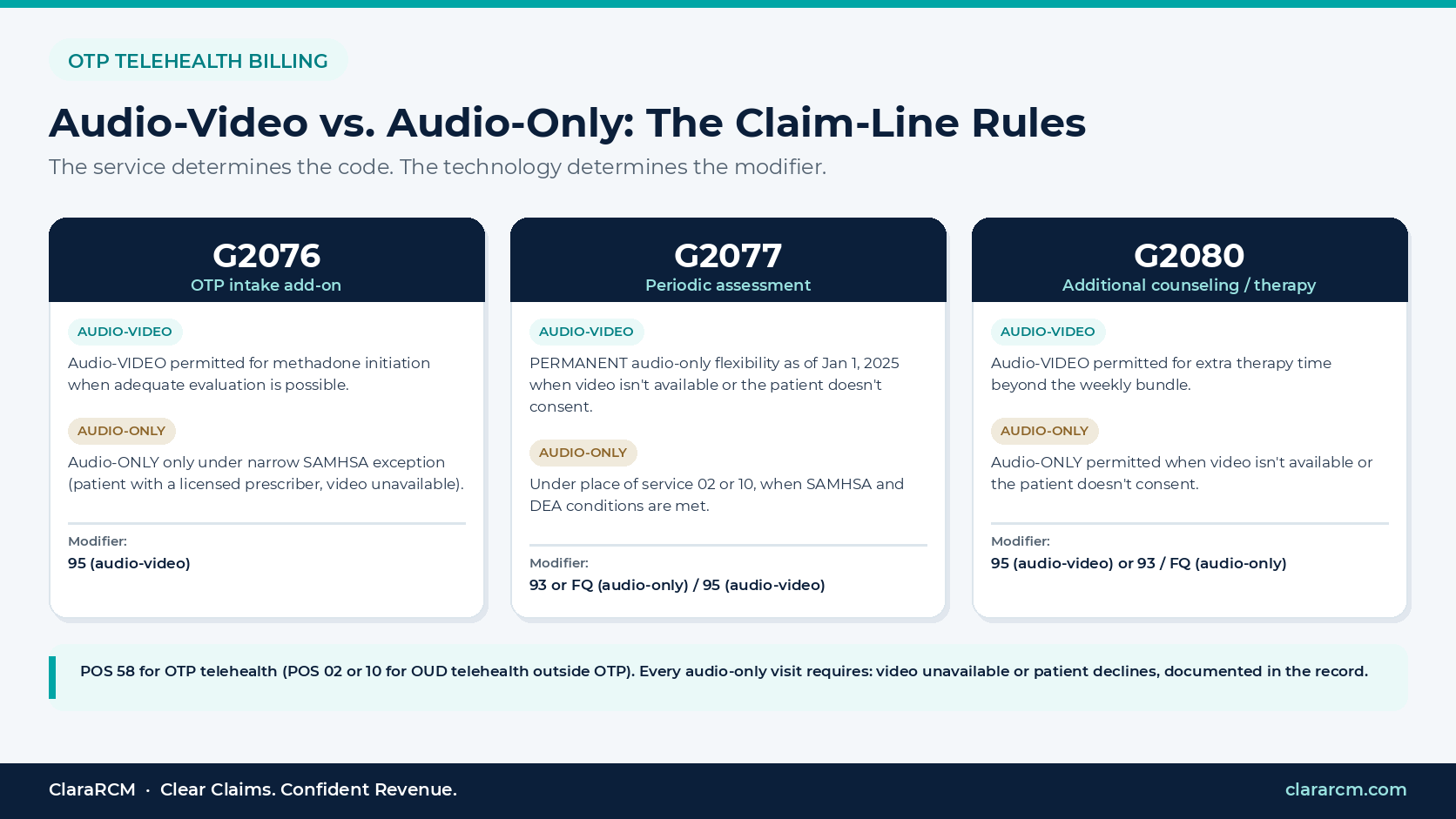
According to CMS, for OTP telecommunications claims with dates of service on or after May 12, 2023, the modifier layer is unchanged in 2026:
- Modifier 95 when the service was furnished using audio-video technology.
- Modifier 93 or modifier FQ when the service was furnished using audio-only technology — documenting that video wasn’t available or the patient didn’t consent.
The service-side codes track a specific decision. G2076 covers the OTP intake add-on. Under the CY 2025 Physician Fee Schedule final rule, CMS made permanent an OTP’s ability to bill G2076 via two-way audio-video for methadone initiation when the program can adequately evaluate the patient over that platform, provided SAMHSA and DEA authorize the underlying prescribing at the time of service. G2077 covers periodic assessments, and audio-only billing for those assessments became permanent beginning January 1, 2025 when video isn’t available and other SAMHSA and DEA requirements are met. G2080 covers additional counseling or therapy beyond the weekly bundle, and can be furnished via either audio-video or audio-only, with the modifier reflecting the mode.
When the Audio-Only Exception Applies
Audio-only telehealth in OTP billing is not a fallback for provider convenience — it is a documented exception with specific conditions the record must support. Per CMS OTP billing guidance and the CY 2025 PFS final rule, an audio-only visit is billable when the patient does not have access to two-way audio-visual communication technology, or does not consent to its use, and all other applicable OTP requirements are met at the time of the service. Documenting the patient-side reason is what makes the modifier 93 or FQ claim defensible on review.
A separate layer sits behind this: DEA and SAMHSA control what an OTP or telehealth prescriber may do remotely with the underlying controlled medication. On January 17, 2025, DEA and HHS finalized the buprenorphine telemedicine prescribing rule , which took effect February 18, 2025 and made permanent the ability to initiate buprenorphine treatment via audio-video or audio-only telemedicine and prescribe up to a six-month initial supply, provided the prescriber first checks the state prescription drug monitoring program. Separately, DEA extended broader controlled-substances telemedicine flexibilities through December 31, 2026 while it finalizes the permanent special-registration framework, so audio-only initiation of buprenorphine for OUD continues to be permitted under federal law through that date.
For office-based buprenorphine practices that also use telehealth — billing standard E/M rather than OTP add-ons — the billing pathway is different from the OTP add-on codes covered here. That workflow is covered in our guide to office-based buprenorphine billing after the X-waiver . Practices with a broader telehealth caseload can also review ClaraRCM’s telehealth billing services for cross-specialty support.
How OTP Telehealth Differs From Standard Medicare Telehealth
OTP telehealth runs on its own billing layer: dedicated G-codes, place of service 58, and telecommunications add-on codes that sit beside the weekly bundled episode — not the standard physician telehealth machinery. That distinction matters at the claim level, because using the wrong set of codes or modifiers gets the visit denied even when the care itself was appropriate.
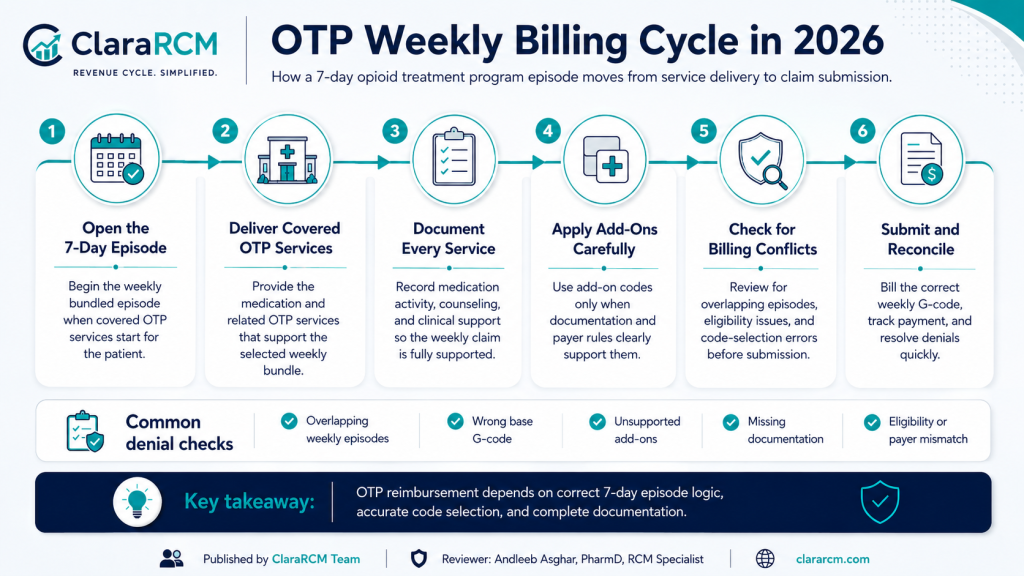
Three practical differences catch billers first. First, the place of service: OTP telehealth uses POS 58 on the OTP’s claim, whereas general Medicare telehealth uses POS 02 (originating site other than home) or POS 10 (patient at home). Second, the code family: the OTP’s telecommunications add-ons — G2076, G2077, G2080 — are OTP-specific and do not exist on a standard physician telehealth claim. Third, the interaction with the weekly bundle: OTP telehealth services attach to the underlying seven-day episode covered in our guide to OTP weekly bundled billing , so overlapping episode spans or duplicate add-ons still cause the same rejections telehealth was supposed to prevent.
One more layer sits on top nationally: some state Medicaid programs require program-specific modifiers on MOUD claims regardless of whether the service is in-person or telehealth. Our guide to modifier HF vs. HE in MOUD billing explains how those state rules interact with federal telehealth billing.
Frequently Asked Questions
Can You Bill for Audio-Only Addiction Treatment Visits?
Yes. According to CMS, OTPs can bill audio-only for G2077 periodic assessments and G2080 additional counseling or therapy — and for G2076 intake in a narrow SAMHSA-authorized exception — when the patient doesn’t have access to audio-video technology or doesn’t consent to its use. Report the correct add-on code with modifier 93 or FQ under POS 58.
What Telehealth Codes Apply to Buprenorphine Treatment?
For OTP-furnished treatment, the telecommunications add-on codes are G2076 for the intake add-on, G2077 for periodic assessments, and G2080 for additional counseling or therapy, reported with the OTP’s weekly bundle. Office-based buprenorphine prescribing outside an OTP is billed differently, using standard evaluation-and-management codes rather than the OTP add-ons.
Does Medicare Require Video for OTP Telehealth Billing?
Video is the default, but not the requirement. CMS finalized permanent audio-only flexibility for OTP periodic assessments (G2077) beginning January 1, 2025, and permits audio-only billing for G2080 counseling and, in a narrow SAMHSA exception, G2076 intake, when the patient doesn’t have access to or consent to audio-visual technology.
Can Buprenorphine Still Be Prescribed via Audio-Only Telemedicine in 2026?
Yes. DEA and HHS finalized the buprenorphine telemedicine prescribing rule effective February 18, 2025, permanently allowing initiation via audio-video or audio-only for up to a six-month supply after a PDMP check. Broader controlled-substances telemedicine flexibilities were also extended through December 31, 2026.

Andleeb Asghar, PharmD
RCM Specialist & Founder, ClaraRCM
Andleeb Asghar is a PharmD, medical billing professional, and revenue cycle management specialist with 7+ years of experience across medical billing, medical coding, clean-claim submission, payer compliance, eligibility verification, denial management, accounts receivable recovery, payment posting, provider enrollment, billing audits, and end-to-end revenue cycle optimization for U.S. healthcare practices. She medically reviews ClaraRCM content for clinical terminology, coding context, regulatory accuracy, payer considerations, and clear communication for healthcare providers and practice leaders.
ClaraRCM provides revenue cycle and medical billing support. This content is for educational purposes and is not legal, clinical, or payer-contract advice.