Modifier HF vs. HE: Billing Medication Management for MOUD Correctly
Modifier HF is appended to medication management billing for MOUD or MAUD treatment, while modifier HE is used for psychiatric medication management — the two HIPAA-standard HCPCS modifiers that distinguish which kind of medication a visit was about. Whether your team searches for it as the HF modifier or as modifier HF, modifier HF billing rules are set at the state Medicaid level, not by CMS nationally, so the exact requirement varies by state. New York’s OASAS program is one clearly documented example of a state that requires this distinction on E&M claims.
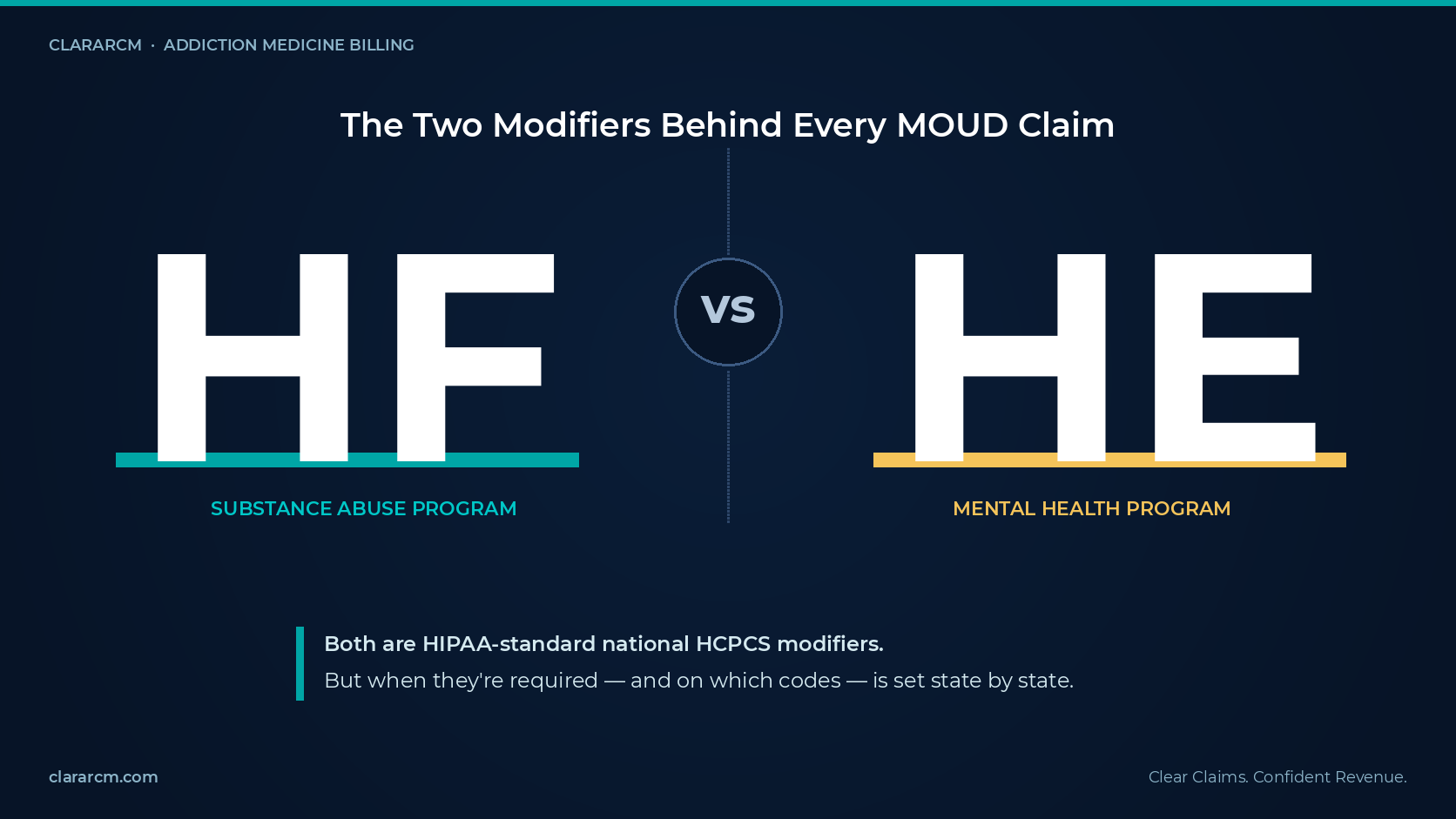
Modifiers HF and HE are two of the least-explained modifiers in behavioral health billing. Both are HIPAA-standard HCPCS Level II modifiers — meaning the definitions are national — but whether either one is required on a given claim is set state by state. Billers often search this topic two different ways: as the “HF modifier” or as “modifier HF,” and both lead here, along with anyone looking up the exact HF modifier description on the HCPCS list. This guide covers what each modifier signals, why New York uses them specifically for medication management, and how to verify what ClaraRCM’s MOUD billing services apply in your state. For the full MOUD billing picture, start with the MOUD Billing Guide 2026 .
What Modifier HF Covers
HF is the HIPAA-standard HCPCS Level II modifier for “substance abuse program.” It signals to the payer that the service on the claim line was furnished as part of a substance use disorder program — including MOUD (medication for opioid use disorder) or MAUD (medication for alcohol use disorder) treatment. The HF modifier doesn’t change the code’s definition or reimbursement in itself; it classifies the visit so the payer’s SUD-specific policies apply.
In practice, states that require HF modifier billing for MOUD typically want it appended to an evaluation and management code (99202–99215) when the visit represents SUD medication management — for example, a buprenorphine dose adjustment visit at an office-based addiction practice, or a medication management encounter at an OASAS certified outpatient program. What HF does is unambiguously tag that E&M as SUD medication management, rather than a general medical visit that happened to involve a patient with SUD.
What Modifier HE Covers
HE is the HIPAA-standard HCPCS Level II modifier for “mental health program.” It signals that the service was furnished as part of a mental health program — the psychiatric counterpart to HF’s substance abuse designation. In states that use it for medication management, HE identifies E&M visits that represent psychiatric evaluations or mental health medication management, so those claims route to the right coverage rules and utilization review pathway.
The two modifiers exist because an E&M code by itself doesn’t reveal whether the visit was about buprenorphine management for OUD, an antipsychotic adjustment for schizophrenia, or routine physical health follow-up. HF and HE let the payer see the difference. In OASAS billing, HE also appears on psychiatric assessment claims paired with add-on codes 90833 or 90836 when the encounter is a psychiatric assessment plus counseling.
Why This Is State-Specific (New York OASAS Example)
HF and HE are national HIPAA-standard modifiers, but the requirement to use them on medication management claims is set at the state Medicaid level — there is no national CMS rule requiring either modifier on MOUD E&M billing. Each state decides whether its Medicaid program (fee-for-service and Medicaid Managed Care) requires the distinction, and enforces it through the state agency that oversees addiction services billing.
New York is the clearest documented example. According to the href="https://oasas.ny.gov/apg-manual" target="_blank" rel="noopener noreferrer" > New York State Office of Addiction Services and Supports Ambulatory Patient Group Clinical and Medicaid Billing Guidance , OASAS requires providers to append modifiers to E&M codes to distinguish three service types: substance use disorder medication management, psychiatric evaluations or mental health medication management, and physical health care. The OASAS manual states this directly: for E&M codes representing SUD medication management, append modifier HF; for E&M codes representing psychiatric evaluations or mental health medication management, append modifier HE.
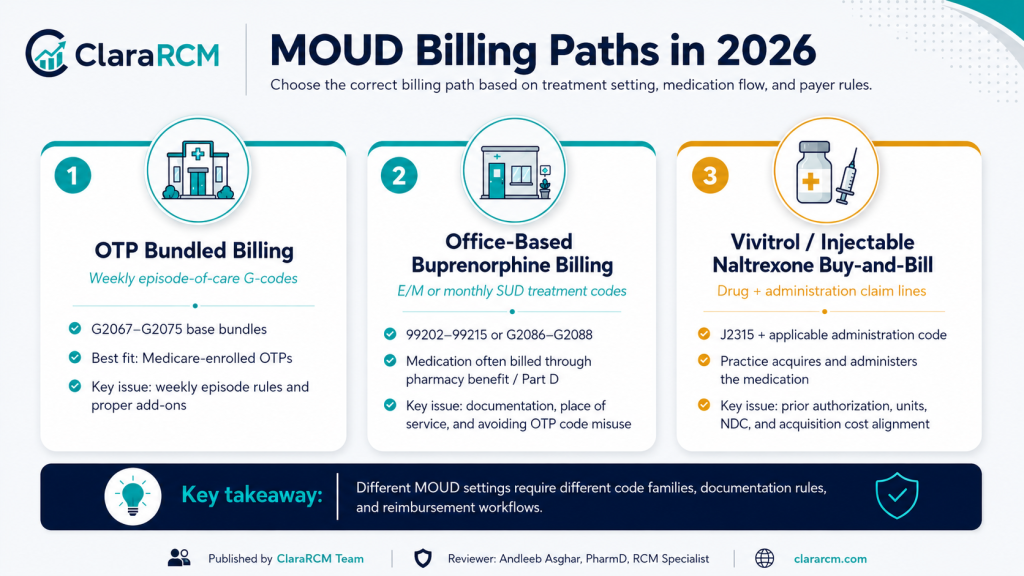
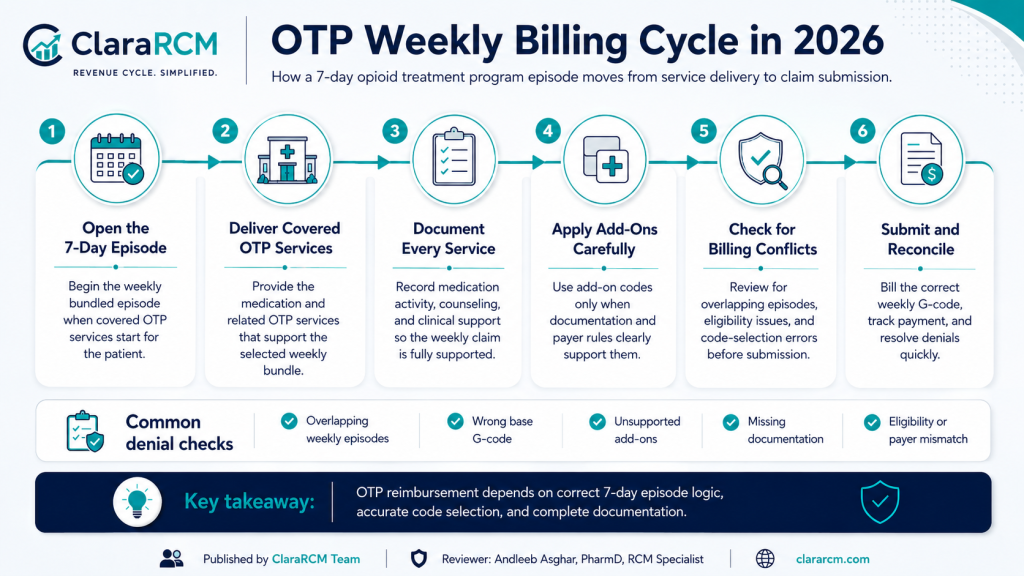
Two OASAS operational rules matter alongside the modifier itself. First, the manual makes clear that medication management is already included in the OTP weekly bundle, so an E&M code representing medication management should not be coded when a bundle code appears on the claim — even with HF. For how the weekly bundle works and what it already covers, see our guide to OTP weekly bundled billing . Second, the modifier requirement applies across all OASAS outpatient services where E&M codes are billed, including clinics billing under rate code 1540 — missing modifiers on those lines have historically triggered adjudication issues at Medicaid Managed Care plans.
How to Verify Your State’s Requirements
Because HF and HE requirements are set state by state, every practice should verify its own state Medicaid and Medicaid Managed Care rules before adjusting how E&M codes are appended. A practice operating in multiple states may have to apply different modifier conventions per state — a fact billing systems configured to a single default frequently miss.
- Identify the state agency that regulates SUD billing. In New York it is OASAS. In California it is DHCS. In many states it is the state Medicaid agency directly. Start with that agency’s current billing manual.
- Search for “modifier HF,” “modifier HE,” and “medication management modifier.” The requirement, when it exists, will appear in the section on evaluation and management billing or in the state’s HCPCS modifier list.
- Check the Medicaid Managed Care plan billing rules separately. Some states leave modifier rules to individual plans, and some plans require modifiers even when the state manual is silent.
- Configure the billing system with the state as the variable. If practices bill across multiple states, code the E&M-plus-modifier logic per state at the claim level, not as a global default.
When claims have already denied over missing or incorrect modifiers, ClaraRCM’s denial management services and billing audit and cleanup services can rework the backlog while the pre-bill configuration is fixed.
Frequently Asked Questions
What Does Modifier HF Mean in Medical Billing?
HF is the HIPAA-standard HCPCS Level II modifier for “substance abuse program.” It tells the payer that the service on that claim line was furnished as part of a substance use disorder program, and in states that require it, it’s appended to E&M codes representing SUD or MOUD medication management.
What Is the HF Modifier Description on a Claim?
The official HCPCS Level II descriptor for modifier HF is “substance abuse program.” That single phrase is the entire modifier description; there is no separate numeric code or expanded definition beyond it. On a claim, appending HF to an E&M code simply tells the payer that visit was furnished as part of a substance use disorder program, which is why states that track MOUD medication management separately from psychiatric or physical health visits require it.
What’s the Difference Between Modifier HF and HE?
HF designates a service furnished as part of a substance abuse program; HE designates a service furnished as part of a mental health program. In state Medicaid programs that use them for medication management — New York’s OASAS being one example — HF is used for SUD or MOUD medication management and HE is used for psychiatric evaluations or mental health medication management.
Is Modifier HF a National CMS Requirement or State-Specific?
State-specific. HF and HE are HIPAA-standard national HCPCS modifiers, but the requirement to use them on medication management claims is set by each state Medicaid program — there is no national CMS rule mandating either modifier on MOUD E&M billing. Providers must confirm their own state Medicaid and Medicaid Managed Care rules.
Do You Bill an E&M With Modifier HF Alongside an OTP Weekly Bundle?
No. Per OASAS billing guidance, medication management is already included in the OTP weekly bundle codes, so an E&M code representing medication management — even with modifier HF — should not be coded when a bundle code appears on the claim. The bundle covers the service; adding an E&M creates a duplicate line.

Andleeb Asghar, PharmD
RCM Specialist & Founder, ClaraRCM
Andleeb Asghar is a PharmD, medical billing professional, and revenue cycle management specialist with 7+ years of experience across medical billing, medical coding, clean-claim submission, payer compliance, eligibility verification, denial management, accounts receivable recovery, payment posting, provider enrollment, billing audits, and end-to-end revenue cycle optimization for U.S. healthcare practices. She medically reviews ClaraRCM content for clinical terminology, coding context, regulatory accuracy, payer considerations, and clear communication for healthcare providers and practice leaders.
ClaraRCM provides revenue cycle and medical billing support. This content is for educational purposes and is not legal, clinical, or payer-contract advice.