Vivitrol (Naltrexone) Buy-and-Bill: J2315 Billing Walkthrough
The Vivitrol HCPCS code is J2315, billed using a buy-and-bill model, meaning the practice purchases the drug, administers it, and bills the payer for both the drug cost and the administration. The most common denial cause is a mismatch between the units billed and the actual vial size dispensed — J2315 is defined as one milligram per unit, so a full 380 mg dose is generally reported as 380 units.
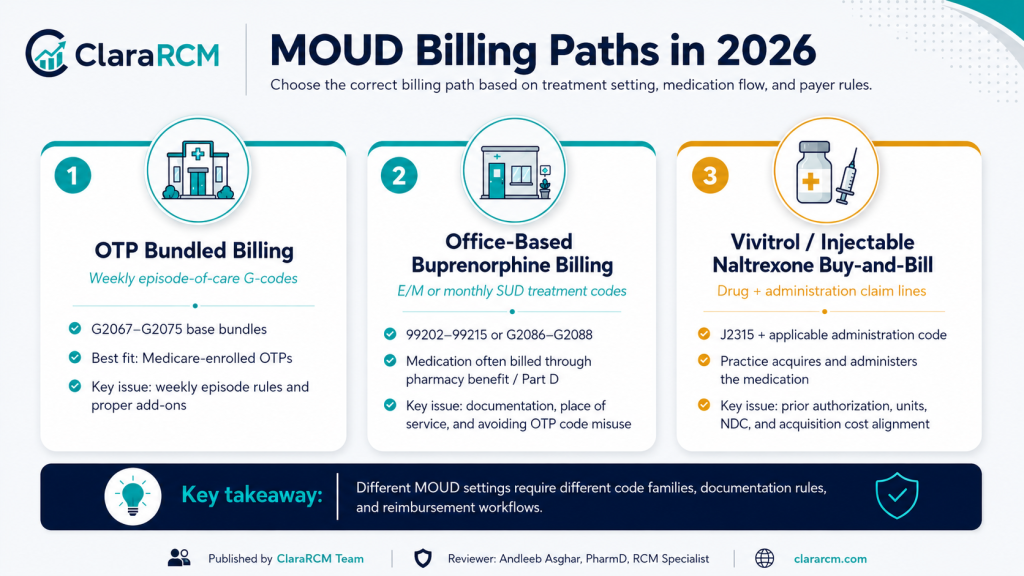
Vivitrol J2315 billing is where a clinical decision becomes a financial one. Whether your team calls it the Vivitrol J code or the Vivitrol injection J code, the mechanics are identical: the practice fronts the acquisition cost of every vial, so a single unit error, benefit mix-up, or authorization gap doesn’t just delay payment — it puts the drug cost itself at risk. This walkthrough covers the buy-and-bill workflow, the unit math, and the denial trigger that catches more practices than any other. For how buy-and-bill fits alongside OTP bundles and office-based prescribing, start with ClaraRCM’s MOUD Billing Guide 2026 .
What Buy-and-Bill Means for Vivitrol
Buy-and-bill means the practice purchases the medication, stores it, administers it in the office, and then bills the patient’s medical benefit for the drug plus the administration service. That is the opposite of office-based buprenorphine, where the prescription routes through the pharmacy benefit and never touches the medical claim — with Vivitrol, the practice owns the financial risk from the moment the vial is ordered.
The claim itself has two lines: the drug, reported with HCPCS J2315, and the administration, commonly reported with a therapeutic injection code such as 96372 when the service and the payer’s policy support it. Because the practice is fronting the drug cost, four checks belong before every injection:
- Confirm the benefit pathway. Verify whether the payer covers Vivitrol under the medical benefit (buy-and-bill) or requires specialty-pharmacy shipment instead — eligibility and benefits verification settles this before the vial is purchased.
- Secure prior authorization. Most payers require authorization covering the dose, frequency, diagnosis, and site of care before the first injection.
- Document the administration. Record the dose, route, injection site, product, NDC, and any wastage the payer requires on the claim.
- Reconcile payment against acquisition cost. Compare the allowed amount to what the practice paid for the vial — accurate payment posting is what makes underpayments visible instead of silent.
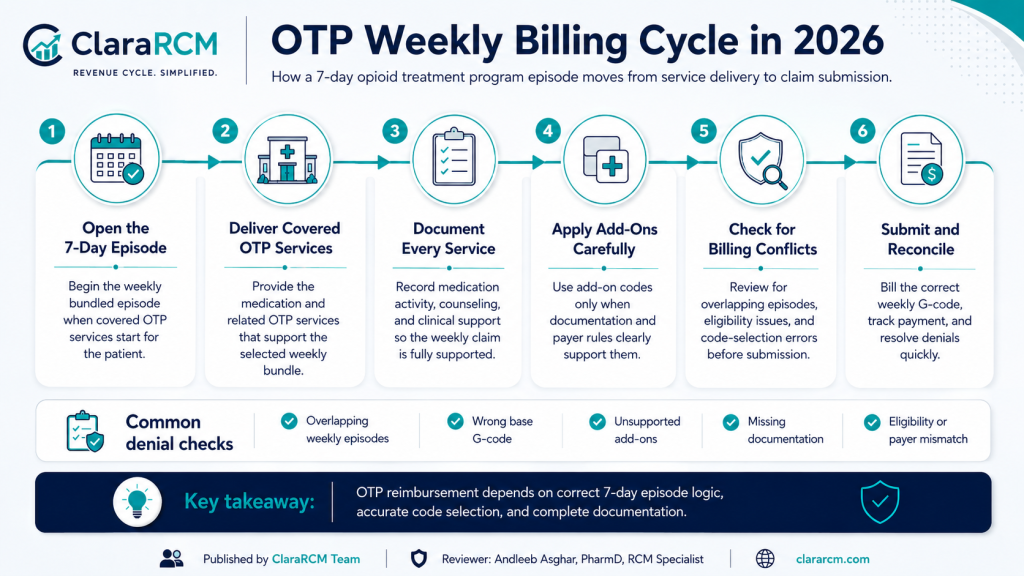
Setting check: Inside a Medicare-enrolled OTP, naltrexone is generally paid through the bundled episode (G2073) rather than a separate J2315 claim — see how the bundles work in our guide to OTP weekly bundled billing . Buy-and-bill applies to office and outpatient settings billing outside those bundles.
Calculating J2315 Units Correctly (Worked Example)
According to the CMS HCPCS code set, J2315 is defined as “injection, naltrexone, depot form, 1 mg” — one unit equals one milligram. The FDA-approved Vivitrol dose is a 380 mg intramuscular injection administered monthly, so when the payer follows the one-milligram HCPCS descriptor, a full dose is reported as 380 units on the claim line.
Many billing teams search for this as the CPT code for Vivitrol, but J2315 is technically a HCPCS Level II code, not a CPT code. CPT codes are maintained by the AMA and generally describe procedures, while HCPCS Level II codes like J2315 describe drugs and supplies. The J2315 CPT code description search almost always lands here for a reason: J2315 is the correct code to bill, whichever term your software, payer portal, or team happens to use for it.
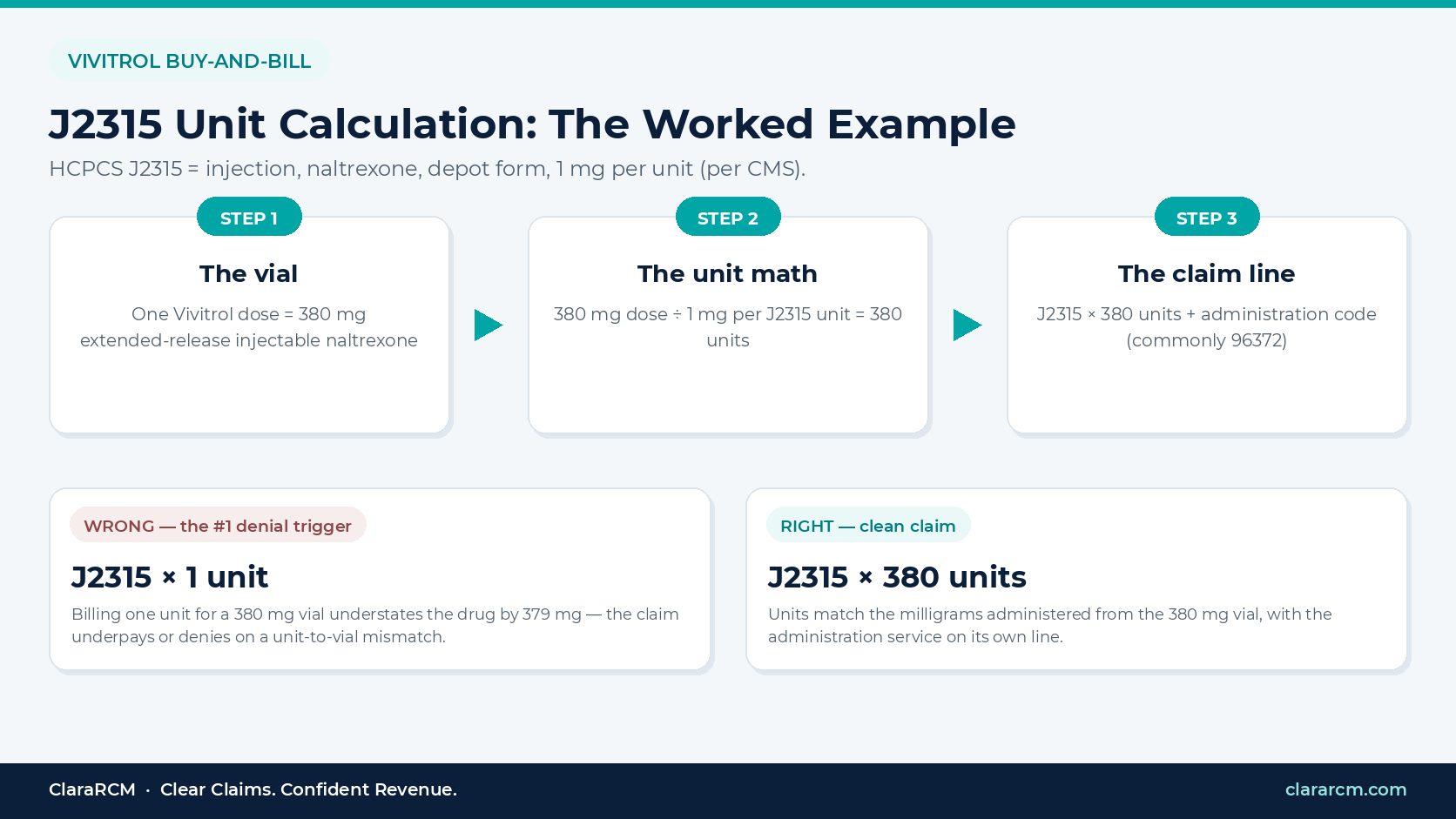
The worked example in claim terms: the practice administers one 380 mg vial. Line one reports J2315 with 380 in the units field and the product’s NDC. Line two reports the administration service. The units field must reconcile with the milligrams documented in the administration note — that cross-check is exactly what payers run, and it’s the pre-bill check ClaraRCM builds into every buy-and-bill claim as part of maintaining a 97% clean claim rate across its clients.
The #1 Denial Trigger: Unit-to-Vial Mismatch
The most common Vivitrol denial is a units field that doesn’t match the vial: one unit billed for a 380 mg dose. Billing systems that default new J-codes to a quantity of one understate the drug by 379 milligrams, and the claim either pays a tiny fraction of the drug cost or denies outright when the payer cross-checks the units against the NDC.
Three related errors travel with it. First, the reverse mistake: reporting 380 units when the payer’s policy defines the billing unit as one vial — which is why the payer’s own unit instruction must be verified rather than assumed. Second, a missing or mismatched NDC, which fails the payer’s drug-validation edit even when the units are right. Third, authorization gaps — an injection given before the authorization’s start date, or after its expiration, denies no matter how clean the coding is.
When a J2315 claim has already denied or underpaid, the recovery path is a corrected claim for unit and NDC errors, or an appeal with the administration record attached for authorization and medical-necessity denials. Our guide to why SUD and MOUD claims get denied covers how to structure those appeals, and ClaraRCM’s denial management services work the backlog while the pre-bill checks get fixed.
Complete MOUD Billing Resource Library
Each post below covers a specific MOUD billing topic in depth. Use them alongside this guide for end-to-end coverage of every billing path.
MOUD Billing Path Finder
Answer 3 quick questions to identify which MOUD billing path applies to your practice — and your single biggest denial risk right now.
Q1: What type of facility or practice are you?
This determines which code family applies to you.
ClaraRCM will review your MOUD billing setup and send you a free, personalized audit within 1 business day.
Your billing path: —
Request received — thank you!
ClaraRCM has your MOUD billing details and will send you a free personalized audit within 1 business day.
Prefer to connect right away?
Book a 30-minute call nowFrequently Asked Questions
What HCPCS Code Is Used for Vivitrol Billing?
Vivitrol is billed with HCPCS code J2315, defined by CMS as “injection, naltrexone, depot form, 1 mg.” The administration is reported separately, commonly with a therapeutic injection code such as 96372 when the payer’s policy supports it.
Is There a CPT Code for Vivitrol, or Is It a HCPCS Code?
Vivitrol does not have its own CPT code. It is billed with HCPCS Level II code J2315, which is the correct code to use whether your team refers to it as the Vivitrol J code, the Vivitrol HCPCS code, or the CPT code for Vivitrol. The administration itself may use a CPT code, such as 96372, billed on a separate claim line.
What Does Buy-and-Bill Mean in Medical Billing?
Buy-and-bill means the practice purchases a medication up front, administers it in the office, and bills the patient’s medical benefit for both the drug and the administration. The practice carries the acquisition cost until the claim pays, which makes benefit verification and prior authorization essential before the vial is ordered.
How Many Units of J2315 Is One Vivitrol Injection?
When the payer follows the CMS one-milligram unit definition, a full 380 mg Vivitrol dose is reported as 380 units of J2315. Always confirm the individual payer’s billing-unit instruction, since some plans publish their own unit rules.
Why Do Vivitrol Claims Get Denied?
The leading causes are a unit-to-vial mismatch (billing one unit for a 380 mg dose), a missing or mismatched NDC, and authorization gaps where the injection falls outside the approved dates. Unit and NDC errors are fixed with a corrected claim; authorization denials require an appeal with the administration record attached.

Andleeb Asghar, PharmD
RCM Specialist & Founder, ClaraRCM
Andleeb Asghar is a PharmD, medical billing professional, and revenue cycle management specialist with 7+ years of experience across medical billing, medical coding, clean-claim submission, payer compliance, eligibility verification, denial management, accounts receivable recovery, payment posting, provider enrollment, billing audits, and end-to-end revenue cycle optimization for U.S. healthcare practices. She medically reviews ClaraRCM content for clinical terminology, coding context, regulatory accuracy, payer considerations, and clear communication for healthcare providers and practice leaders.
ClaraRCM provides revenue cycle and medical billing support. This content is for educational purposes and is not legal, clinical, or payer-contract advice.