Mental Health Billing: How Therapy Claims Actually Get Paid
Mental health billing is the process of converting a therapy session into a paid claim through eight steps: verify benefits, confirm authorization, deliver and document the session, select the time-based CPT code, pair a covered ICD-10 diagnosis, apply required modifiers, submit to the correct payer or carve-out administrator, and post the payment or work the denial. Most therapy claim denials trace back to three things — session time that does not match the CPT code billed, an expired or missing prior authorization, and a claim routed to the health plan instead of the behavioral health carve-out. ClaraRCM manages mental health billing for solo therapists and group practices across all 50 states.
Mental health billing breaks in ways that general medical billing does not. A dermatology claim is a procedure, a diagnosis, and a date. A therapy claim is a stopwatch, a diagnosis a payer may or may not consider medically necessary, an authorization that quietly expires at session eight, and a behavioral health administrator that may not be the insurance company printed on the patient's card. Every one of those is a separate failure point, and each one produces a denial that arrives four to six weeks after the session was already delivered.
This guide from ClaraRCM follows one therapy claim from intake to payment, written for the clinician doing the session rather than the administrator running the payer contracts. If you want the systems-level view — payer mix strategy, contract negotiation, and revenue cycle infrastructure — start with our behavioral health revenue cycle management guide instead. If you want to know why the claim you sent last month came back with a CO-197, keep reading.
What Is Mental Health Billing?
Mental health billing is the end-to-end process of documenting a psychotherapy or psychiatric service, translating it into the correct CPT and ICD-10 codes, submitting it to the payer or behavioral health administrator responsible for the benefit, and collecting the contracted reimbursement. It covers individual and group psychotherapy, diagnostic evaluations, family sessions, crisis intervention, psychological testing, and psychiatric medication management delivered by psychiatrists, psychologists, LCSWs, LPCs, LMFTs, LMHCs, and supervised associate-level clinicians.
What separates it from general medical billing is not the codes themselves — it is the number of things a payer can check before deciding to pay. Four structural differences drive nearly all of the friction:
- Time is the code. Most medical CPT codes describe a procedure. Psychotherapy codes describe a duration, so the session note is the only evidence supporting the code you billed.
- The benefit is often carved out. A patient hands you a UnitedHealthcare card, but the behavioral health benefit is administered by Optum. Billing the card generates an automatic out-of-network or non-covered denial. See our guide to behavioral health carve-out billing.
- Authorization is ongoing, not one-time. Many commercial plans authorize a block of sessions — six, eight, twelve — and everything after that block denies until a renewal is filed.
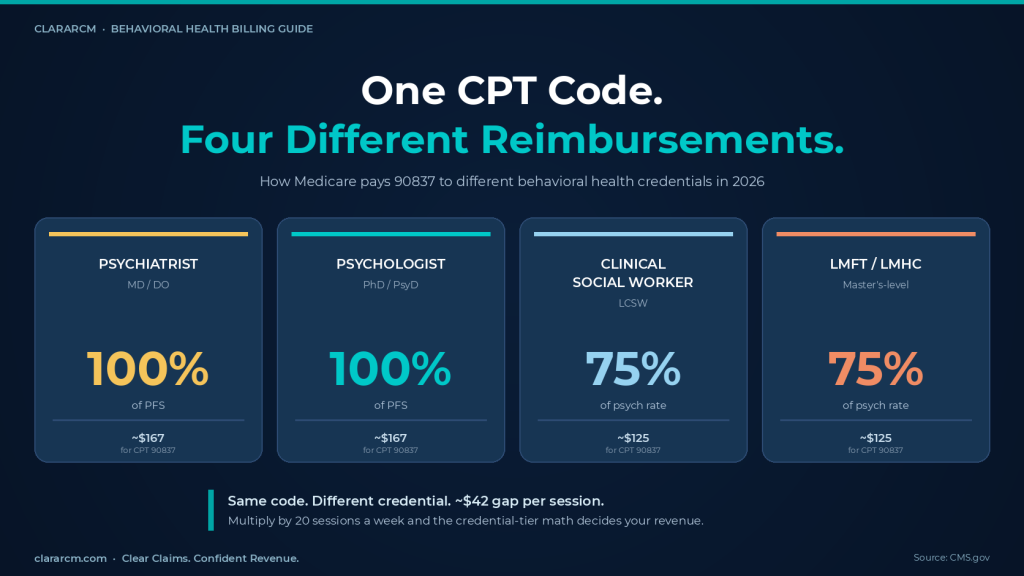
- Credential tier changes the rate. The same 90837 pays a different amount depending on whether the rendering provider is a psychiatrist, psychologist, LCSW, or LPC, and some payers require a credential modifier to process the claim at all.
The practical consequence is that a therapy claim has more ways to fail than a comparable medical claim, and those failures are almost entirely preventable at the point of scheduling and documentation — not at the appeal stage.
The Mental Health Billing Process, Step by Step
A therapy claim moves through eight stages, and roughly 70% of denials are created in the first three — before the session even happens. Here is the full lifecycle of one claim.
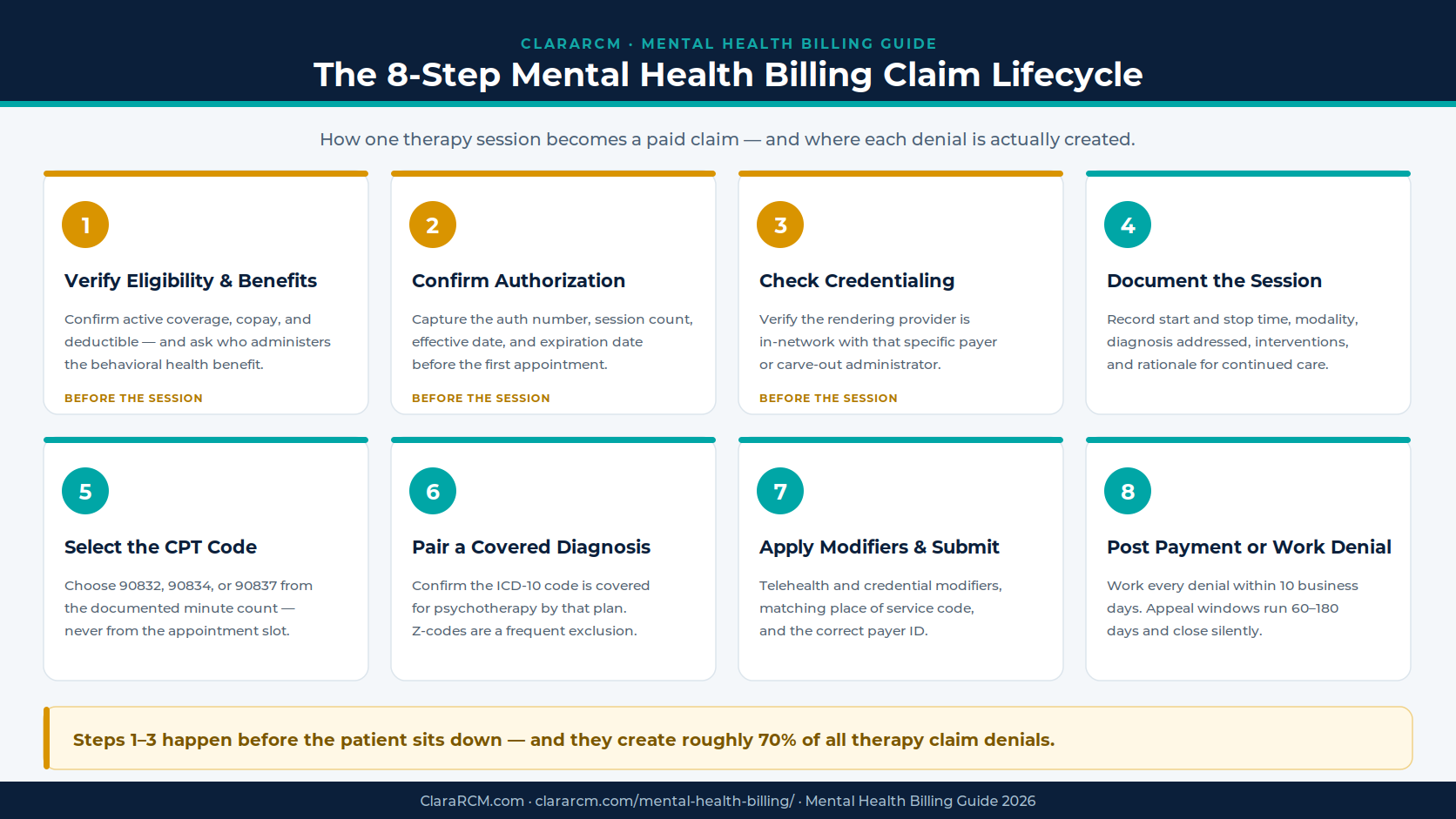
- Verify eligibility and behavioral health benefits. Confirm the plan is active, capture the copay, coinsurance, and deductible status, and — critically — ask whether behavioral health is managed by a separate administrator. This single question prevents the most expensive category of therapy denial. ClaraRCM's eligibility and benefits verification team runs this before the first appointment.
- Confirm authorization requirements. Ask how many sessions are authorized, the exact authorization number, the effective and expiration dates, and whether the plan requires concurrent review. Record the expiration date in the scheduling system, not in a note nobody reads.
- Confirm the rendering provider is credentialed with that specific payer. Being in-network with a health plan does not make you in-network with its behavioral health carve-out, and a group's contract does not automatically cover a newly hired associate. Our provider credentialing service handles enrollment and CAQH maintenance.
- Deliver and document the session. The note must contain the start and stop time or total face-to-face minutes, the modality, the diagnosis addressed, the interventions used, and the clinical rationale for continued treatment.
- Select the CPT code from the documented time. Not from the calendar block. Not from habit. From the minutes actually recorded in the note.
- Pair a covered ICD-10 diagnosis. Some diagnoses are not covered for psychotherapy by some payers — adjustment disorders and V/Z codes are the usual casualties. See our breakdown of psychotherapy diagnosis pairing denials.
- Apply modifiers and submit to the correct entity. Telehealth modifier, credential modifier where required, place of service code, and the payer ID for the behavioral health administrator rather than the medical plan. ClaraRCM's claim submission process scrubs all four before the claim goes out.
- Post payment or work the denial within 10 business days. Appeal windows run 60 to 180 days depending on payer. Reviewing denials at month-end quietly forfeits a portion of them every cycle.
Where the money actually leaks: in ClaraRCM audits of new behavioral health clients, the largest single recoverable bucket is almost never a coding error — it is sessions delivered after an authorization expired, billed anyway, denied CO-197, and never appealed. Set renewal alerts two weeks before the last authorized session, not on it.
Mental Health CPT Codes You Will Actually Use
A clinical practice bills the vast majority of its volume from about a dozen CPT codes, with 90834 and 90837 accounting for most individual therapy claims and 90791 covering the initial evaluation. The rest of the code set exists for specific situations — crisis, family work, group sessions, and psychiatric medication management.
| CPT Code | Description | Time Requirement | Key Billing Rule |
|---|---|---|---|
| 90791 | Psychiatric diagnostic evaluation, no medical services | Not time-based | Typically once per episode of care; some payers limit to one per year per provider |
| 90792 | Psychiatric diagnostic evaluation with medical services | Not time-based | Prescriber-only code; non-medical clinicians must use 90791 |
| 90832 | Individual psychotherapy | 16–37 minutes | Under 16 minutes is not separately billable as psychotherapy |
| 90834 | Individual psychotherapy | 38–52 minutes | The default code for a standard 45–50 minute clinical hour |
| 90837 | Individual psychotherapy | 53 minutes or more | Highest audit exposure; document clinical rationale for the extended session |
| 90846 | Family psychotherapy, patient not present | 26 minutes or more | Bill under the identified patient; some plans do not cover it |
| 90847 | Family psychotherapy, patient present | 26 minutes or more | Cannot be billed same day as individual therapy for the same patient by most payers |
| 90853 | Group psychotherapy | Not time-banded | One unit per patient per session regardless of group length |
| 90839 / +90840 | Psychotherapy for crisis | 60 min / each add'l 30 min | Requires documented urgent presentation; not a substitute for a long routine session |
| +90785 | Interactive complexity (add-on) | Not time-based | Requires a documented complicating factor; never billed alone |
| +90833 / +90836 / +90838 | Psychotherapy add-on to E/M | 30 / 45 / 60 min | Prescriber-only; psychotherapy time must be documented separately from E/M time |
| 99213 / 99214 | E/M for psychiatric medication management | MDM or time-based | Prescriber-only; pair with a psychotherapy add-on when both are delivered |
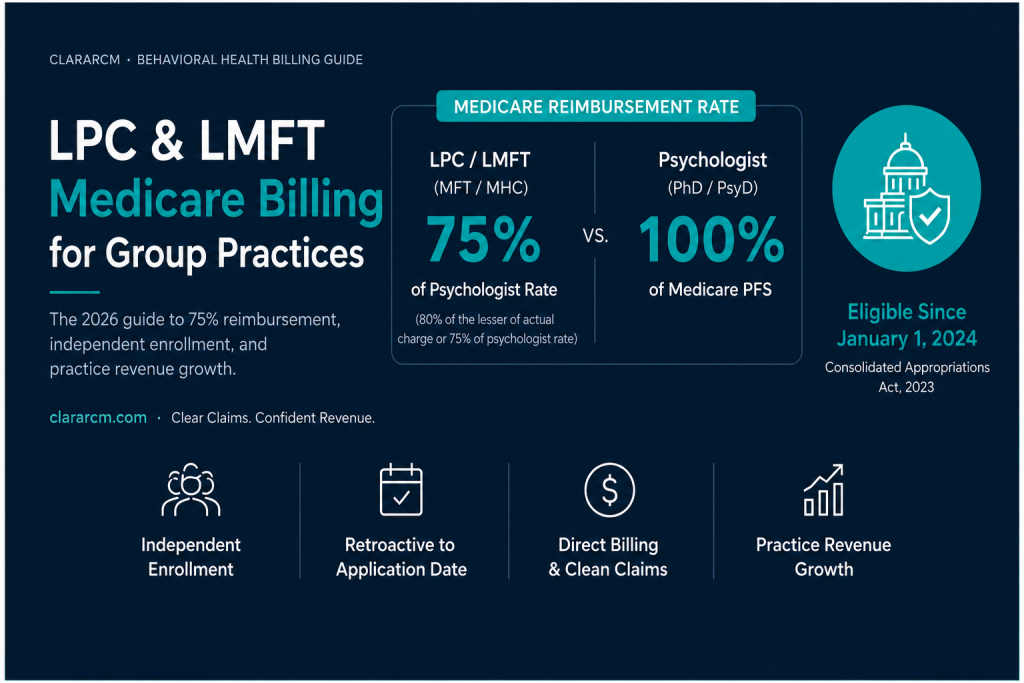
Which codes you are permitted to bill depends on your license and your enrollment status, not on what you delivered clinically. LPCs and LMFTs became independently billable under Medicare on January 1, 2024, and reimburse at 75% of the psychologist rate — a difference that materially changes group practice economics. See our guide to LPC and LMFT Medicare billing for group practices. For associate-level clinicians billing under a supervisor, the rules differ again; our behavioral health supervision billing guide covers incident-to and supervisory modifier requirements by payer.
The Time Rules That Cause Most Denials
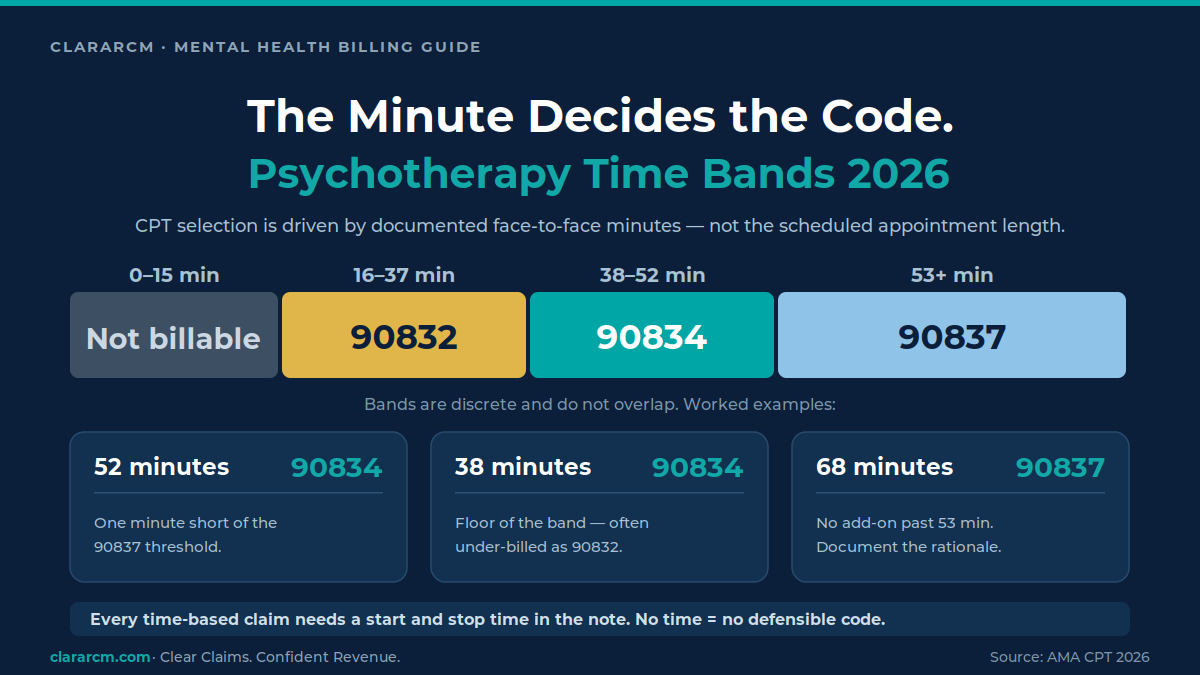
Psychotherapy CPT codes are selected from documented face-to-face minutes, and the time bands do not overlap — 90832 covers 16 to 37 minutes, 90834 covers 38 to 52 minutes, and 90837 covers 53 minutes or more. Scheduled appointment length is irrelevant. If the note says 48 minutes and the claim says 90837, the claim is wrong even if the calendar block was 60 minutes.
Worked example 1: the 52-minute session
Session ran 52 documented minutes
This is the single most common near-miss in mental health billing. Fifty-two minutes feels like an hour, the appointment was booked as an hour, and the clinician reaches for 90837. But 90837 begins at 53 minutes. Fifty-two minutes falls at the very top of the 90834 band.
Billing 90837 here is not a rounding difference — on a pre-payment review or a post-payment audit, the note contradicts the code and the payer recoups. If the session genuinely warranted a longer format, the fix is clinical and documentary: run the session to its actual clinical length and record the real start and stop times.
Correct code: 90834Worked example 2: the 38-minute session
Session ran 38 documented minutes
Thirty-eight minutes is the exact floor of the 90834 band, and it is frequently under-billed as 90832 by clinicians who assume 90834 requires a "full" 45 minutes. It does not. A documented 38-minute session supports 90834 at the higher reimbursement rate.
Practices that systematically default short sessions to 90832 leave real money on the table across a year of volume. Reviewing 60 days of claims against session notes usually surfaces this pattern within an hour.
Correct code: 90834Worked example 3: the 68-minute session
Session ran 68 documented minutes
Sixty-eight minutes is 90837 — and 90837 is the only code that applies. There is no add-on for the extra fifteen minutes beyond the 53-minute threshold, and the second unit of 90837 is not billable for a single continuous session. Prolonged service codes generally do not attach to standalone psychotherapy.
What matters here is the documentation, because 90837 is where prepayment review lives. The note should state the minutes, the clinical reason the extended format was indicated, and what was accomplished in the additional time. If your 90837 usage exceeds roughly 70% of your individual sessions, expect an automated review. See our 90837 pre-payment review and audit response guide.
Correct code: 90837Last updated: August 2026. CPT code descriptors and time definitions are maintained by the American Medical Association and updated annually. Verify current descriptors in the AMA CPT codebook and payer-specific policies before applying to claims.
Modifiers in Mental Health Billing
Modifiers tell the payer how the service was delivered and who delivered it — and a missing modifier produces a clean-looking claim that denies for reasons the remittance advice rarely explains clearly. Four categories cover almost all behavioral health situations.
- Telehealth modifiers. Modifier 95 identifies synchronous audio-video psychotherapy for most payers. Modifier FQ identifies audio-only services where the payer permits them. Some Medicare Advantage and commercial plans still require GT. The modifier must match the place of service code — POS 10 when the patient is at home, POS 02 when the patient is elsewhere.
- Credential and program modifiers. HO (master's degree level), HN (bachelor's level), AJ (clinical social worker), AH (clinical psychologist), and HF (substance abuse program) are required by many Medicaid plans and some commercial carve-outs. Omitting them generates CO-4 and CO-16 denials.
- Distinct service modifiers. Modifier 59 or the more specific X-modifiers separate services that would otherwise bundle under NCCI edits — for example a screening code billed the same day as psychotherapy.
- Modifier 25. Used by prescribers when a significant, separately identifiable E/M service is delivered alongside another service on the same date.
Modifier requirements are payer-specific, not universal, which is why a claim that pays cleanly with Aetna denies with the same codes at a Medicaid MCO. Our medical coding support team maintains payer-level modifier rules and applies them per claim rather than per practice.
Prior Authorization for Therapy
Most commercial plans do not require authorization for the first outpatient therapy sessions but do require it after an initial block — commonly six, eight, or twelve visits — and every session delivered after that block expires denies with CO-197 until a renewal is approved. Traditional Medicare does not require prior authorization for outpatient psychotherapy; Medicare Advantage plans frequently do.
The renewal request typically asks for the current diagnosis, the treatment plan, progress toward goals, the frequency requested, and the clinical justification for continued care. What causes practices trouble is not the paperwork — it is the calendar. Authorizations expire on a date the front desk cannot see, mid-treatment, for a patient who keeps showing up on schedule.
Two operational fixes eliminate nearly all of this category: record the authorization number and expiration date in the appointment record itself so it appears at check-in, and set an alert two weeks before the final authorized session. Where a payer denies continued care that would be approved under a comparable medical benefit, the MHPAEA parity framework provides a documented appeal pathway — parity enforcement expanded meaningfully under the final rule effective January 1, 2026, and behavioral health denials that impose stricter review than comparable medical/surgical benefits are appealable on those grounds.
The 12 Most Common Mental Health Billing Errors
These twelve errors account for the large majority of preventable therapy claim denials, and every one of them is catchable before the claim is submitted.
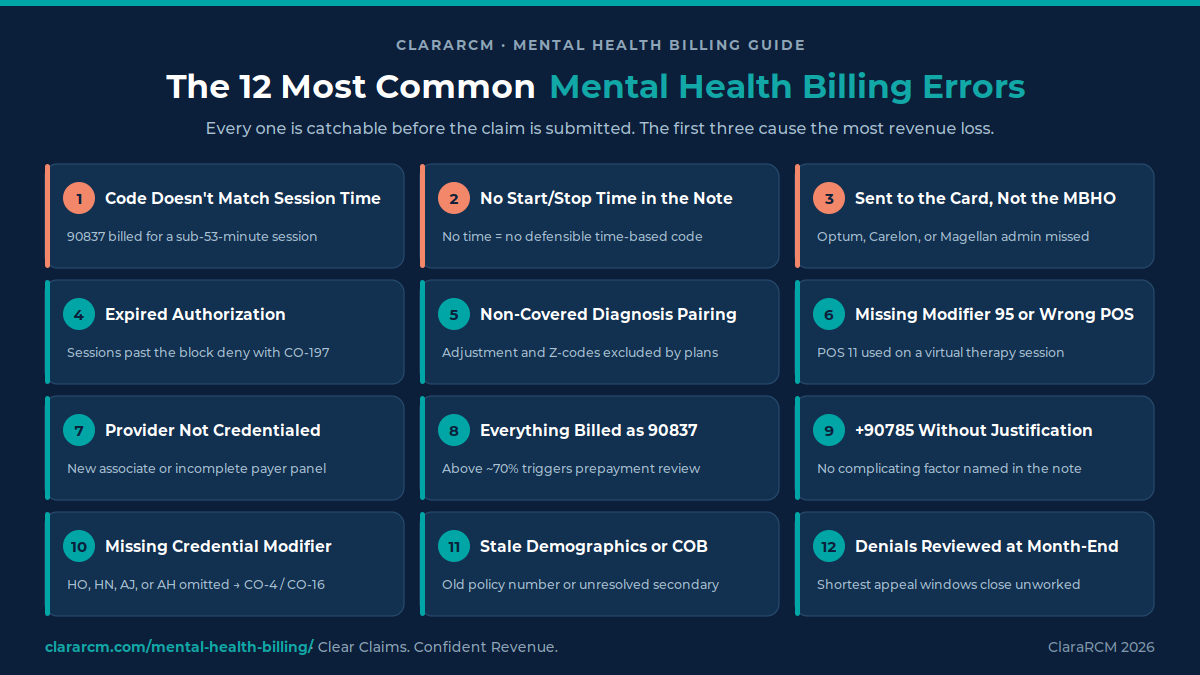
Code Does Not Match Documented Time
Billing 90837 for a 48-minute session or 90832 for a 40-minute session. Fix: select the code from the note's minute count after the session, never from the appointment slot.
No Start and Stop Time in the Note
Without documented time, no time-based code is defensible on audit. Fix: make start/stop time a required field in the note template so it cannot be signed without it.
Claim Sent to the Card, Not the Carve-Out
Behavioral health managed by Optum, Carelon, or Magellan while the card says UnitedHealthcare, Anthem, or Cigna. Fix: ask at every eligibility check who administers the behavioral health benefit.
Expired Authorization
Sessions delivered past the authorized block, denied CO-197. Fix: track expiration in the scheduler and set renewal alerts two weeks out.
Non-Covered Diagnosis Pairing
Adjustment disorders and Z-codes are excluded from psychotherapy coverage by some plans. Fix: verify the payer's covered diagnosis list before the second session.
Missing Telehealth Modifier or Wrong POS
Modifier 95 omitted, or POS 11 used on a virtual session. Fix: build modality into the note template so the modifier and POS are set at documentation, not at submission.
Rendering Provider Not Credentialed With That Payer
A new associate or a new panel that was never completed. Fix: confirm credentialing status per payer before scheduling the first session with a new clinician.
Defaulting Every Session to 90837
A 90837 rate above roughly 70% of individual sessions triggers automated prepayment review. Fix: bill the actual documented time and record clinical rationale for extended sessions.
Interactive Complexity Billed Without Justification
+90785 appended routinely without a documented complicating factor. Fix: use it only when the note names the specific complexity present.
Missing Credential Modifier
HO, HN, AJ, or AH omitted where the payer requires it, producing CO-4 or CO-16. Fix: maintain a payer-by-payer modifier matrix rather than a single practice-wide rule.
Stale Demographics and Coordination of Benefits
An old policy number, a changed plan, or an unresolved secondary payer. Fix: re-verify eligibility monthly for all active patients, not just at intake.
Denials Reviewed at Month-End
Appeal windows run 60 to 180 days; batching denials monthly forfeits the shortest ones. Fix: work denials within 10 business days of receipt, prioritized by dollar value and deadline.
ClaraRCM's denial management team categorizes every behavioral health denial by root cause and feeds those findings back into the pre-bill workflow, so a pattern gets fixed once rather than appealed repeatedly. Our AR follow-up service works denials inside the 10-day window to protect appeal rights.
The Mental Health Billing Checklist
Run this checklist before submitting any therapy claim. It is organized by when each item happens — before the session, at documentation, and before submission — because catching an error at intake costs nothing and catching it at the remittance advice costs six weeks.
Pre-Session Checklist
Complete before the patient's first appointment and re-verify monthly.
- Eligibility verified and plan confirmed active for the date of service
- Behavioral health administrator identified (health plan or carve-out MBHO)
- Correct payer ID and claims address recorded for that administrator
- Rendering provider confirmed in-network with that specific entity
- Copay, coinsurance, and remaining deductible captured
- Authorization requirement confirmed; auth number and expiration date recorded
- Covered diagnosis list checked for the plan
- Secondary insurance and coordination of benefits resolved
- Start and stop time or total face-to-face minutes recorded
- Modality documented (in person, audio-video, audio-only)
- Diagnosis addressed in the session and stated in the note
- Interventions and clinical content described
- Medical necessity and rationale for continued treatment supported
- Clinical rationale documented if billing 90837
- Complicating factor named if billing +90785
- Note signed with credentials and dated
- CPT code matches the documented minutes, band by band
- ICD-10 diagnosis is on the payer's covered list
- Telehealth modifier applied and matched to the place of service code
- Credential modifier applied where the payer requires one
- Modifier 59 or X-modifier applied where NCCI bundling would otherwise apply
- Authorization number present and unexpired for the date of service
- Rendering and billing NPI correct for the claim type
- Claim routed to the behavioral health administrator, not the medical plan
- Submitted within the payer's timely filing window
Use it as a template, not a poster. The checklist only works when it is embedded in the workflow — required fields in the note template, a mandatory auth field at check-in, a scrub rule at submission. A printed checklist taped near the desk is a reminder; a required field is a control.
Therapy Claim Denial Risk Checker
Answer 3 questions about your practice and we will identify the denial pattern most likely draining your revenue right now, plus the specific fix.
Q1: What type of mental health practice are you?
This determines which code set and credential rules apply to your claims.
Q2: What is your primary payer mix?
Payer type determines authorization thresholds and modifier requirements.
Q3: What is your biggest billing problem right now?
This identifies your highest-priority fix.
ClaraRCM will review your mental health billing setup and send a free personalized audit within 1 business day.
Your situation: —
Request received — thank you!
ClaraRCM has your billing details and will send you a free personalized audit within 1 business day.
Prefer to connect right away?
Book a 30-minute call nowInsurance Billing for Solo and Small Practices
Solo and small mental health practices face the same payer complexity as large groups with none of the administrative infrastructure, which is why the failure mode is almost always the same: billing gets done in the evening, denials get reviewed monthly, and appeal windows close quietly.
If you are billing insurance as a therapist without a dedicated biller, three decisions matter more than everything else combined.
1. Get credentialing right before you get billing right
A perfectly coded claim from an uncredentialed provider does not pay. Panels take 60 to 150 days depending on payer, and behavioral health carve-outs require separate applications from the parent health plan. Keep CAQH attested every 120 days — a lapsed attestation silently suspends enrollments. ClaraRCM's provider credentialing service handles applications, follow-up, and re-attestation.
2. Automate the two checks you will otherwise forget
Eligibility re-verification and authorization expiration. Both are calendar problems rather than knowledge problems, and both are responsible for denials that a clinician cannot fix retroactively. Whatever your EHR supports for alerts, turn it on.
3. Work denials weekly, not monthly
A denial worked in week one is usually a corrected claim. The same denial worked in week seven may be a formal appeal with clinical documentation, and past the filing window it is a write-off. A recurring weekly block for denial review is the single highest-return hour in a small practice's administrative week.
For a broader set of operational tactics aimed at small behavioral health practices, see our behavioral health billing tips for success.
When to Bring In a Billing Company
The decision point is not practice size — it is whether unbilled work, unworked denials, and aging AR are costing more than a billing service would. Five signals usually mean the math has already tipped.
- Denial rate above 8%. Behavioral health runs higher than general medicine, but a persistent double-digit denial rate signals a systemic workflow problem rather than isolated errors.
- AR beyond 60 days exceeding 20% of total AR. Aged behavioral health AR rarely recovers on its own, and each additional month reduces the recoverable share.
- Claims going out more than 5 days after the session. Submission lag compounds into cash flow strain and pushes claims toward filing deadlines.
- Clinical hours displaced by billing. Every hour spent on payer portals is an hour of billable clinical time not delivered — usually a worse trade than the billing fee.
- Adding clinicians or a new payer panel. Growth multiplies credentialing, modifier, and authorization complexity faster than most practices expect.
A specialized behavioral health biller differs from a generalist in specific, checkable ways: they know the carve-out administrators by name, they maintain payer-level modifier matrices, they track authorization expirations as a standing process, and they can explain how supervision and credential tiers change your rates. Our mental health and behavioral health billing service is built around exactly those workflows, and the free billing audit quantifies what your current process is leaving behind before you commit to anything.
More in the Mental Health & Behavioral Health Billing Cluster
Frequently Asked Questions About Mental Health Billing
What CPT code do I use for a 60-minute therapy session?
A 60-minute individual psychotherapy session is billed as CPT 90837, which covers 53 minutes or more of face-to-face time. The code is selected from the documented session time, not the scheduled appointment length — a session booked for 60 minutes that actually ran 50 documented minutes is 90834, not 90837. There is no additional unit or add-on code for time beyond 53 minutes in a single continuous session. Because 90837 carries the highest audit exposure in behavioral health, the note should include the start and stop time and the clinical rationale for the extended session format.
Do therapists need prior authorization for every session?
No. Most commercial plans authorize an initial block of sessions — commonly six, eight, or twelve — and require a renewal request only when that block is exhausted. Traditional Medicare does not require prior authorization for outpatient psychotherapy, though Medicare Advantage plans frequently do, and managed Medicaid plans vary by state. The practical risk is not the first authorization but the renewal: sessions delivered after an authorization expires deny with CO-197 and are difficult to authorize retroactively. Record the expiration date in the scheduling system and set a renewal alert two weeks before the last authorized session.
What is the most common mental health billing error?
The most common error is a mismatch between the CPT code billed and the session time documented in the note — most often 90837 billed for a session that ran under 53 minutes. The second most common is routing the claim to the health plan printed on the patient's card when the behavioral health benefit is administered by a separate carve-out such as Optum, Carelon, or Magellan, which produces denials that look like credentialing or network errors. The third is delivering sessions after an authorization has expired. All three are preventable before submission with an eligibility check, a documented minute count, and an authorization expiration alert.
How long does it take to get paid for a therapy claim?
A clean electronically submitted therapy claim typically pays within 14 to 30 days depending on the payer, with electronic remittance and EFT enrollment shortening the cycle. Paper claims and claims requiring manual review take longer. A denied claim that is corrected and resubmitted usually adds three to six weeks, and a claim requiring a formal appeal with clinical documentation can extend to 60 to 120 days. This is why the pre-submission checks matter more than the appeal process — the difference between a clean claim and a denied one is roughly a month of cash flow per claim.

Andleeb Asghar, PharmD
RCM Specialist & Founder, ClaraRCM
Andleeb Asghar is a PharmD, medical billing professional, and revenue cycle management specialist with 7+ years of experience across mental health and behavioral health billing, psychotherapy CPT coding, prior authorization management, denial management, and end-to-end RCM for U.S. therapy practices across all 50 states.
Last updated: August 1, 2026. ClaraRCM provides revenue cycle management and medical billing support services. This content is intended for educational purposes and does not constitute legal, clinical, or payer-contract advice. CPT code descriptors, HCPCS codes, modifier requirements, and payer policies are updated regularly. Verify current requirements with the AMA, CMS, and individual payers before applying to claims.