Behavioral Health Billing

Unlocking the Secrets of Behavioral Health Billing: Tips for Success

Behavioral health billing is the process of submitting mental health, substance use disorder, and applied behavior analysis (ABA) therapy claims to insurance payers for reimbursement — a process that is structurally more complex than general medical billing because it involves separate carve-out administrators, credential-tiered reimbursement rates, parity law protections, and specialty-specific documentation requirements. Practices that optimize their behavioral health billing workflows consistently achieve higher collection ratios, fewer denials, and shorter days in accounts receivable than those running mental health claims through a general medical billing process.

Published byClaraRCM Team
Medically reviewed byAndleeb Asghar, PharmD
Last updated
Reading time10 minutes

Behavioral health billing sits at the intersection of insurance complexity, clinical documentation requirements, and regulatory protections that simply don't apply to other specialties. A private practice psychiatrist, an outpatient LCSW, an ABA therapy clinic, and an intensive outpatient program all technically deliver mental health services — and all face completely different payer rules, prior authorization thresholds, and reimbursement structures. Getting it right requires understanding those differences, not applying a one-size-fits-all billing process. ClaraRCM serves 500+ providers across all 50 states, and behavioral health practices represent some of the highest-complexity billing we handle — and some of the largest revenue recoveries when previous processes had gaps.

For the full revenue cycle picture, this post is part of ClaraRCM's Behavioral Health Revenue Cycle Management Guide. For the specific carve-out routing issue that causes the most unexplained denials, see our post on behavioral health carve-out billing with Optum, Carelon, and Magellan.

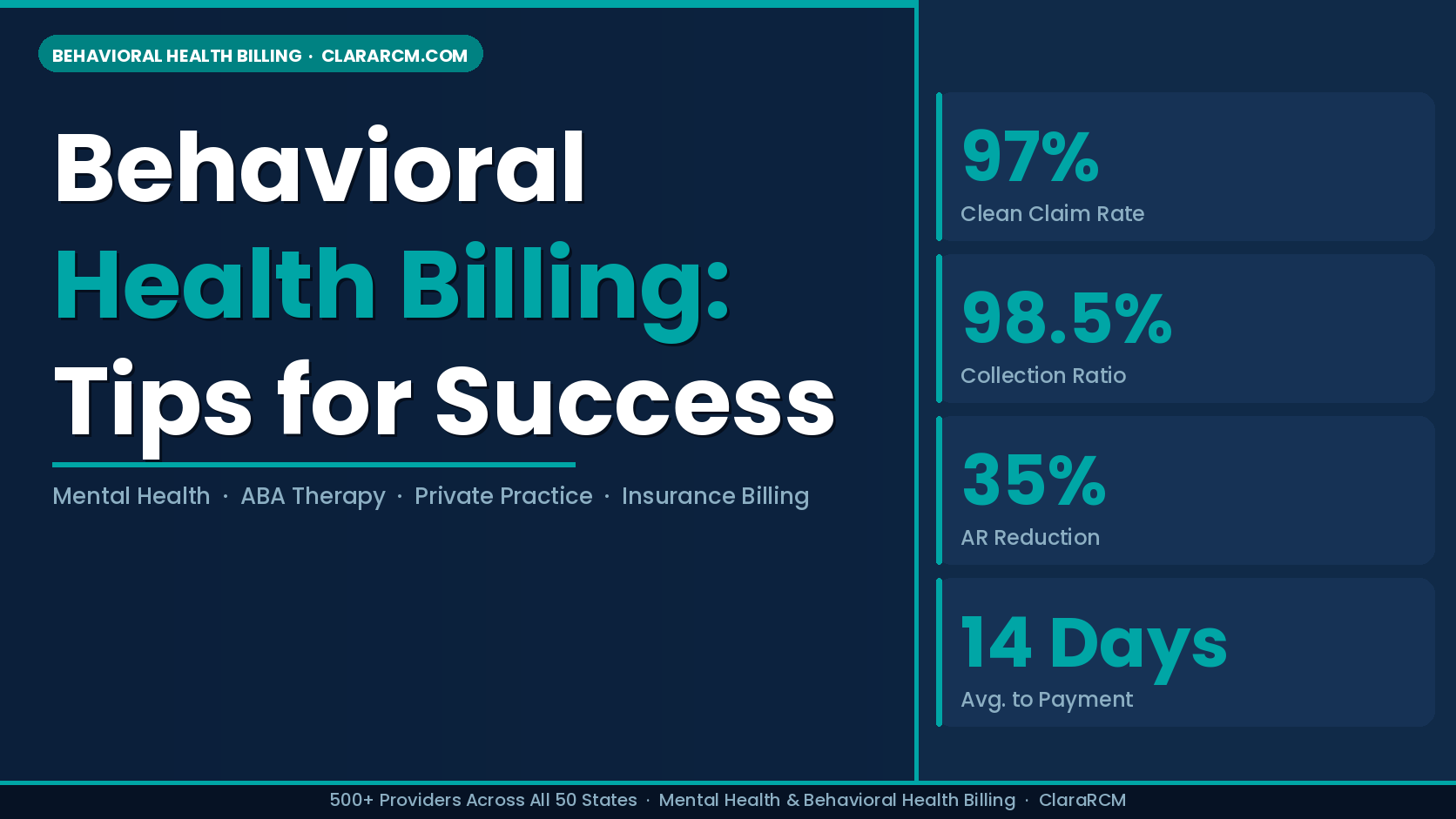
97% Clean claim rate across all behavioral health specialties
98.5% Collection ratio for mental health billing clients
35% Average AR reduction within 90 days of onboarding

Understanding Behavioral Health Billing

Behavioral health billing refers to the end-to-end process of translating clinical services — psychotherapy sessions, psychiatric evaluations, substance use disorder treatment, and ABA therapy — into insurance claims that payers accept, process, and reimburse at the correct rate. It is distinct from general medical billing in several structural ways that create the specialty's specific denial patterns and revenue risks.

Key Components of Behavioral Health Insurance Billing

Every behavioral health claim moves through the same pipeline, but each step has behavioral-health-specific requirements that differ from medical billing norms:

  • Eligibility and benefits verification — not just confirming coverage, but confirming whether behavioral health benefits are managed by a separate carve-out administrator (Optum, Carelon, or Magellan) rather than the plan shown on the member's card. Missing this step is the single most common source of behavioral health routing denials.
  • Prior authorization — required for most higher levels of care (IOP, PHP, residential) and for ongoing treatment beyond the initial sessions with many commercial payers. Authorization requirements vary dramatically by payer and plan.
  • CPT code selection — the psychotherapy time band codes (90832, 90834, 90837), psychiatric evaluation codes (90791, 90792), and add-on codes (90833, 90836, 90838) each have specific documentation requirements. See our guide on 90837 pre-payment review and audit response for the highest-risk code in this set.
  • Diagnosis coding — behavioral health claims require accurate ICD-10-CM diagnosis codes that match the documented clinical presentation. Incorrect diagnosis pairing is one of the top three denial drivers. See our full guide on psychotherapy diagnosis pairing denials.
  • Claims submission and routing — submitting to the correct payer entity (plan vs. MBHO carve-out) with the correct NPI, rendering provider credentials, and place of service code.
  • Payment posting and denial management — posting ERA/EOB payments accurately, identifying underpayments, and working denials before appeal windows close.

How Behavioral Health Billing Differs From General Medical Billing

Factor Behavioral Health Billing General Medical Billing
Payer routing May route to MBHO carve-out (Optum, Carelon, Magellan), not the health plan Routes to the health plan on the insurance card
Credentialing Requires separate credentialing with each MBHO carve-out administrator One credentialing process with the health plan
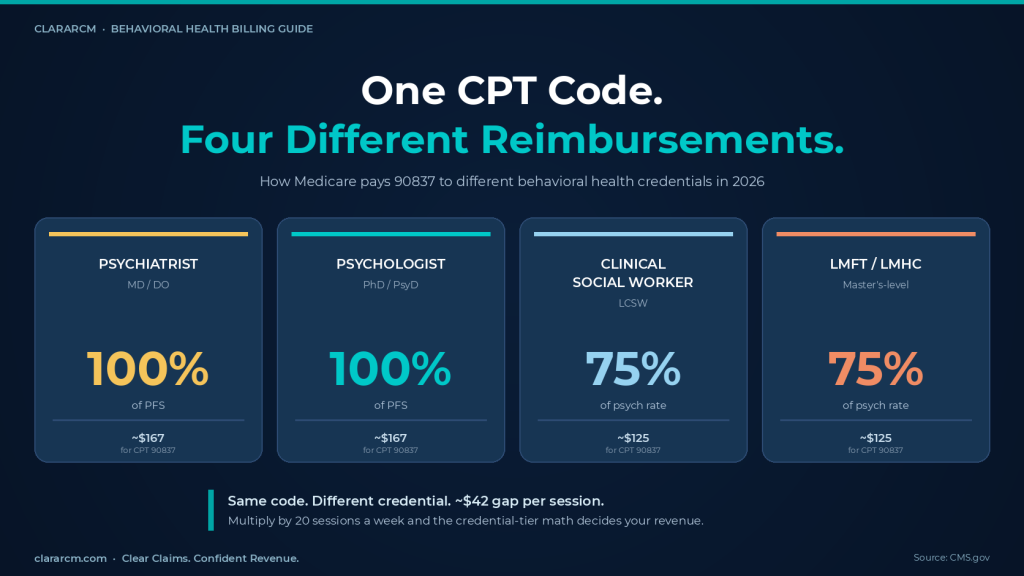
Rate tiers Reimbursement often tiered by provider credential (PhD/MD > MA/LPC) Rate typically tied to CPT code, not credential
Documentation burden Medical necessity required at session level; ongoing auth reviews common Medical necessity typically required at initial visit or procedure
Parity protections Subject to MHPAEA federal parity law — payers cannot apply stricter limitations than medical/surgical benefits Not subject to MHPAEA
Supervision rules Complex supervision billing requirements by credential and payer. See behavioral health supervision billing guide Supervision billing rules exist but are less complex

Mental Health Billing and ABA Therapy Billing

Mental health billing and ABA therapy billing are both subsets of behavioral health billing, but they use different code sets, different authorization structures, and different payer administrative systems that require distinct expertise. Practices that offer both service lines often need to maintain two separate billing workflows to avoid cross-coding errors.

behavioral health billing mental health ABA therapy billing companies ClaraRCM overview
Behavioral health billing spans mental health psychotherapy, psychiatric services, substance use disorder treatment, and ABA therapy — each with distinct code sets, payer rules, and authorization requirements. Source: ClaraRCM.com 2026.

Mental Health Billing

Mental health billing for outpatient therapy and psychiatric services primarily uses CPT codes in the 90800 series. The most frequently billed codes — 90832 (30 min), 90834 (45 min), 90837 (60 min) — are time-based and require documented start/stop times or total face-to-face minutes to support the units billed. Psychiatric evaluation codes 90791 (non-prescriber) and 90792 (prescriber) are intake codes, not ongoing session codes, and billing either repeatedly is a common denial trigger.

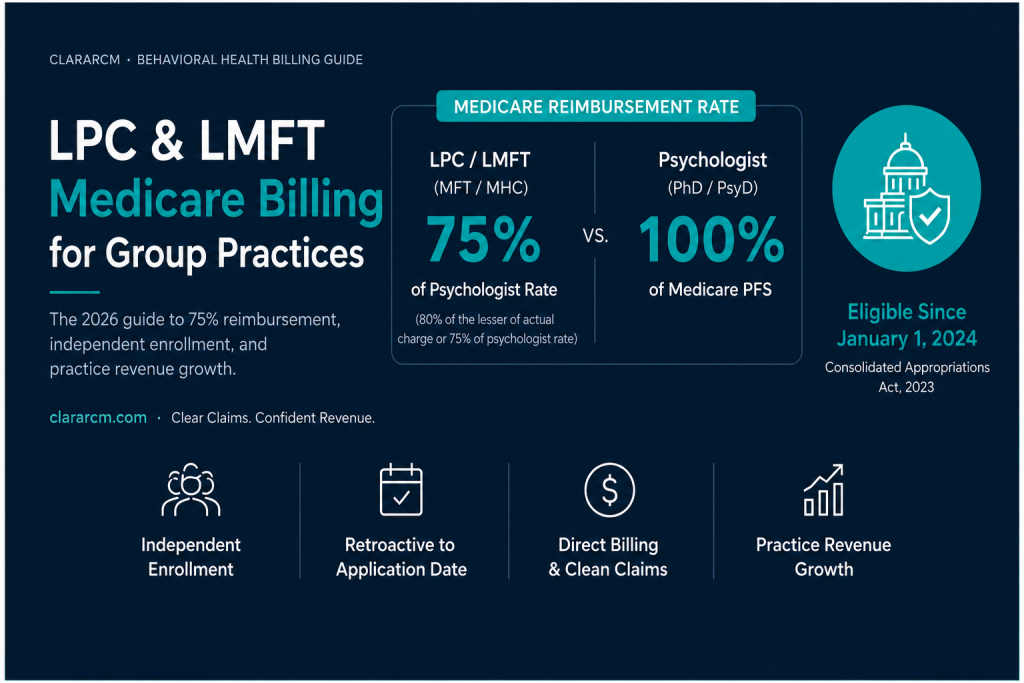
For LPC and LMFT providers billing Medicare specifically, the rules are significantly different from commercial insurance — see our detailed guide on LPC/LMFT Medicare billing for group practices. For practices with supervised clinicians, behavioral health supervision billing has its own credentialing and claim submission requirements by state and payer.

ABA Therapy Billing

ABA therapy billing uses an entirely separate CPT code set in the 97151–97158 range (and 0362T/0373T for group adaptive behavior treatment), with requirements that differ from psychotherapy billing in almost every respect. ABA services require a Behavior Analysis Treatment (BAT) authorization from most commercial payers, separately from any mental health authorization the family may already have. RBT services are billed under the supervising BCBA's NPI with modifier HQ in most cases. Medicaid ABA coverage varies significantly by state — both in covered codes and in the prior authorization and documentation requirements.

ABA billing tip: The 97151 assessment code (Behavior identification assessment) is one of the highest-audit codes in ABA. Documentation must reflect the actual assessment hours provided by the BCBA, not estimated hours. Payers routinely request records for 97151 to verify the time billed matches the assessment documentation in the treatment plan.

Code accuracy note (as of 2026): CPT codes for behavioral health and ABA services are updated annually by the AMA. All codes referenced in this guide reflect 2026 CPT descriptors. Verify current descriptors at ama-assn.org before applying to claims.

Private Practice Billing Services: The Outsourcing Case

Private practice billing services allow solo and group mental health practices to outsource their entire billing workflow — from eligibility verification and claim submission through denial management and payment posting — to a specialized behavioral health billing company, rather than managing it in-house. The case for outsourcing is strongest in behavioral health because the specialty's administrative complexity is disproportionate to the staff size of most private practices.

Benefits of Outsourcing Mental Health Billing

Efficiency

Faster Claim Turnaround

Specialized billing services for therapists submit claims daily or within 24 hours of the session, compared to weekly batch submission common in in-house billing. ClaraRCM averages 14 days from date of service to reimbursement for behavioral health clients.

Accuracy

Higher Clean Claim Rate

Behavioral health billing companies that specialize in mental health coding reach 97%+ clean claim rates by running pre-submission edits against MBHO-specific claim requirements — catching errors before the payer ever sees the claim.

Cost

Reduced Overhead

In-house billing requires staff, training, software, clearinghouse fees, and ongoing compliance oversight. Outsourced billing services for therapists convert those fixed costs to a variable fee tied to collections — typically 4–8% of net collections for behavioral health.

Compliance

Parity Law Protection

Specialized behavioral health billing companies track MHPAEA parity violations — when payers apply stricter prior auth or day limits to mental health than to comparable medical/surgical benefits. These are appealable violations that in-house billers rarely identify.

What to Look for When Selecting Billing Services for Therapists

Not all medical billing companies can handle behavioral health billing effectively. The specialty requires specific knowledge that general billers often lack:

  • MBHO carve-out credentialing experience — the company should be able to credential your providers with Optum, Carelon, and Magellan as a standard service, not an add-on.
  • Mental health CPT code expertise — including the time-band codes (90832/90834/90837), add-ons (90833/90836/90838), and evaluation codes (90791/90792).
  • Insurance paneling for therapists — the credentialing component that gets your providers into insurance networks. This is a prerequisite for billing, and companies that don't manage it force you to manage it separately. ClaraRCM's provider credentialing services handle paneling with all major commercial payers and Medicaid programs.
  • Denial management for behavioral health-specific denial codes — including CO-96 (non-covered), CO-50 (medical necessity), and CO-197 (prior authorization). See our denial management services page for how ClaraRCM approaches this.
  • Transparent reporting — weekly or monthly AR aging reports, denial rate tracking by payer, and collection ratio reporting specific to your practice.

Common Challenges in Mental Health Insurance Billing

The most common challenges in mental health insurance billing are carve-out routing errors, medical necessity denials, prior authorization gaps, diagnosis code mismatches, and credentialing delays — and each has a distinct cause and fix. Understanding which challenge is driving your denial volume tells you exactly where to intervene first.

behavioral health billing insurance routing denial management mental health billing companies
Behavioral health claims routing errors — submitting to the health plan instead of the MBHO carve-out administrator — generate automatic denials even for credentialed, in-network providers. Source: ClaraRCM.com 2026.
Denial Management

Carve-Out Routing Denials

Submitting behavioral health claims to the health plan named on the member's card instead of to the MBHO carve-out administrator generates automatic "provider not in network" or "not a covered service" denials, even for credentialed in-network providers. Fix: confirm carve-out status at eligibility verification for every patient.

Denial Management

Medical Necessity Denials

Payers increasingly use automated clinical review tools to evaluate whether session documentation supports the billed level of care. Vague or templated therapy notes are the most common trigger. The fix is progress note specificity — documenting functional impairment, treatment response, and ongoing medical necessity at every session.

Claims Rejection

Prior Authorization Gaps

Authorization obtained for an initial set of sessions expires without renewal, or a new clinician begins treating the patient without a new auth in their name. Both generate CO-197 denials. Fix: implement an auth expiration tracking system with 2-week advance alerts.

Claims Rejection

Diagnosis Code Mismatches

The ICD-10 code on the claim doesn't match the diagnosis in the clinical record, or an unspecified code is used where a more specific code is required by the payer's LCD. This is one of the most preventable denials in behavioral health. See our full guide on psychotherapy diagnosis pairing denials.

Revenue Loss

Credentialing Delays

A new therapist sees patients before credentialing is complete, generating 60–120 days of uncollectable or self-pay-only claims. MBHO credentialing timelines are non-negotiable — but they can be managed. Starting the process at hire date, not after orientation, eliminates most of the revenue gap.

Revenue Loss

Timely Filing Failures

Behavioral health practices with high patient volumes and thin administrative staff frequently miss timely filing windows on secondary payers or on resubmissions after denials. Medicare's window is 12 months from date of service; commercial payers commonly allow 90–180 days. Track resubmission deadlines separately from original submission dates.

Denial Management in Behavioral Health Billing

Effective denial management for behavioral health billing requires tracking denials by root cause, not just by code. A CO-16 denial (missing information) requires a different fix than a CO-50 denial (medical necessity) or a CO-197 denial (prior authorization). ClaraRCM's denial management team categorizes every denial by root cause on receipt, routes it to the correct specialist, and works it within the timely filing window — not at end-of-month cleanup.

Best Practices for Effective Behavioral Health Billing

The practices that consistently achieve 97%+ clean claim rates in behavioral health billing share five operational habits: they verify carve-out status at intake, they credential at hire (not at start date), they track authorizations proactively, they document medical necessity at every session, and they work denials within the first 10 business days of receipt.

  1. Verify behavioral health carve-out status at every intake Ask explicitly: "Is behavioral health managed by a separate administrator?" Record the MBHO name, payer ID, and behavioral health phone number separately from the medical benefits. Submit claims to the MBHO, not the health plan. ClaraRCM's eligibility and benefits verification service confirms carve-out status on every new patient before the first session.
  2. Start MBHO credentialing applications at hire Optum credentialing takes 60–90 days. Carelon takes 60–120 days. Every week of delay is a week of uncollectable sessions. Initiate CAQH ProView updates and MBHO applications the day the offer letter is signed, not the day the clinician starts seeing patients.
  3. Track authorizations with 2-week advance alerts Set authorization expiration reminders 14 days before the last authorized session. Request extensions before the current auth expires — retroactive authorizations are harder to obtain and some payers don't grant them at all. This single workflow change eliminates the majority of CO-197 denials in behavioral health billing.
  4. Document medical necessity at every session, not just the initial evaluation Each session note must document the patient's current functional impairment, the treatment intervention used, and the clinical rationale for continued treatment at this level of care. Generic notes that copy from session to session are the most common trigger for medical necessity audits and concurrent review denials.
  5. Work denials within 10 business days Most behavioral health payers allow 60–180 days to appeal a denial. Waiting until month-end to review denials leaves the practice chronically at risk of missing appeal windows on earlier denials. A daily denial review workflow catches routing errors while resubmission is still straightforward.

The Role of Behavioral Health Billing Companies

Behavioral health billing companies are third-party revenue cycle management organizations that specialize in mental health, substance use disorder, and ABA therapy claims — handling credentialing, claim submission, denial management, payment posting, and AR follow-up on behalf of practices that either lack in-house billing capacity or are looking to improve collection performance.

What Sets a Specialized Behavioral Health Billing Company Apart

The key differentiator between a general medical billing company and a specialized behavioral health billing company is the operational depth in three areas:

  • MBHO carve-out knowledge — understanding which health plans carve out to which administrator, and having existing payer relationships and credentialing processes for each. ClaraRCM maintains active credentialing relationships with Optum, Carelon, and Magellan, along with state Medicaid behavioral health carve-outs across all 50 states.
  • Behavioral health CPT code expertise — the ability to select the correct time-band psychotherapy code based on documented session minutes, apply the correct add-on codes (90833/90836/90838) for medication management add-ons, and avoid the common diagnosis-pairing errors that generate CO-4 and CO-96 denials.
  • Parity law compliance awareness — identifying when a payer's prior authorization requirement or session limit violates MHPAEA federal parity protections, and assisting practices in filing parity appeals when the commercial plan's behavioral health restrictions exceed its comparable medical/surgical benefit restrictions.

Overview of Behavioral Health Billing Solutions

Behavioral health billing solutions range from full-service RCM outsourcing (ClaraRCM's model) to billing software platforms that practices use to manage claims in-house. The right choice depends on practice size, administrative capacity, and collection goals:

Solution type Best for Key advantage Key limitation
Full-service RCM (ClaraRCM) Solo to mid-size group practices (1–50 clinicians) Complete coverage: credentialing, billing, denials, AR, reporting Monthly percentage fee tied to collections
Billing-only outsourcing Practices with in-house credentialing already in place Lower fee if credentialing handled separately Credentialing gaps still fall on the practice
Practice management software Larger groups with dedicated in-house billing staff Full control; lower long-term cost at scale Requires trained staff; no built-in denial management expertise
Hybrid model Groups that want to retain intake/posting in-house Flexibility; keep patient-facing billing in-house Coordination complexity between in-house and outsourced workflows

For a practice evaluating behavioral health billing solutions, the starting point is always a billing audit — understanding where your current denial rate, clean claim rate, and days-in-AR stand before committing to any solution. ClaraRCM offers a free billing audit that benchmarks your current performance and identifies the highest-impact gaps. For practices already using an outsourced solution and looking to negotiate better payer rates, see our guide to negotiating behavioral health fee schedules.

Frequently Asked Questions About Behavioral Health Billing

What is behavioral health billing?

Behavioral health billing is the process of submitting mental health, substance use disorder, and ABA therapy claims to insurance payers and collecting reimbursement on behalf of licensed mental health providers. It differs from general medical billing because behavioral health benefits are frequently managed by separate carve-out administrators (Optum, Carelon, Magellan), require credential-tiered fee schedules, and are subject to federal MHPAEA parity protections that don't apply to medical claims.

How do behavioral health billing companies get paid?

Most behavioral health billing companies charge a percentage of net collections — typically 4–8% for outpatient mental health practices, with some variation based on practice size and service complexity. Some companies charge a flat monthly fee instead, which is more common for larger groups with high claim volume. ClaraRCM uses a percentage-of-collections model, which aligns the billing company's incentive with the practice's: the company only earns more when the practice collects more.

What CPT codes are used for mental health billing?

The most commonly billed mental health CPT codes are the psychotherapy time-band codes: 90832 (30 minutes), 90834 (45 minutes), and 90837 (60 minutes) for individual therapy. Psychiatric diagnostic evaluations use 90791 (non-prescriber) or 90792 (prescriber with medical services). Add-on codes 90833, 90836, and 90838 bill psychotherapy combined with an E/M visit for psychiatrists. All time-based codes require documented start/stop times or total face-to-face minutes in the session note.

What is insurance paneling for therapists?

Insurance paneling for therapists is the process of applying to become an in-network provider with an insurance plan, which involves submitting credentialing documents (license, malpractice, NPI, CAQH attestation), passing the payer's credentialing review, and signing a provider agreement that sets the reimbursement rates for your credential level. Paneling must be completed separately with each health plan and, for behavioral health, separately with each MBHO carve-out administrator. ClaraRCM's provider credentialing services manage paneling across all payers and MBHOs simultaneously, tracking timelines independently to minimize the revenue gap before a new clinician can bill insurance.

Why do mental health billing claims get denied more than medical claims?

Mental health billing denials are higher than general medical for several structural reasons: claims frequently go to the wrong entity (health plan instead of MBHO carve-out), authorization is required more frequently and expires more quickly, medical necessity documentation standards are higher, and providers are often unsure of the correct CPT code for a given session length. Research consistently shows that behavioral health claims face denial rates of 10–15% compared to 5–7% for general medical claims at practices without specialized billing. ClaraRCM's behavioral health billing process reduces denial rates to under 3% by catching routing errors at eligibility verification and applying pre-submission claim edits specific to each MBHO's requirements.

Can a therapist bill Medicare directly?

Yes, but with restrictions based on credential type. Licensed Clinical Social Workers (LCSWs) and licensed clinical psychologists can bill Medicare directly for outpatient mental health services under their own NPI. LPCs and LMFTs gained Medicare billing privileges in January 2024 under the Consolidated Appropriations Act, though Medicare reimburses them at 75% of the psychologist rate rather than the full amount. Marriage and Family Therapists (MFTs) are also included in this expansion. For the detailed rules on how group practices should bill Medicare with LPC and LMFT providers, see ClaraRCM's guide to LPC/LMFT Medicare billing for group practices.

More in the Behavioral Health Billing Cluster

Andleeb Asghar PharmD behavioral health billing specialist ClaraRCM
Medically Reviewed By

Andleeb Asghar, PharmD

RCM Specialist & Founder, ClaraRCM

Andleeb Asghar is a PharmD, medical billing professional, and revenue cycle management specialist with 7+ years of experience across behavioral health billing, MBHO credentialing, denial management, ABA therapy billing, and end-to-end RCM for U.S. mental health practices and group therapy clinics.

Last updated: July 22, 2026. ClaraRCM provides revenue cycle management and medical billing support services. This content is intended for educational purposes and does not constitute legal, clinical, or payer-contract advice. CPT code descriptors and payer policies are updated regularly; verify current requirements with the AMA and individual payers before applying to claims.

Scroll to Top