
How Long Does Prior Authorization Take? 2026 Timelines by Payer
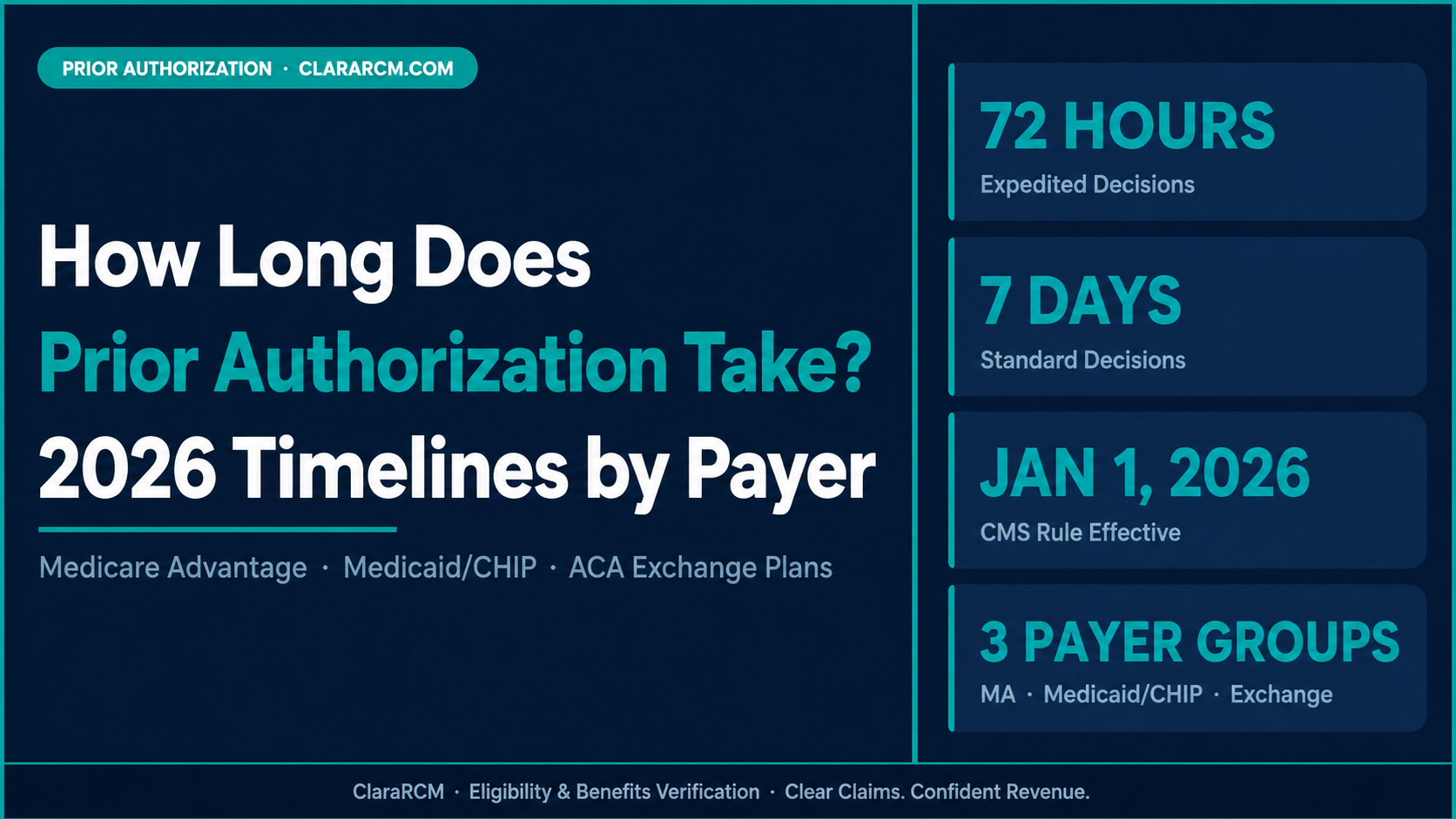
As of January 1, 2026, most impacted payers must decide standard prior authorization requests within 7 calendar days and expedited requests within 72 hours, under CMS's Interoperability and Prior Authorization Final Rule (CMS-0057-F) — down from timelines that ran as long as 14 days before. This rule applies to Medicare Advantage, Medicaid and CHIP (fee-for-service and managed care), and ACA exchange plans. It does not apply to drug or pharmacy benefit prior authorizations, or to traditional Medicare fee-for-service, which have separate timelines covered below.
Prior authorization timelines are one of the most anxiety-driving questions in healthcare billing — patients waiting on treatment, practices waiting on revenue. The rules changed meaningfully in 2026, and much of what's published online still reflects the old, slower timelines. This guide covers the current federal floor, how Medicare, Medicaid, and commercial timelines differ, how to request expedited review, and what to do when an authorization runs past its expected window. ClaraRCM's eligibility and benefits verification team tracks authorization status across every payer type so practices aren't discovering an expired or overdue authorization at the denial stage.
The Short Answer
Most prior authorization requests are decided within 24–72 hours if expedited, or 5–15 business days if standard — but the exact window depends entirely on the payer type, and the rules tightened significantly for many payers starting January 1, 2026. The single biggest factor in how long your specific request takes is which of three payer categories it falls under: Medicare, Medicaid, or commercial insurance — each covered in detail below.
Service Authorization vs. Medication Authorization
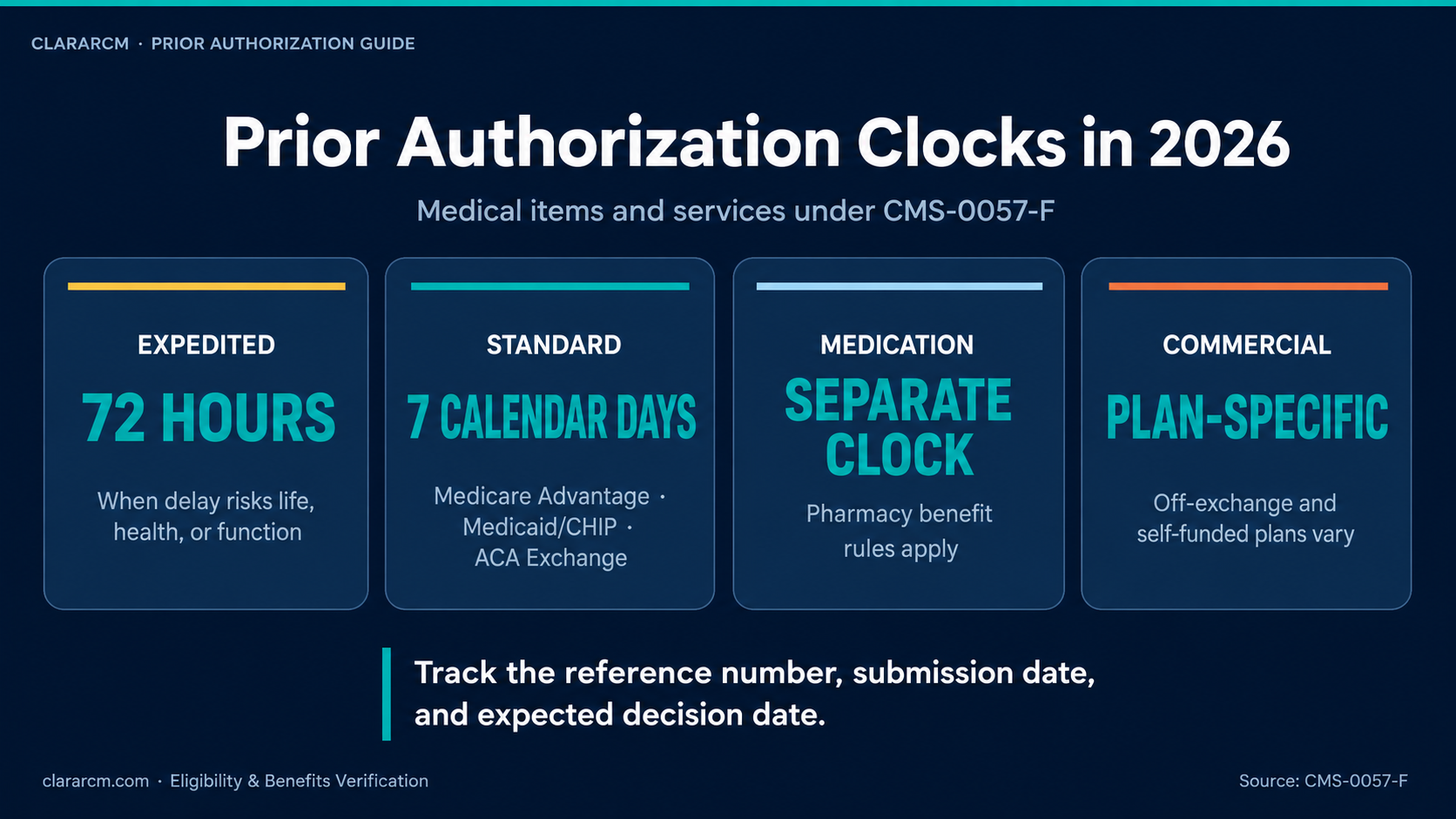
A prior authorization for a medical service and a prior authorization for a medication run on different clocks, reviewed by different teams within the same payer — this is the single biggest source of confusion in prior authorization timing. CMS-0057-F's 72-hour/7-day timelines apply to authorizations for medical items and services. They do not apply to drug prior authorizations processed under the pharmacy benefit, which follow separate state and payer-specific rules and can move faster or slower depending on the drug and the plan.
Practical distinction: a request for an MRI, a surgery, or a durable medical equipment item is a service authorization. A request to cover a specific prescription drug — especially through Medicare Part D or a commercial pharmacy benefit manager — is a medication authorization. If you're tracking both for the same patient, expect two separate timelines and two separate points of contact.
Medicare Timelines
Medicare Advantage plans must now decide standard requests within 7 calendar days and expedited requests within 72 hours under CMS-0057-F, while traditional Medicare fee-for-service generally does not require prior authorization for most outpatient services. This is a meaningful split: Medicare Advantage (Part C) is directly bound by the new federal timelines; original Medicare's prior authorization requirements are narrower and apply mainly to specific service categories CMS designates, such as certain DME items and select outpatient procedures.
Medicaid Timelines (Varies by State)
Medicaid fee-for-service and Medicaid managed care plans are both now subject to the same federal 7-day standard / 72-hour expedited timeline under CMS-0057-F, though individual states may layer additional requirements on top. Before this rule, standard Medicaid authorization timelines in many states ran up to 14 days. Because states administer Medicaid independently, always confirm the specific state program's current timeline and submission requirements — the federal rule sets the outer limit, not necessarily the state's actual practice.
Commercial Payer Timelines
CMS-0057-F does not directly regulate fully-insured commercial employer plans outside the ACA exchange, so commercial prior authorization timelines vary more by individual payer policy than by federal mandate. ACA exchange (Qualified Health Plan) issuers on the federally facilitated exchanges are covered by the new rule. Off-exchange commercial and self-funded employer plans typically publish their own timelines in provider manuals — commonly in the same 5–15 business day range for standard requests and 24–72 hours for urgent requests, but always confirm against the specific payer's current policy rather than assuming.
Requesting Expedited Review
Expedited (urgent) review is available when following the standard timeline could seriously jeopardize the patient's life, health, or ability to regain maximum function — not simply because a service is time-sensitive from a scheduling standpoint. To request expedited review, the submission typically needs explicit clinical justification for urgency, not just a checkbox marked "urgent." A request marked urgent without supporting clinical documentation is frequently downgraded to standard processing by the payer's utilization review team.
What supports an expedited request: documented acute symptoms, risk of clinical deterioration if treatment is delayed, or a diagnosis where delay itself carries direct clinical risk. Vague language like "patient wants this soon" does not meet the standard.
What Delays an Authorization
Incomplete clinical documentation
The single most common delay. Missing chart notes, missing supporting diagnosis, or missing prior treatment history restarts the review clock in many payer systems.
Wrong submission channel
Faxing a request to a portal-only payer, or vice versa, can add days before the request is even logged as received.
Missing or mismatched NPI
An NPI that doesn't match the credentialed provider on file for that specific service generates a hold, not a denial — but the hold still consumes time.
Requesting the wrong authorization type
Submitting a service authorization request through a pharmacy benefit channel (or vice versa) sends the request into the wrong review queue entirely.
ClaraRCM's eligibility and benefits verification workflow checks documentation completeness and submission channel before a request goes out, specifically to prevent these avoidable delays.
Tracking an Authorization in Progress
Most payers assign a reference or authorization tracking number at submission — recording this number, the submission date, and the expected decision date in the patient record is the single most effective habit for catching an overdue authorization before it becomes a denial. Practices that track authorization status only at the point of service, rather than proactively, routinely discover an expired or still-pending authorization on the day of the scheduled service.
What to Do If You're Past the Expected Timeline
If a standard request has run past 7 calendar days or an urgent request past 72 hours without a decision, contact the payer's utilization management department directly and request a status update with the reference number — payers are increasingly accountable to public reporting on these metrics under CMS-0057-F, which gives practices real leverage in these calls. If the delay is affecting patient care, ask specifically whether the request can now be escalated to expedited review given the added delay. For claims that proceed and are later denied for authorization-related reasons despite a documented on-time submission, our denial management team handles the appeal process.
Behavioral health note: authorization mechanics for psychiatric medication management and for IOP/PHP levels of care carry additional behavioral-health-specific rules beyond the general timelines in this guide — see our behavioral health billing cluster for that detail once published.
Is Your Authorization Overdue?
Answer 2 quick questions and we'll tell you whether your authorization has exceeded the federal timeline — and what to do next.
Q1: What type of authorization is this?
Q2: How many days since you submitted it?
ClaraRCM will review your authorization status and follow up within 1 business day.
Request received
A ClaraRCM specialist will follow up within 1 business day.
Frequently Asked Questions
How long does prior authorization take for medication?
Medication (pharmacy benefit) prior authorizations run on separate timelines from medical service authorizations and are not covered by CMS-0057-F's 72-hour/7-day service timelines. Typical medication PA turnaround ranges from 24–72 hours for urgent requests to several business days for standard requests, but always confirm with the specific plan's pharmacy benefit manager.
What's an expedited prior authorization?
An expedited (urgent) prior authorization is a faster review track available when following the standard timeline could seriously jeopardize the patient's life, health, or function. It requires clinical documentation supporting urgency, not just a request marked "urgent." Under CMS-0057-F, impacted payers must decide expedited requests within 72 hours.
Can I appeal a slow prior authorization?
You can request status escalation and, if a payer is subject to CMS-0057-F, cite the federal timeline requirement directly. If a claim is later denied for authorization-related reasons despite a timely, complete submission, that denial can be appealed through the payer's standard appeals process.
Does Medicare require prior authorization?
Medicare Advantage plans require prior authorization for many services and are now bound by the 72-hour/7-day CMS-0057-F timelines. Traditional Medicare fee-for-service generally does not require prior authorization for most outpatient services, though it does for a narrower, CMS-designated list of specific items and procedures.

Andleeb Asghar, Licensed Pharmacist
RCM Specialist & Founder, ClaraRCM
Andleeb Asghar is a licensed Pharmacist, medical billing professional, and revenue cycle management specialist with 7+ years of experience across eligibility and benefits verification, prior authorization, denial management, and end-to-end RCM for U.S. healthcare practices across all specialties.
Last updated: August 7, 2026. ClaraRCM provides revenue cycle and medical billing support. This content is for educational purposes and is not legal or payer-contract advice. Prior authorization timelines vary by payer and are updated regularly. Verify current requirements with CMS and individual payers.