
ICD-10 Pain Codes for Orthopedic Billing: The Complete Reference
"Pain" alone is never a billable ICD-10 diagnosis — G89, the pain category header, requires a fourth character specifying acute, chronic, post-surgical, or site-related pain before a payer will accept it. The most commonly billed codes are G89.11 (acute pain due to trauma), G89.29 (other chronic pain), and G89.4 (chronic pain syndrome), each with different documentation requirements and different denial risks. This guide covers the full G89 series, when the generic R52 code is and isn't appropriate, and the site-specific coding orthopedic practices need that generalist billing guides skip entirely.
Pain coding sits underneath nearly every orthopedic visit, but it's rarely the primary reason a claim was denied — it's the reason a claim was downcoded, delayed, or flagged for review. Payers increasingly reject unspecified pain codes on claims where a more specific option was clearly available in the documentation. ClaraRCM's orthopedic billing team built this guide as the single reference for every G89 code an orthopedic practice needs, when to use the generic R52 fallback instead, and the four denial patterns that account for most pain-coding rejections.
Why "Pain" Alone Is Never a Billable Diagnosis
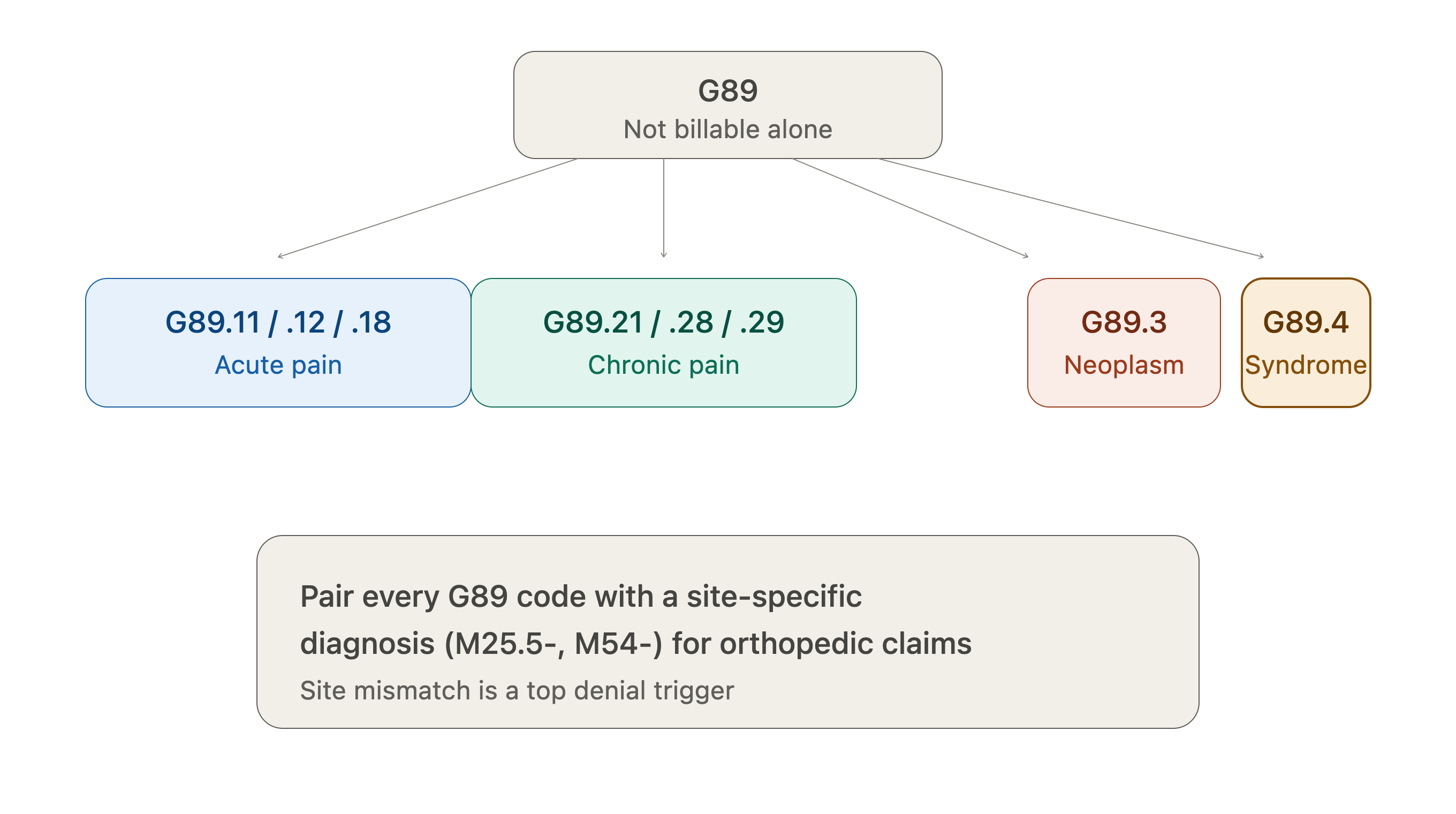
G89 — "pain, not elsewhere classified" — is a non-billable header code. Every payer requires a fourth character specifying the type of pain before a claim will process. This is the single most common source of avoidable pain-coding denials: a coder selects G89 from an EHR dropdown without drilling into the specific subcategory, and the claim rejects for an invalid or non-specific diagnosis.
ICD-10-CM coding guidelines are explicit here: when pain management or pain control is the primary reason for the encounter, the G89 code is sequenced first, followed by the site-specific code for the underlying condition. When the encounter is for the underlying condition itself and pain is incidental, the site-specific code goes first and the G89 code — if used at all — is secondary.
The G89 Series Explained
The G89 category splits into acute pain (G89.1x), chronic pain (G89.2x), neoplasm-related pain (G89.3), and chronic pain syndrome (G89.4) — each requiring the correct subcategory rather than the parent header. For a live, searchable code lookup beyond this reference table, ICD10Data.com's G89 category page is the industry-standard practical tool most coders already use.
| Code | Description | Category |
|---|---|---|
| G89.0 | Central pain syndrome | Neurological pain |
| G89.11 | Acute pain due to trauma | Acute |
| G89.12 | Acute post-thoracotomy pain | Acute, post-surgical |
| G89.18 | Other acute postprocedural pain | Acute, post-surgical |
| G89.21 | Chronic pain due to trauma | Chronic |
| G89.22 | Chronic post-thoracotomy pain | Chronic, post-surgical |
| G89.28 | Other chronic postprocedural pain | Chronic, post-surgical |
| G89.29 | Other chronic pain | Chronic |
| G89.3 | Neoplasm related pain (acute or chronic) | Cancer-related |
| G89.4 | Chronic pain syndrome | Chronic, behavioral component |
Acute Pain Codes by Cause
Acute pain codes require identifying the cause — trauma, post-thoracotomy, or another post-procedural source — not just the fact that the pain is acute.
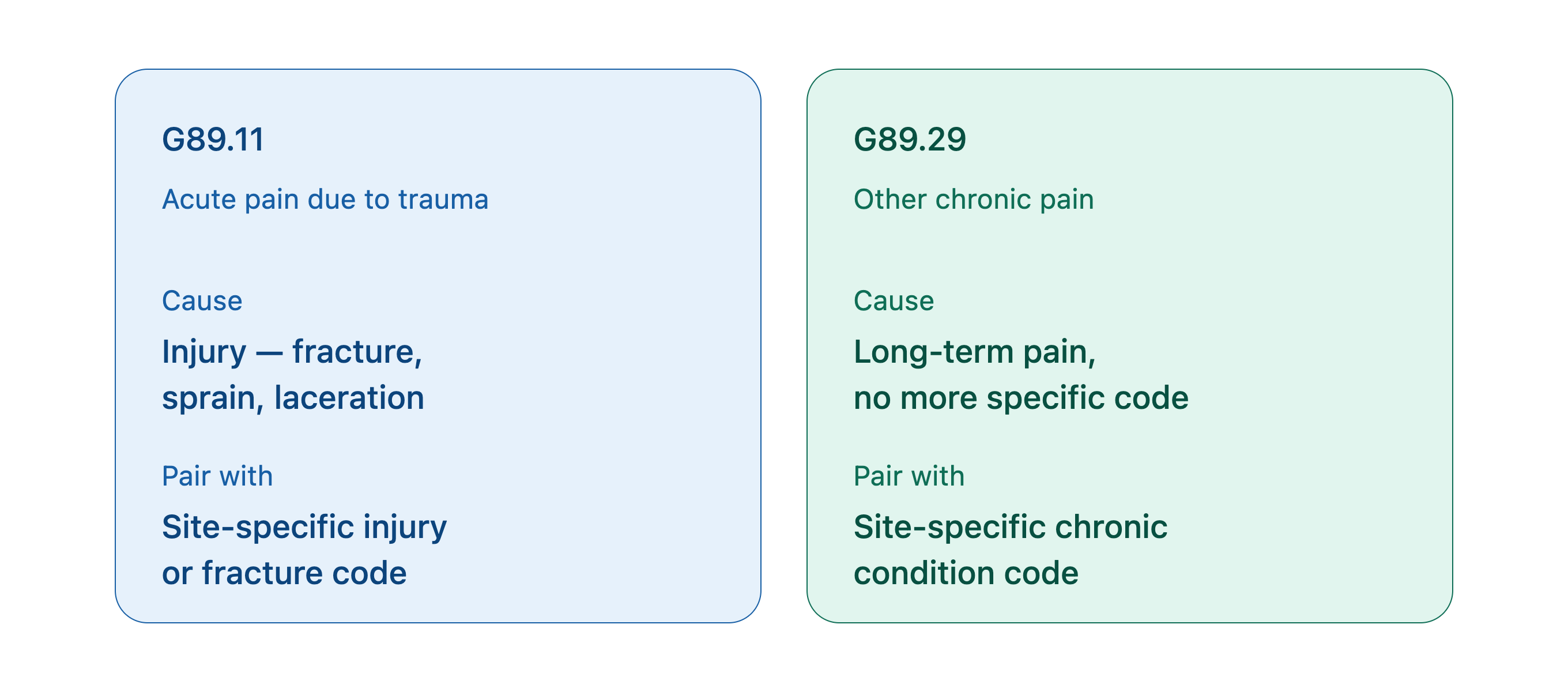
- G89.11 — Acute pain due to trauma. The code orthopedic practices use most: fracture, sprain, laceration, or other injury-related acute pain, typically sequenced after or alongside the specific injury code (e.g., an M-series fracture or sprain code).
- G89.12 — Acute post-thoracotomy pain. Chest-surgery-specific; rarely applies in a pure orthopedic setting.
- G89.18 — Other acute postprocedural pain. This is the code for acute pain following an orthopedic surgical procedure that isn't a thoracotomy — post-arthroscopy pain, post-joint-replacement pain in the immediate recovery window, and similar.
Sequencing rule: when the encounter is specifically for pain management following an injury or surgery, the G89 acute pain code is sequenced first. When the encounter is a routine post-op follow-up and pain is simply part of the note, the procedure or injury code leads and G89.18 or G89.11 is secondary, if used at all.
Site-Specific Pain Codes for Orthopedics
Where the pain is located should almost always be coded through the site-specific M-series or musculoskeletal code, not through a generic G89 or R52 code alone — G89 describes the pain type, not the anatomical site. This is the layer generalist billing content consistently skips, and it's where orthopedic practices lose the most avoidable revenue.
For most orthopedic encounters, the correct structure pairs a G89 pain-type code with a site-specific musculoskeletal diagnosis — for example, joint pain uses the M25.5- series (coded to the specific joint: shoulder, elbow, wrist, hip, knee, ankle), and back pain uses the M54 series. Coding only to "acute pain" without the joint or region-specific code is one of the most common orthopedic denial patterns, because it fails to establish medical necessity for a joint-specific procedure or imaging order.
The mismatch denial: a claim for a knee injection or knee X-ray paired with an unspecified or wrong-site pain code (for example, a shoulder-region code on a knee claim) generates an automatic medical necessity denial. The pain diagnosis and the treated site must match exactly.
Unspecified Pain Codes: When R52 Is (and Isn't) Appropriate
R52 — "pain, unspecified" — is the correct fallback only when documentation identifies pain but does not identify a site, cause, or specific pain type; it is not a substitute for site-specific orthopedic coding when that detail exists in the chart. R52 belongs to a different ICD-10 chapter than G89 (symptoms and signs, not the nervous system chapter) and payers treat it as a lower-specificity, higher-scrutiny code.
If the clinical note documents "knee pain following a fall," coding that encounter as R52 instead of G89.11 plus the site-specific knee code is a specificity downgrade that increases denial risk — the documentation supported a more specific code and it wasn't used.
Chronic Pain Syndrome (G89.4) vs. Chronic Pain (G89.29)
G89.29 describes chronic pain itself; G89.4 describes chronic pain syndrome, which specifically includes a documented behavioral or psychological component affecting function — the two are not interchangeable. G89.29 is the more commonly assigned code and applies whenever the provider documents chronic pain without a more specific chronic-pain diagnosis available elsewhere in the code set. G89.4 requires the chart to support that pain is affecting the patient's behavior or psychological state in a clinically documented way, not simply that the pain has lasted a long time.
Using G89.4 without that supporting documentation is a common audit trigger, since it implies a level of clinical complexity the note doesn't establish.
Pain Management Coding
When pain management is the reason for the visit — an injection, a referral, or medication management specifically for pain control — the G89 code is typically sequenced first, ahead of the underlying musculoskeletal diagnosis. This reverses the usual sequencing rule and is one of the more frequently missed distinctions in orthopedic coding: the same patient, same underlying diagnosis, gets coded differently depending on whether the visit's purpose is treating the underlying condition or managing the pain itself.
For practices referring patients out for pain-management-specific treatment or ongoing physical therapy, see our guide to physical therapy billing for how PT referral documentation should connect back to the originating pain diagnosis.
Common Denial Triggers in Pain Coding
Four patterns account for the majority of avoidable pain-coding denials in orthopedic billing.
Unspecified code where specific exists
Billing G89 alone, or R52, when the chart documents a clear cause and site. Fix: always drill to the fourth-character G89 subcode plus the site-specific M-series code.
Pain code without a supporting diagnosis
A pain code billed with no underlying condition or injury code to support it reads as incomplete to a payer's medical necessity review. Fix: pair every pain code with its site-specific diagnosis.
Site mismatch
Pain diagnosis site doesn't match the treated body part on the procedure or imaging order. Fix: verify site alignment before submission — this is a five-second check that prevents an automatic denial.
Wrong sequencing
Billing the pain code first when the visit was for the underlying condition (or vice versa for a pain-management-specific visit). Fix: confirm the primary purpose of the encounter before sequencing.
ClaraRCM's medical coding support team audits pain-code selection against site-specific diagnoses before submission, and our denial code glossary covers what to do once a pain-related claim has already denied.
Full ICD-10 Pain Code Lookup Table
| Code | Description | When to use |
|---|---|---|
| G89.0 | Central pain syndrome | Neurological origin, not orthopedic-specific |
| G89.11 | Acute pain due to trauma | Injury-related acute pain — most common orthopedic use |
| G89.12 | Acute post-thoracotomy pain | Chest surgery only |
| G89.18 | Other acute postprocedural pain | Post-orthopedic-surgery acute pain |
| G89.21 | Chronic pain due to trauma | Long-term pain from a prior injury |
| G89.22 | Chronic post-thoracotomy pain | Chest surgery only |
| G89.28 | Other chronic postprocedural pain | Long-term post-surgical orthopedic pain |
| G89.29 | Other chronic pain | Default chronic pain code when no more specific option applies |
| G89.3 | Neoplasm related pain | Cancer-related, acute or chronic |
| G89.4 | Chronic pain syndrome | Documented behavioral/psychological component required |
| R52 | Pain, unspecified | Only when site and cause are genuinely not documented |
Source: CDC/NCHS's official ICD-10-CM files page, current for FY2026 (effective October 1, 2025 through September 30, 2026). Verify current codes against CMS's ICD-10 coding and billing page before applying to claims — codes update annually each October, with a mid-year April update.
Frequently Asked Questions
What is the ICD-10 code for pain?
There is no single ICD-10 code for pain. G89 is the category header and is not billable on its own — it requires a fourth character specifying acute, chronic, post-surgical, neoplasm-related, or syndrome pain. R52 (pain, unspecified) applies only when the site and cause genuinely aren't documented.
What's the difference between G89.11 and G89.18?
G89.11 is acute pain due to trauma — an injury. G89.18 is other acute postprocedural pain — pain following a surgical or medical procedure that isn't a thoracotomy. The distinction is cause: injury versus procedure.
Is "unspecified pain" ever billable?
Yes — R52 is a billable code, but only when documentation doesn't identify a site or cause. If the chart documents a specific site and cause, using R52 instead of the more specific G89 subcode and site-specific diagnosis is a specificity downgrade that increases denial risk.
What ICD-10 code is used for chronic pain management?
G89.29 (other chronic pain) is the most commonly assigned code for chronic pain management when no more specific chronic pain diagnosis applies. G89.4 (chronic pain syndrome) is used only when the documentation supports a behavioral or psychological component affecting function, not simply pain duration.

Andleeb Asghar, Licensed Pharmacist
RCM Specialist & Founder, ClaraRCM
Andleeb Asghar is a licensed Pharmacist, medical billing professional, and revenue cycle management specialist with 7+ years of experience across ICD-10 diagnosis coding, orthopedic billing, denial management, and end-to-end RCM for U.S. healthcare practices across all specialties.
Last updated: August 7, 2026. ClaraRCM provides revenue cycle and medical billing support. This content is for educational purposes and is not legal, clinical, or coding advice. ICD-10-CM codes update annually each October 1 — verify current codes with the CDC and CMS before applying to claims.