Denial Code Glossary: CO, PR, OA and PI Codes Explained
A medical billing “denial code” usually combines a two-letter Claim Adjustment Group Code—such as CO, PR, OA or PI—with a numeric Claim Adjustment Reason Code (CARC). The group code generally assigns responsibility for the adjustment amount, while the CARC explains why the claim or service line was paid differently than billed. A RARC may provide the detail needed to choose the correct next action.
This denial code glossary explains nine common CARCs and the operational questions to check before correcting, appealing, transferring or writing off an adjustment. It is a cross-specialty reference—not a substitute for the complete ERA or SPR, payer policy, contract, original claim and documentation. For hands-on recovery and root-cause reporting, review ClaraRCM's denial management services.
How to Read a Medical Billing Denial or Adjustment Code
Read the group code, CARC, RARC, paid amount and claim history together. The CARC explains why payment differed from the billed amount; the group code generally indicates responsibility for the adjustment; the RARC can supply the missing operational detail.
| Group code | X12 meaning | Operational caution |
|---|---|---|
| CO | Contractual Obligation | Generally assigned to the provider. Do not transfer it to the patient without confirming the remittance, contract and applicable billing rules. |
| PR | Patient Responsibility | May represent deductible, coinsurance, copay or another patient liability. Verify secondary coverage, plan rules and correct posting before billing. |
| OA | Other Adjustment | Used when the adjustment does not fit the other responsibility groups. The CARC and RARC determine the next step. |
| PI | Payer Initiated Reductions | A payer-initiated reduction. Review payer policy, contract language and any remark code before accepting or disputing it. |
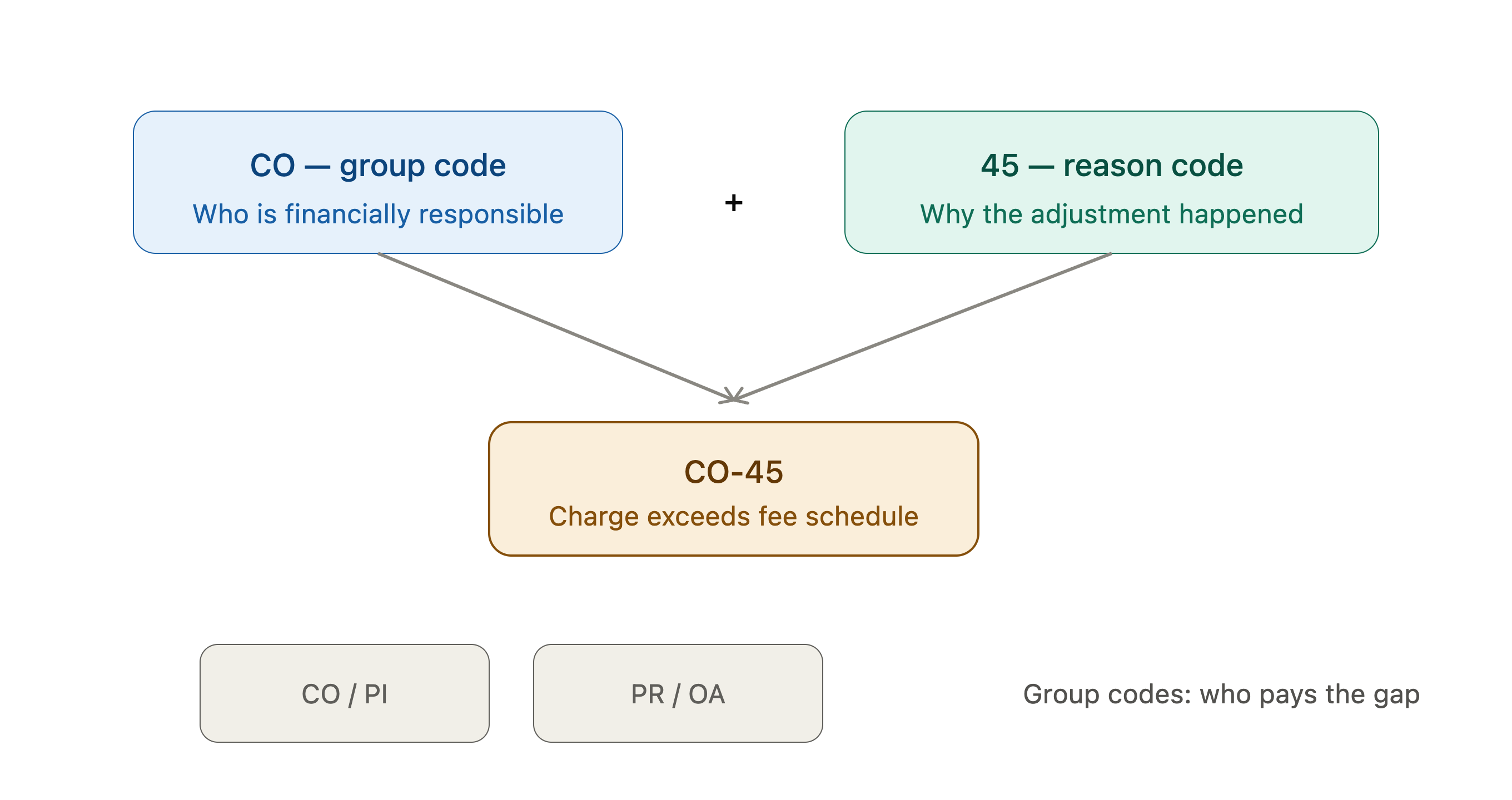
Official definition: X12 states that CARCs describe why a claim or service line was paid differently than billed, while Claim Adjustment Group Codes generally assign responsibility for adjustment amounts. Confirm descriptors in the current X12 CARC list and X12 RARC list.
CO-45: Charge Exceeds the Fee Schedule or Allowable Amount
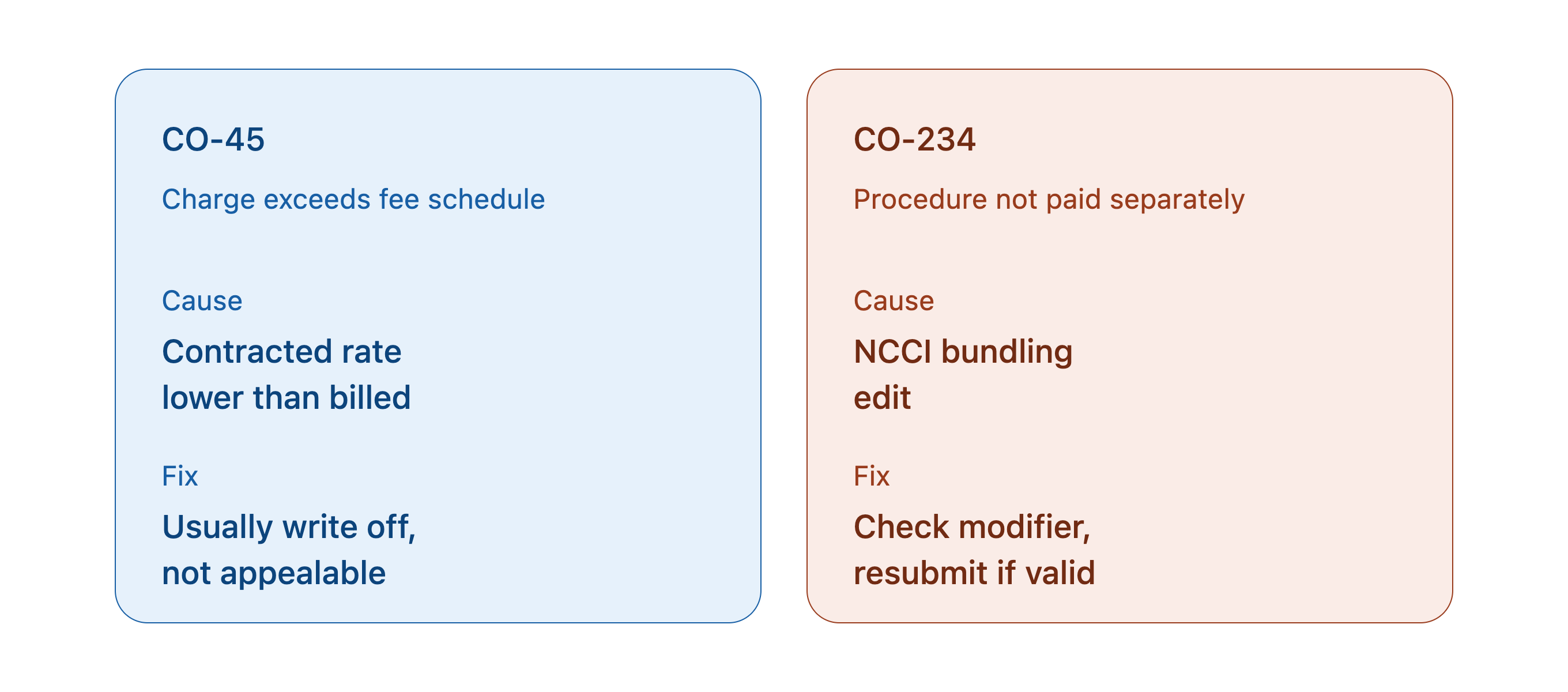
CO-45 usually represents the difference between the billed charge and a contracted, legislated or maximum allowable amount. It is normally a pricing adjustment rather than evidence that the entire claim was denied. X12 also permits CARC 45 with PR when liability belongs to the patient, so do not interpret “45” without its group code.
For CO-45, compare the payer's allowed amount with the applicable contract and fee schedule. If they match, the adjustment is generally contractual and should not be billed to the patient. Investigate when the allowance does not match the contract, the wrong network or fee schedule appears to have been applied, a credential tier is incorrect, or the payer shifted liability unexpectedly.
First review: compare the expected and actual allowed amount by payer, CPT/HCPCS code, place of service, rendering provider and effective date. If the contract is correct but commercially weak, that is a negotiation issue—not a claim appeal. Behavioral health practices can use ClaraRCM's guide to behavioral health fee-schedule negotiation.
CO-234: Procedure Is Not Paid Separately
CO-234 means the procedure was not paid separately, but the code alone does not establish why. X12 requires at least one non-alert RARC or NCPDP reject reason with CARC 234. Review that remark, the payer policy, the paid line and the related service before deciding whether the adjustment reflects packaging, bundling, a payment policy or another rule.
Do not add modifier 59 automatically. If the payer identifies an NCCI Procedure-to-Procedure edit, check the current edit file and modifier indicator. Use modifier 59 or XE, XP, XS or XU only when the edit permits it, no more specific modifier applies, and the documentation supports a genuinely distinct service. Never use a modifier solely to obtain payment.
If documentation supports a separately reportable service, follow the payer's corrected-claim or appeal instructions. If the service is correctly included in another payment, accept the adjustment and correct the upstream coding workflow. ClaraRCM's medical coding support reviews code combinations, modifiers, documentation and payer edits before submission.
CO-97, CO-16, CO-11 and CO-29: Meaning and First Review
| Code | What it indicates | First review |
|---|---|---|
| CO-97 | The benefit for the service is included in the payment or allowance for another already-adjudicated service. | Identify the related paid service and policy. Check global, packaged or bundling rules and whether any supported correction is permitted. |
| CO-16 | The claim or service lacks information or contains a submission/billing error. | Read every associated RARC; X12 requires at least one. Correct the identified field through the payer's proper claim workflow. ClaraRCM's claim submission service addresses upstream claim-data controls. |
| CO-11 | The diagnosis is inconsistent with the procedure. | Compare the claim with the documented diagnosis and payer policy. Correct only when the record supports the change; do not select a diagnosis merely to force payment. |
| CO-29 | The filing time limit has expired. | Verify the payer's filing rule and claim history. If available, assemble clearinghouse acceptance, payer receipt, retro-eligibility, COB or other evidence allowed by the payer. ClaraRCM's AR follow-up service tracks aging and deadlines earlier. |
PR-1, PR-2 and PR-3: Patient Responsibility Codes
PR-1 identifies a deductible amount, PR-2 a coinsurance amount and PR-3 a copayment amount. These codes can transfer valid liability to the patient, but they should not trigger automatic billing without review. Confirm that the correct plan adjudicated the claim, secondary coverage was handled, network and assignment rules were followed, and the amount posted matches the remittance.
Estimate these amounts before care when possible through ClaraRCM's eligibility and benefits verification, then reconcile the estimate against the final payer adjudication.
Quick Denial Code Lookup Table
Fee-schedule or allowable adjustment
Compare the allowance with the contract. Investigate wrong fee schedules, network status, credential tiers and effective dates.
Procedure not paid separately
Read the required RARC and payer policy. Do not assume NCCI or add a modifier without support.
Benefit included in another payment
Identify the related adjudicated service and applicable global, packaging or bundling rule.
Missing information or billing error
Use the associated RARC to identify the exact missing or invalid element before correcting.
Diagnosis-procedure inconsistency
Compare claim, documentation and payer policy. Change coding only when the clinical record supports it.
Filing deadline expired
Check the payer rule and claim history; appeal only when the payer permits it and evidence supports an exception.
Deductible, coinsurance or copay
Validate adjudication, secondary coverage and posting before transferring the balance to the patient.
Sources checked August 20, 2026: X12 Claim Adjustment Reason Codes, X12 Remittance Advice Remark Codes, CMS remittance guidance, and the CMS Medicare NCCI PTP edit resources. Verify current descriptors, remarks, payer policy and contract terms for the claim being reviewed.
When a Denial Code Signals a Systemic Revenue-Cycle Problem
A single code tells you what happened to one adjustment. A recurring pattern tells you where the workflow is failing. Segment codes by payer, CPT/HCPCS, rendering provider, location, modifier, RARC, dollar value and age. Repeated CO-16 adjustments may reveal a claim-build defect; recurring CO-29 points to queue or filing controls; a payer-specific CO-45 variance may expose an incorrect contracted rate or credential tier.
Do not group all 90837 payment issues under “bundling.” Utilization review, documentation requests, medical necessity and payment-policy adjustments require different evidence. Use ClaraRCM's guide to 90837 pre-payment review and audit response for that specific workflow. For multi-code, multi-payer backlogs, ClaraRCM's billing audit and cleanup services separate recoverable denials, underpayments, contractual adjustments and unresolved AR.
Frequently Asked Questions About Denial Codes
What is a CO-45 adjustment?
CO-45 generally means the billed charge exceeded the applicable fee schedule, maximum allowable, or contracted or legislated fee arrangement. Compare the allowed amount with the contract before accepting the adjustment. CARC 45 can also appear with PR when liability is assigned to the patient, so the group code matters.
What does CO-234 mean?
CO-234 means the procedure was not paid separately. It does not, by itself, prove that an NCCI edit caused the adjustment. Review the required RARC, payer policy, related paid service and claim documentation before selecting a correction or appeal path.
What is the difference between CO and PR codes?
CO means Contractual Obligation and generally assigns the adjustment to the provider. PR means Patient Responsibility and can assign a valid deductible, coinsurance, copay or other liability to the patient. Confirm the full remittance and applicable billing rules before transferring a balance.
Should every CO-45 adjustment be appealed?
No. If the payer applied the correct contracted or legislated allowance, the adjustment is normally expected. Investigate when the allowance, contract, network, credential tier or effective date appears incorrect.
Can modifier 59 fix CO-234 or CO-97?
Not automatically. Modifier 59 or an X modifier is appropriate only when the applicable edit permits it, the services were genuinely distinct, the documentation supports that distinction and no more specific modifier applies. The code and RARC must be reviewed first.

Andleeb Asghar, Pharmacist
RCM Specialist & Founder, ClaraRCM
Andleeb Asghar is a Pharmacist, medical billing professional, and revenue cycle management specialist with experience in denial management, remittance analysis, payer workflows, coding review and end-to-end RCM for U.S. healthcare practices.
Last updated: August 20, 2026. ClaraRCM provides medical billing and revenue cycle management support. This article is educational and is not legal, clinical, coding or payer-contract advice. CARCs, RARCs, payer policies, code sets, contracts and billing requirements can change. Verify the current remittance, official code list, payer instructions, contract and supporting documentation before billing a patient, correcting a claim or filing an appeal.