Mental Health Medical Billing: What Practice Owners Need to Run It Properly
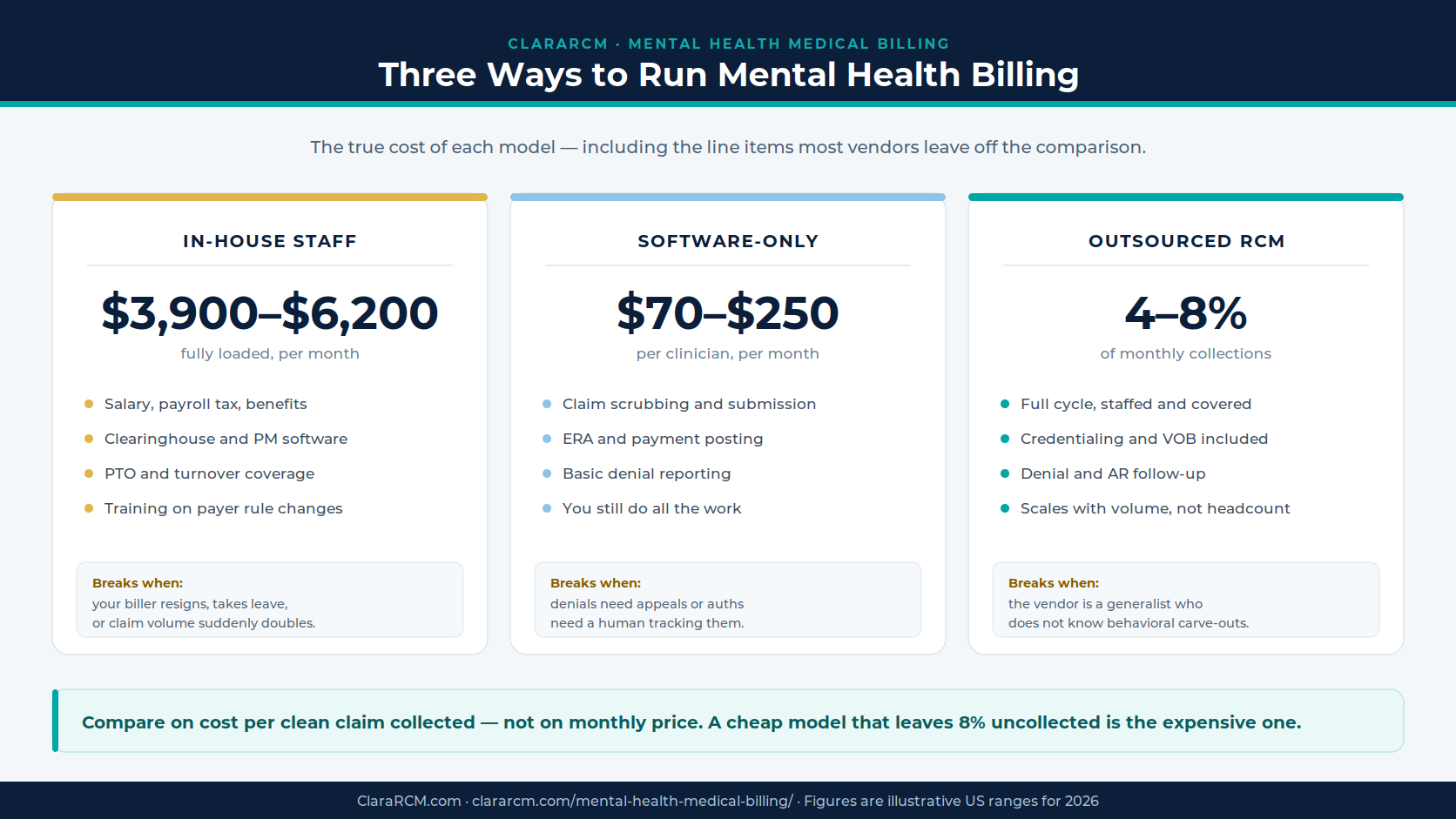
Mental health medical billing can be run three ways — an in-house biller at roughly $3,900 to $6,200 per month fully loaded, billing software at $70 to $250 per clinician per month plus your own labour, or an outsourced RCM partner at 4% to 8% of collections. The right choice depends on claim volume, not practice size: below roughly 250 claims a month, in-house rarely pays for itself once benefits, PTO coverage, turnover, and software are counted. Whichever model you choose, the practice owner retains the compliance obligation, the fee schedule, and the payer contracts — none of that transfers to a vendor.
There is a point in the life of every growing therapy practice where billing stops being a task and becomes a system. Usually it arrives with the third clinician, or the first Medicaid contract, or the month the owner realises they cannot say what their collection ratio is. Up to that point billing was something that happened on Sunday evenings. After it, billing is an operating function with a cost, a workflow, a compliance surface, and a measurable effect on whether the practice is profitable.
This guide from ClaraRCM is written for that owner. It is not a coding tutorial — for the codes, time bands, and modifiers, see our mental health billing guide for clinicians. This is the operator's view: what the three staffing models actually cost, how to design the workflow so denials stop being generated in the first place, which obligations stay with you no matter who bills, and where money leaves a therapy practice without ever producing a denial letter.
What Mental Health Medical Billing Actually Covers
Mental health medical billing is the complete revenue function of a behavioral health practice — not just claim submission, but eligibility verification, prior authorization management, credentialing, charge capture, coding, claim scrubbing, payment posting, denial appeals, patient balance collection, and payer contract administration. Practices that scope it narrowly as "sending claims" are usually the ones with an unexplained gap between what they billed and what they banked.
The function splits into three groups of work, and they fail for different reasons:
- Front-end (before the session). Intake accuracy, benefits verification, carve-out identification, authorization capture, credentialing status. Cheap to do, expensive to skip — this is where the majority of denials are created.
- Mid-cycle (the claim itself). Charge entry, code selection from documented time, modifier application, scrubbing, submission to the correct payer. Requires technical knowledge that is specific to behavioral health.
- Back-end (after submission). Payment posting, contractual variance checking, denial work, appeals, AR follow-up, patient statements. Labour-intensive, deadline-driven, and the first thing that gets dropped when the person doing it is busy.
A practice can be excellent at one group and still lose money. A biller who submits flawless claims but never checks paid amounts against the contracted rate will not notice a payer underpaying by 12% for a year. Owners who evaluate billing only by "are claims going out?" are measuring the middle third of a three-part system.
Three Models: In-House, Software-Only, Outsourced
Every practice runs one of three billing models, and the honest comparison is not monthly price but total cost per clean claim collected — a model that costs less per month but leaves 8% of collectible revenue behind is the more expensive option.
| Model | Typical cost | What it covers | Where it breaks | Best fit |
|---|---|---|---|---|
| In-house biller | $3,900–$6,200/month fully loaded | Full cycle, but only while that person is at their desk | Resignation, leave, illness, or a doubling of claim volume | Practices above roughly 400 claims/month with stable staffing |
| Software only | $70–$250 per clinician/month | Scrubbing, submission, ERA posting, basic reporting | Appeals, authorization tracking, and payer phone calls — software does none of these | Solo clinicians with simple commercial payer mixes |
| Outsourced RCM | 4–8% of collections | Full cycle, staffed, with coverage and credentialing included | Generalist vendors who do not know behavioral health carve-outs | Most practices between 1 and 25 clinicians |
| Hybrid | Varies | In-house front desk handles VOB and auth; vendor handles claims and AR | Unclear ownership at the handoff point | Practices with a strong administrator but no billing specialist |
The hybrid model deserves more attention than it usually gets. Front-end work — verifying benefits, catching a carve-out, recording an authorization expiry — is done best by whoever is already speaking to the patient. Back-end work is done best by people who do it all day. Splitting on that line, with a written handoff, often outperforms either pure model.
The question that settles it: what happens to your claims during the two weeks your biller is on holiday? If the honest answer is "they wait," you are running a single point of failure with a five-figure annual cost attached. That risk is not on any vendor's comparison chart, and it is the most common reason practices switch models.
Designing the Billing Workflow
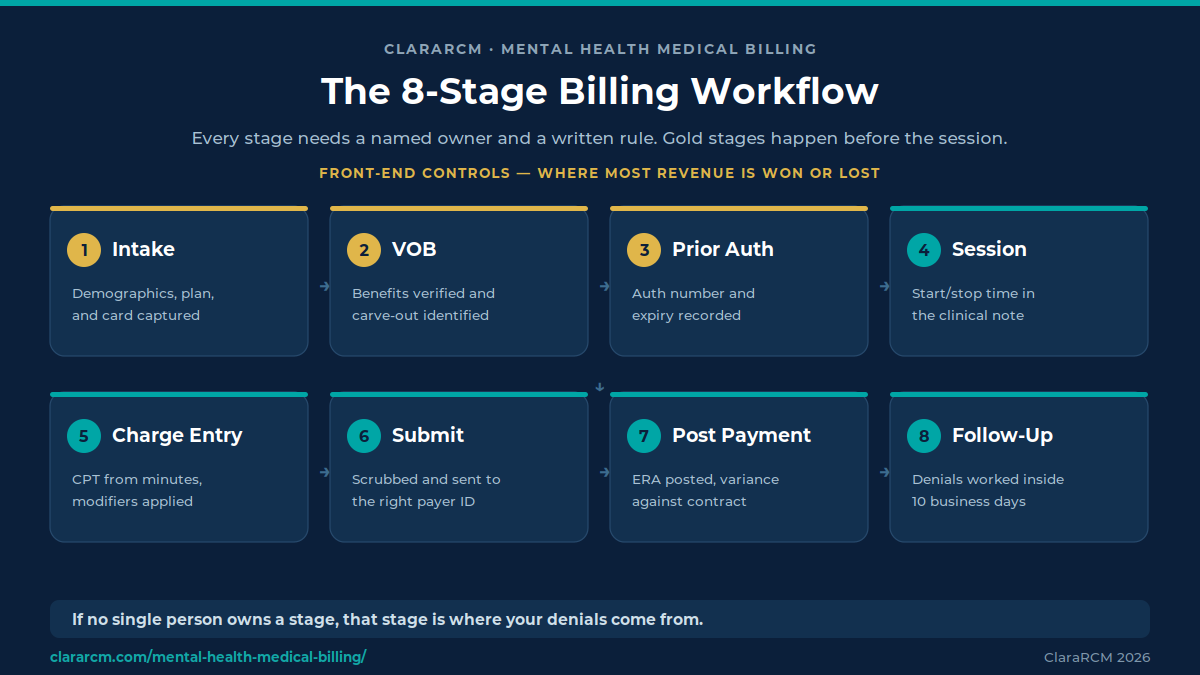
A billing workflow has eight stages, and each one needs a named owner and a written rule — if no single person owns a stage, that stage is where your denials come from.
The front end: intake, verification, authorization
These three stages happen before any clinical work and determine whether the claim can be paid at all. Intake captures demographics, plan details, and a legible copy of both sides of the card. Verification confirms active coverage, benefit levels, and — the step generalists skip — whether behavioral health is administered by a separate carve-out entity. Authorization records the number, session count, and expiry in a field the front desk sees at check-in, not in a note nobody opens. ClaraRCM's eligibility and benefits verification service runs all three before the first appointment.
The middle: session, charge entry, submission
The clinical note is a billing document as well as a clinical one, and it needs the session's start and stop time to support any time-based code. Charge entry converts that documentation into codes and modifiers; the rule to write down is that codes come from documented minutes, never from the calendar block. Submission routes to the correct payer ID with a scrub pass first. Set a standard of claims going out within 48 hours of the session — lag here compounds into every downstream metric.
The back end: posting and follow-up
Posting is not data entry. Every remittance should be checked against the contracted rate, because silent underpayment is invisible unless somebody compares. Our payment posting service flags contractual variances as part of posting rather than as a separate audit. Follow-up means denials worked within 10 business days and AR reviewed weekly by dollar value and filing deadline — not by date received.
Write it down, then test it. A workflow that lives in one experienced person's head is not a workflow, it is a dependency. Document each stage on a single page with the owner's name, the rule, and the system of record. Then hand it to someone who has never done it and see whether they can follow it. That test surfaces gaps faster than any audit.
The True Cost Per Claim
The advertised cost of in-house billing is a salary; the real cost is salary plus payroll taxes, benefits, software, training, PTO coverage, and the amortised cost of turnover — typically 35% to 55% above base pay before a single claim is submitted. Most comparison content skips this because it is published by software vendors whose pricing looks better against a bare salary figure.
| Line item | Illustrative annual cost | Notes |
|---|---|---|
| Base salary, experienced behavioral health biller | $46,000–$58,000 | Lower for a generalist; a generalist will cost you more in denials |
| Payroll taxes and statutory costs | $3,900–$5,000 | Roughly 8–9% of base in most states |
| Benefits (health, retirement match) | $6,000–$12,000 | Varies widely; often the largest hidden line |
| Practice management and clearinghouse software | $1,800–$4,800 | Per-claim clearinghouse fees on top for some vendors |
| Training, CEUs, payer rule updates | $600–$1,500 | Skipping this is how coding drift starts |
| PTO and leave coverage | $2,000–$4,500 | Temp cover, overtime, or the owner doing it at 11pm |
| Turnover, amortised | $3,000–$7,000 | Recruiting plus 8–12 weeks of reduced output while ramping |
| Fully loaded total | $63,300–$92,800 | Roughly $5,275–$7,733 per month |
Convert that to cost per claim by dividing by annual claim volume. A practice submitting 300 claims a month — 3,600 a year — is spending roughly $17.50 to $25.80 per claim on billing labour alone. The same practice collecting $45,000 a month would pay $1,800 to $3,600 monthly for outsourced billing at 4–8%. The models converge somewhere around 400–500 claims per month; below that, in-house is usually the more expensive option, and above it, in-house starts to win on unit cost provided the staffing is stable.
Figures are illustrative 2026 US ranges for planning purposes and vary substantially by state, market, and experience level. Build the table with your own numbers before making a staffing decision — the structure matters more than the values.
Billing Model Fit Checker
Answer 3 questions about your practice and we will show which billing model your numbers point to, plus the risk you are carrying right now.
Q1: How many claims does your practice submit each month?
Volume drives the economics more than headcount does.
Q2: Who handles billing today?
This tells us what you are currently paying for and what you are not.
Q3: What worries you most about billing right now?
This identifies your highest-priority fix.
ClaraRCM will review your billing setup and send a free personalized audit within 1 business day.
Your situation: —
Request received — thank you!
ClaraRCM has your practice details and will send a free personalized audit within 1 business day.
Prefer to connect right away?
Book a 30-minute call nowCompliance Obligations You Own Regardless of Who Bills
Outsourcing billing transfers the work, not the liability — the practice remains the covered entity, the submitting provider of record, and the party responsible for the accuracy of every claim bearing its NPI. A billing vendor's error is still your overpayment to refund and your record to correct.
- HIPAA and the BAA. Any vendor touching PHI needs a signed Business Associate Agreement before the first file transfer. Ask how PHI is transmitted and stored, and who on their side can access your data.
- Claim accuracy. Claims submitted under your NPI are your representations. Systematic upcoding does not become the vendor's problem because a vendor keyed it.
- Documentation sufficiency. No biller can create a start and stop time that a clinician did not record. Documentation standards are a clinical-leadership obligation.
- Credentialing accuracy. CAQH attestation every 120 days, current licensure on file, and correct roster data. Lapses suspend enrollments silently. Our provider credentialing service maintains this on an ongoing basis rather than at renewal panic.
- Overpayment refunds. Identified overpayments generally must be returned within 60 days of identification. Keeping them because a vendor did not flag them is not a defence.
- Record retention. Retention periods vary by state and payer contract; six to ten years is a common planning range. Confirm your vendor's retention and your access rights on exit.
Two contract terms matter more than price when selecting a vendor: what happens to your data if you leave, and who bears the cost of correcting their errors. Get both in writing.
Where Revenue Quietly Leaks
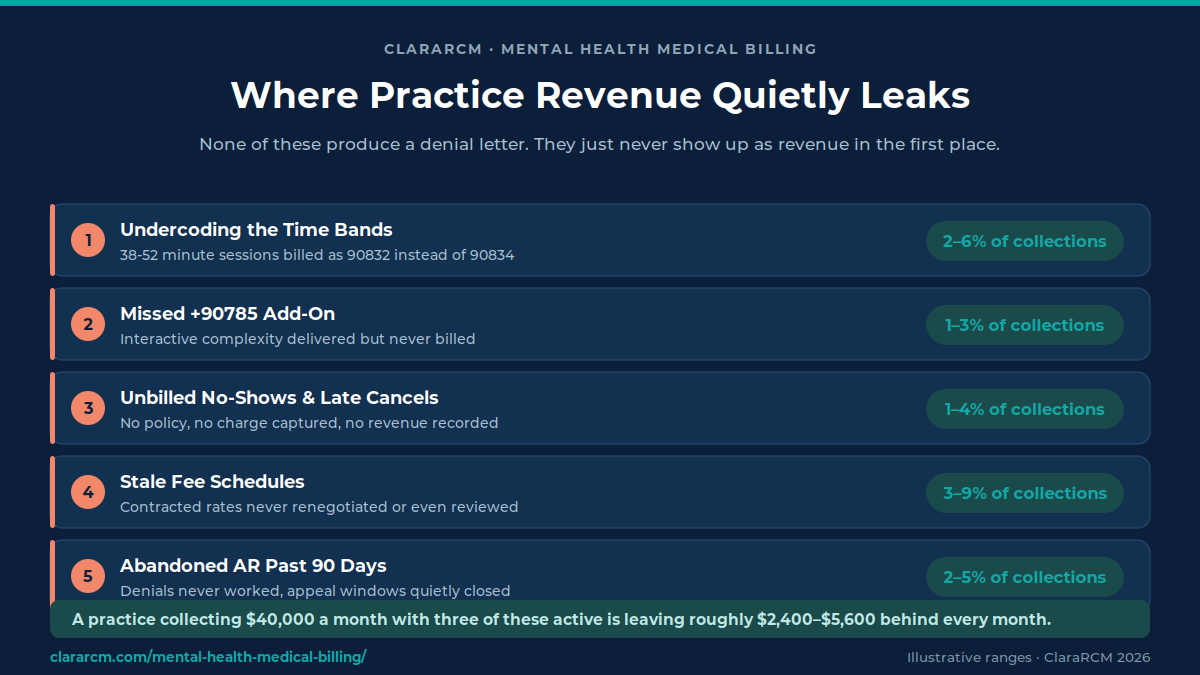
The most expensive revenue losses in a therapy practice do not generate denial letters — the money simply never becomes revenue, so nothing in the billing system flags it. These five leaks are the ones that show up repeatedly in practice audits.
Undercoding the Time Bands
Sessions running 38 to 52 minutes billed as 90832 because the clinician assumed 90834 requires a full 45. The claim pays, so nothing flags it. Compare 60 days of claims against session notes to size it.
Missed +90785 Add-On
Interactive complexity is frequently delivered — third-party involvement, court-mandated reporting, communication barriers — and almost never billed, because the clinician does not think of it as a separate service.
Unbilled No-Shows and Late Cancels
Without a written policy, a signed acknowledgement, and a charge-capture step, late cancellations are pure loss. This is a policy problem wearing a billing costume.
Stale Fee Schedules
Contracted rates signed years ago and never revisited, while costs rose every year. The largest single lever most practices have never pulled — see our guide to negotiating behavioral health fee schedules.
Abandoned AR Past 90 Days
Denials nobody worked, appeal windows that closed, balances written off by default rather than decision. Our AR follow-up team works aged behavioral health AR systematically by deadline and dollar value.
Silent Contractual Underpayment
A payer pays 88% of the contracted rate and nobody compares the remittance to the contract. It is not a denial, so it never appears in a denial report. Variance checking at posting is the only way to catch it.
A practice collecting $40,000 a month with three of these active is leaving roughly $2,400 to $5,600 behind every month. A billing audit and cleanup sizes each one against your own claim data rather than industry averages.
Cash Flow Management for Therapy Practices
Therapy practices have an unusual cash flow profile: costs are almost entirely fixed — salaries, rent, software — while revenue arrives 14 to 45 days after the service and varies with holidays, clinician leave, and seasonal attendance. That mismatch, not profitability, is what puts otherwise healthy practices under strain.
Shorten the cycle
Every day between session and submission is a day of delay you control. Submit within 48 hours, enrol in EFT and ERA with every payer, and collect copays at time of service rather than by statement later. These three changes routinely pull a week or more out of the cycle without any change in payer behaviour.
Plan for the predictable dips
December and August are structurally weaker in most therapy practices, and January brings deductible resets that shift a large share of balances from payer to patient for six to eight weeks. Neither is a surprise, so both should be in the cash plan. A practice that knows January collections run 15% light does not panic in January.
Hold a real reserve
Three months of fixed operating expenses is the standard target. Practices that carry it can absorb a payer's system migration, a delayed credentialing approval, or a clearinghouse outage without touching a line of credit. Practices that do not carry it experience each of those as a crisis.
Track two numbers weekly
Charges submitted and payments received. Nothing more elaborate is needed at the weekly level. When those two lines diverge for more than two consecutive weeks, something upstream has broken, and you will know before the month closes rather than after.
Monthly Reports You Should Demand From Any Biller
If a billing vendor or in-house biller cannot produce these seven reports on request, you do not have visibility into your revenue cycle — you have a monthly deposit and a hope. All seven are standard outputs of any competent billing operation.
- Clean claim rate — percentage accepted on first submission, trended monthly and broken out by payer
- Collection ratio — payments received against contracted allowable, not against billed charges
- AR aging by bucket — 0–30, 31–60, 61–90, 90+ days, with the 90+ column named and explained
- Denial report by reason code and payer — volume, dollar value, and appeal outcome for each category
- Days in AR — trended over at least six months so direction is visible, not just level
- Charge lag — average days from date of service to claim submission, by clinician
- Payer mix and yield — volume and average reimbursement per session by payer
The last one is the report owners most often lack and most need. Knowing that one payer accounts for 30% of your sessions and 19% of your revenue changes scheduling, panel, and contract decisions. Without it, you are making strategic choices on gut feel. ClaraRCM's revenue cycle management service delivers all seven monthly as standard.
Practice Profitability Benchmarks
Benchmarks are a diagnostic, not a target — a number outside the range is a prompt to investigate, not evidence of failure. These are the operating ranges a well-run outpatient behavioral health practice should be working within.
| Metric | Healthy range | Investigate when |
|---|---|---|
| Clean claim rate | 95–98% | Below 90% — systemic front-end or coding problem |
| Collection ratio (against allowable) | 96–99% | Below 93% — unworked denials or silent underpayment |
| Denial rate | 5–8% | Above 10% — workflow issue, not bad luck |
| Days in AR | 25–40 days | Above 50 — follow-up is not happening |
| AR beyond 60 days | Under 20% of total AR | Above 25% — aged AR is being abandoned |
| Billing cost as % of collections | 4–8% | Above 10% — model mismatch for your volume |
| Clinician utilisation | 65–80% of available slots | Below 60% — scheduling or no-show problem, not billing |
| Net margin, group practice | 10–20% | Below 8% — examine payer mix and fee schedules first |
When several metrics sit outside range at once, resist the urge to fix them individually. They are usually symptoms of one upstream cause — most often a front-end verification process that never got designed. Fix the cause and four numbers move together.
More in the Mental Health & Behavioral Health Billing Cluster
Frequently Asked Questions
Is mental health billing the same as medical billing?
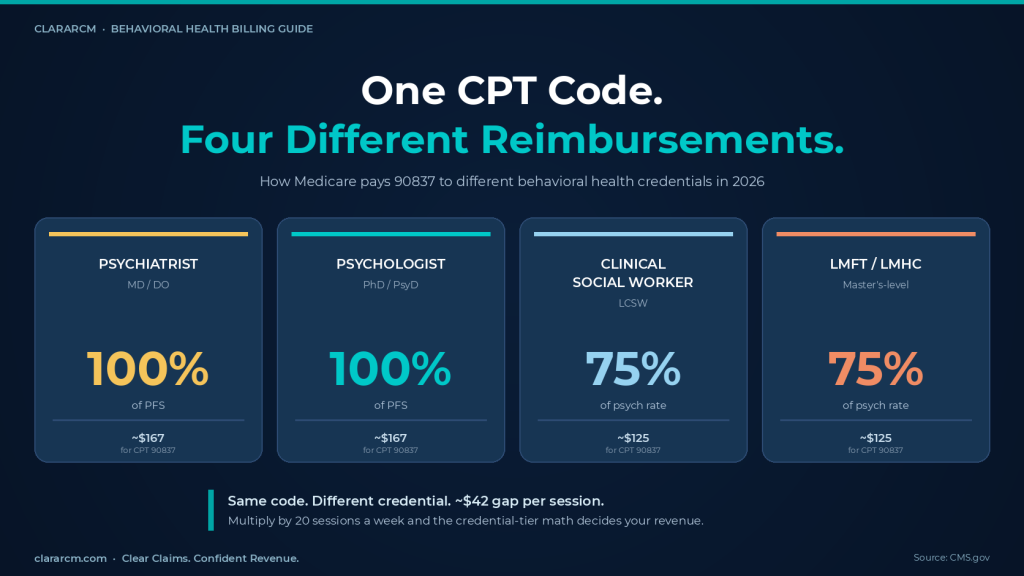
No. The claim format and clearinghouse infrastructure are shared, but four structural differences separate them. Psychotherapy CPT codes are selected by documented time rather than by procedure, so the session note is the only evidence supporting the code. Behavioral health benefits are frequently carved out to a separate administrator such as Optum, Carelon, or Magellan, so the payer on the member's card is often not the payer to bill. Prior authorization is ongoing rather than one-time, with blocks of sessions that expire mid-treatment. And reimbursement varies by the rendering clinician's credential tier for the same code. A generalist biller applying standard medical workflows to therapy claims will produce predictable denials.
Can one person handle billing for a group practice?
One experienced full-time biller can typically manage 400 to 700 clean claims a month, which covers most practices up to roughly eight to twelve clinicians depending on payer mix and claim complexity. Medicaid-heavy and carve-out-heavy practices sit at the lower end because authorization tracking and appeals consume more time per claim. The real constraint is not throughput but continuity: a single biller is a single point of failure, and claims stop moving during holiday, illness, or the notice period after a resignation. If you run this model, document the workflow and arrange cross-training or backup coverage before you need it.
What should billing cost as a percentage of collections?
Outsourced mental health billing typically runs 4% to 8% of collections, with behavioral health at the higher end of the general medical range because of authorization management, carve-out routing, and credential-tier complexity. In-house billing should be evaluated the same way: divide fully loaded annual billing cost, including benefits, software, PTO coverage, and turnover, by annual collections. Practices are often surprised to find their in-house model costs 9% or more once every line is counted. Compare on cost per clean claim collected rather than headline rate, because a cheaper model that leaves 8% of collectible revenue uncollected is the more expensive one.
When should I hire a billing company?
Five signals usually mean the economics have already shifted: a denial rate persistently above 8%, more than 20% of total AR sitting beyond 60 days, claims going out more than five days after the session, clinical hours being displaced by administrative work, or an imminent expansion in clinicians or payer panels. Any single one is worth investigating; two or more together generally means the current model is costing more than a billing service would. Run the fully loaded cost table against your own numbers before deciding, and evaluate any prospective vendor on whether they can name your carve-out administrators and explain credential-tier reimbursement without prompting.

Andleeb Asghar, PharmD
RCM Specialist & Founder, ClaraRCM
Andleeb Asghar is a PharmD, medical billing professional, and revenue cycle management specialist with 7+ years of experience across behavioral health revenue cycle design, practice billing operations, credentialing, denial management, and end-to-end RCM for U.S. therapy practices across all 50 states.
Last updated: August 2, 2026. ClaraRCM provides revenue cycle management and medical billing support services. This content is intended for educational purposes and does not constitute legal, financial, clinical, or payer-contract advice. Cost figures and benchmark ranges are illustrative 2026 US estimates for planning purposes and vary by state, market, payer mix, and practice model. Verify current requirements with the AMA, CMS, and individual payers before applying to claims.