
Substance Abuse Billing Services for Treatment Providers
Keep your team focused on treatment while ClaraRCM manages the claims behind it. Our substance abuse billing services connect eligibility, authorization checks, coding, payment posting, denial management and A/R follow-up for U.S. addiction treatment providers.
- Billing support for alcohol and drug treatment services
- Specialist attention to MOUD, OTP and office-based claims
- Clear follow-up on unpaid claims and payment differences
Support for substance use disorder (SUD) practices, behavioral health groups and integrated care organizations across the United States.
Get a Free Substance Abuse Billing Audit
Tell us about your program. We will review where payer requirements, claim errors and unpaid balances need attention.
Practice enquiries only. Please do not include patient information.
ClaraRCM-reported aggregate performance across specialties, not SUD-specific benchmarks or a promise of results. Outcomes vary with payer mix, documentation, contracts and starting A/R.
What is substance abuse billing?
Substance abuse billing is the process of preparing, submitting and following up insurance claims for substance use disorder treatment. It connects the documented service, treatment setting, provider credentials, payer requirements and payment terms.
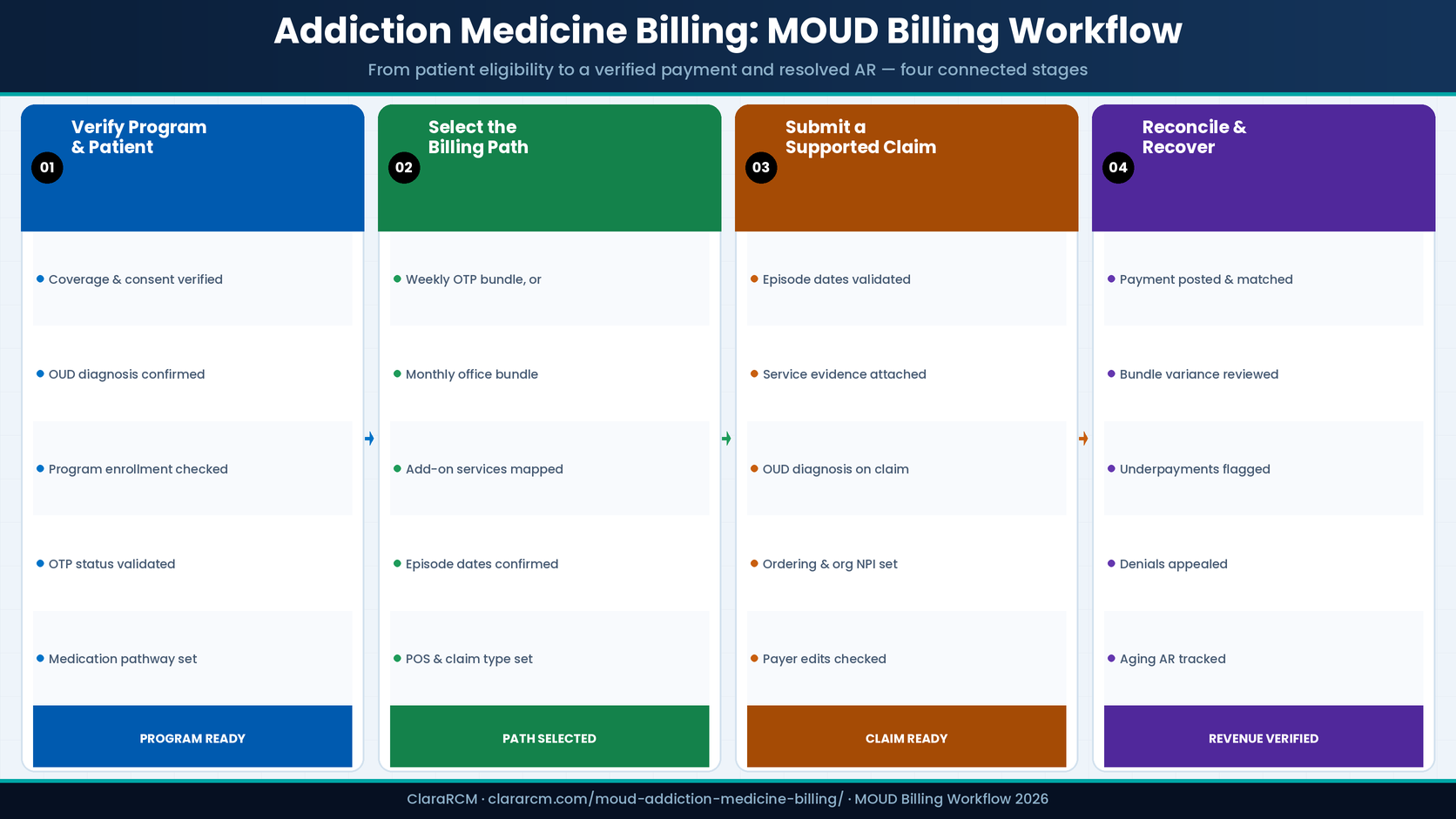
For a treatment provider, that means managing the whole journey from benefit verification to a resolved balance. Our addiction treatment billing workflow guide explains each stage. This service brings those stages into your day-to-day revenue cycle.
Substance abuse billing services from intake to payment
A submitted claim is only one step. ClaraRCM helps your team identify the right payer, prepare supported claims, reconcile payments and follow through on balances that remain open.
Eligibility and benefit checks
Confirm active coverage, network participation, patient responsibility and the entity administering the SUD benefit. Flag authorization requirements before the claim reaches the payer.
Eligibility verification services →Coding and claim preparation
Review service documentation, diagnoses, code families, units, modifiers and claim format. Check for overlap between separately billed services and program bundles.
Medical coding support →Claims and rejection follow-up
Submit claims to the correct destination, review clearinghouse and payer responses, and correct rejected claims. Track acceptance so submission does not become a blind spot.
Claim submission services →Denial management and appeals
Separate correctable claim errors from coverage and documentation disputes. Track payer deadlines, coordinate missing records and appeal supported services.
Denial management services →Payment posting and underpayments
Post remittances, review adjustments and compare paid amounts with applicable contract terms. Investigate payment differences before a claim is closed.
Payment posting services →Aging A/R and billing cleanup
Organize unpaid balances by age, payer, denial reason and next action. Prioritize recoverable claims and document what has been corrected, appealed or resolved.
A/R follow-up services →Enrollment and authorization need their own checks. Coordinate provider credentialing with the actual behavioral health network, and track approved dates, units and continued-stay requests where required. Our behavioral health carve-out billing guide explains why the administrator on the claim matters.
Billing priorities across substance use treatment programs
Alcohol treatment, opioid treatment and other drug treatment services can involve different program contracts and claim rules. We begin by confirming your setting, payer mix and required scope of support.
| Treatment setting | What needs attention | What the billing review checks |
|---|---|---|
| Outpatient alcohol and drug treatment | Assessments, counseling, psychotherapy, medication management and co-occurring conditions. | Rendering clinician, coverage, documentation, time or units, and any same-day billing restrictions. |
| IOP and PHP | Program attendance, authorized dates, approved units, treatment intensity and continued-stay documentation. | Payer-specific program billing, included services, claim format and consistency between authorized and delivered care. |
| Residential and withdrawal management | Facility participation, admission and discharge dates, level of care and contracted payment structure. | The program's contract, billing entity, covered days and professional versus facility responsibilities. |
| OTPs and office-based MOUD | Enrollment, medication pathway, episode or monthly service requirements and supported additional services. | The correct billing pathway for the actual treatment setting. Explore the MOUD billing guide. |
For facility programs, the initial review establishes payer requirements and the scope of billing support. A treatment level alone does not determine the code or guarantee coverage.
Integrated care needs coordinated billing. When SUD treatment overlaps with psychiatric care, primary care or a community clinic, connect the workflow with our behavioral health billing, primary care billing and FQHC and RHC billing services.
Medicare, Medicaid and commercial insurance billing
We check the rules that apply to the claim: the payer, benefit administrator, state program, provider type, treatment setting and date of service.
Medicare
Validate enrollment and separate OTP billing from office-based services. Check covered services, code requirements and claim details. Verify Medicare Advantage plan requirements separately.
Medicaid and managed care
Check the state program and managed-care plan for covered services, provider qualifications, authorization, H-codes, units and modifiers. Build the claim around the applicable manual and contract.
Commercial plans and carve-outs
Identify the benefit administrator, network, payer ID and authorization process. Match allowed amounts to the contract and escalate discrepancies through the payer's correction or appeal process.
For deeper guidance, read behavioral health fee schedules and payer contracts and HF and HE modifiers in MOUD billing.
How we address substance abuse billing denials
Each unpaid claim needs a reason, an owner and a next step. We review the payer response alongside the original claim and supporting records, then choose the appropriate correction, follow-up or appeal.
| Claim problem | What we investigate | Next action |
|---|---|---|
| Wrong payer or network | Medical versus behavioral health administration, payer ID and participating provider details. | Confirm the responsible entity and correct routing or enrollment issues. |
| Authorization mismatch | Approved provider, treatment setting, dates, service type and remaining units. | Reconcile the authorization with delivered care and follow the payer's correction or review process. |
| Medical necessity or documentation | The records requested, treatment plan and support for the billed service or level of care. | Coordinate with the clinical team and prepare supported documentation for review. |
| Bundle, unit or modifier error | Duplicate services, overlapping dates, code descriptors and payer-specific edits. | Correct the claim when supported and update the pre-submission check. |
| Payment below expectation | The remittance, contract allowance, adjustments and patient responsibility. | Request clarification or reprocessing and track the disputed amount. |
| Aging or repeated denial | Claim history, submission evidence, appeal deadlines and previous payer responses. | Prioritize the next recoverable action and report unresolved barriers. |
Read our guide to SUD and MOUD claim denials. For a possible benefit-design issue, our addiction treatment parity appeals guide explains questions to investigate; an appeal still needs case-specific support.
Already have a backlog? Start with a review of your unpaid claims, payer responses and filing deadlines.
MOUD and OTP billing within your SUD revenue cycle
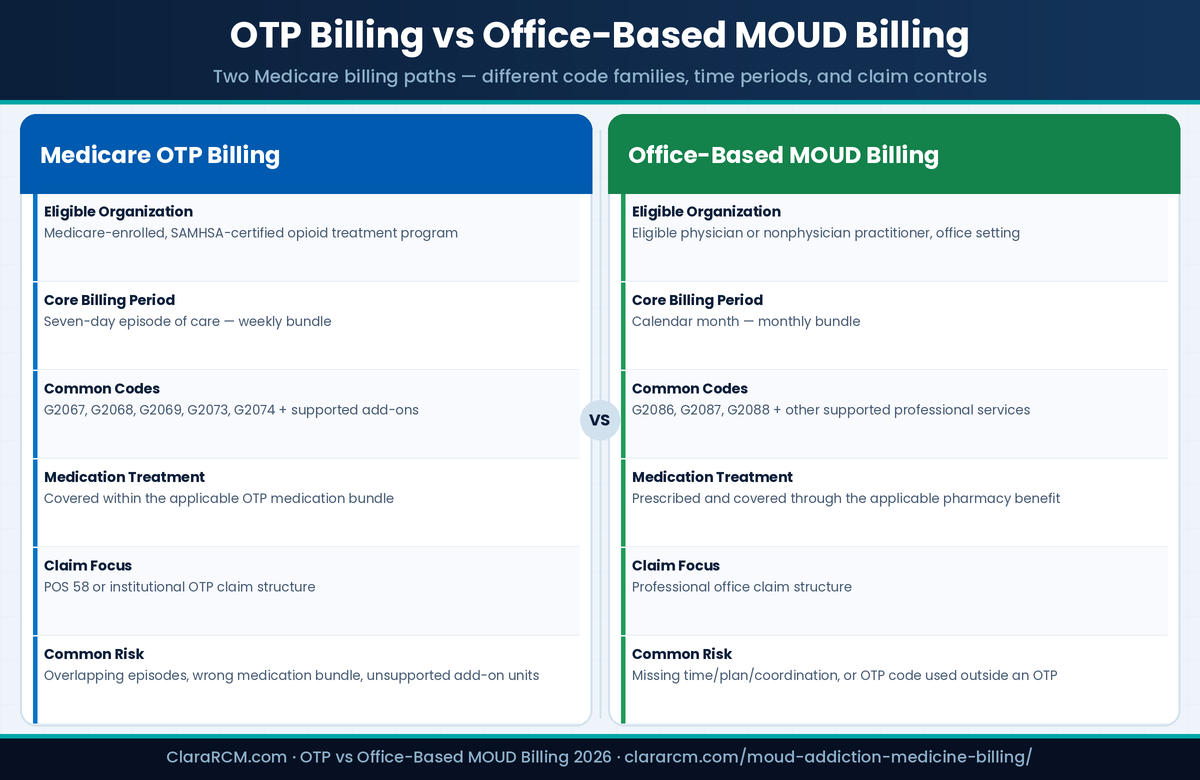
Medication treatment brings its own billing requirements. We review the program, medication supply, administration, service period and payer instructions before selecting a claim pathway.
Opioid treatment programs
Review medication-linked bundles, episode dates and supported additional services. Keep the source documentation connected to each claim. Our OTP weekly bundled billing guide covers the relevant G-code pathways.
Office-based buprenorphine treatment
Identify the appropriate professional billing pathway and check documentation and timing. Read office-based buprenorphine billing for the detailed workflow.
Injectable naltrexone and remote care
Review drug sourcing, authorization, units and administration for Vivitrol J2315 buy-and-bill. For remote services, check the payer's current requirements using our buprenorphine and methadone telehealth billing guide.
Office-based monthly SUD bundles: CMS describes G2086 for the first month with at least 70 minutes of qualifying work, G2087 for subsequent months with at least 60 minutes, and G2088 for additional work after more than 120 minutes. Treatment-plan, coordination and reporting requirements also apply. Check the CMS office-based SUD billing instructions.
For code selection across outpatient, IOP, PHP and residential settings, use our substance abuse billing codes reference. Verify Medicare OTP allowances using the official CMS OTP payment table.
Keep billing evidence connected to the claim
Our billing workflow flags missing documentation and coordinates requests with your clinical team. The goal is a clear record of the service, the payer's requirement and the action taken.
For records subject to 42 CFR Part 2, payment and appeal workflows must account for applicable consent and disclosure requirements. HHS set February 16, 2026 as the compliance date for applicable provisions of the updated rule.
Read 42 CFR Part 2 and medical billing alongside the HHS final-rule fact sheet.
Start with the part of your billing that needs attention
Whether you need ongoing substance abuse billing support or a focused review of old claims, the starting point is your actual workflow, payer mix and unresolved balances.
Review your program
Discuss treatment settings, payer contracts, billing volume, software and the problems your team is seeing.
Define the scope
Agree on current claims, historical A/R, authorization tasks, documentation handoffs and reporting responsibilities.
Set up the workflow
Confirm system access, claim routing, escalation contacts and a process for resolving missing information.
Track the work
Review claim status, denial patterns, aging balances and payment differences with clear next actions.
How much does outsourced billing cost?
Your proposal should reflect the work your program needs.
ClaraRCM reviews claim volume, payer mix, treatment settings, existing A/R and the requested service scope before discussing fees. Ask us to distinguish ongoing billing from historical cleanup and additional tasks.
Explore billing audit and cleanup services →ClaraRCM · Led by Andleeb Asghar, Pharmacist & Founder
Medical billing, denial management and revenue cycle support for U.S. healthcare providers. Meet ClaraRCM.
MOUD bundle denial and missed service calculator
Model the annual amount associated with affected weekly bundles and separately billable services under your own assumptions. Use it to start a discussion about where the billing workflow needs attention.
Estimated annual amount under the assumptions above.
Calculation: [(patients × episodes × affected share × bundle allowance) + (missed services × service allowance)] × unrecovered share × 12.
Starting values are illustrative. Count a service only once and only when separately billable. Delayed claims may still be paid; this estimate is not a measure of confirmed losses or a promise of recovery.
Send Your Calculator Results to ClaraRCM
Our team will review your bundle and missed service inputs and identify practical billing control points.
Please share practice contact details only.
Explore our substance abuse billing guides
Find detailed guidance for a coding question, payer problem or medication workflow. Bring the issue to your audit so we can discuss it in the context of your program.
Substance abuse billing codes
Compare code families, treatment settings and the checks needed before choosing claim details.
Read the CPT and HCPCS reference →Addiction treatment billing workflow
Follow the process from insurance verification and authorization through claims, denials and A/R.
Read the treatment billing guide →MOUD billing pathways
Explore OTP, office-based treatment and medication billing considerations in more detail.
Read the MOUD billing guide →SUD and MOUD claim denials
Investigate claim problems involving enrollment, services, dates and supporting documentation.
Explore denial causes and follow-up →Behavioral health carve-outs
Understand benefit administrators, network requirements and claim-routing questions.
Read the carve-out billing guide →Patient navigation and support
Review CHI and PIN billing considerations when these services are part of your care model.
Explore CHI and PIN for SUD care →Substance abuse billing services: frequently asked questions
What does a substance abuse billing company do?
A substance abuse billing company manages the administrative work that connects SUD treatment to insurance payment. ClaraRCM helps with eligibility checks, claim preparation, submission, payment posting, denial follow-up and aging accounts receivable. The agreed scope determines how authorization tracking, credentialing and historical cleanup are handled.
Can you support alcohol treatment as well as opioid treatment?
Yes. Our service addresses billing for substance use treatment, including alcohol and drug treatment services. We also retain a specialist focus on MOUD and OTP billing. During the initial review, we confirm your program setting, payer contracts and the support required.
Which substance abuse billing codes should our program use?
Code selection depends on the documented service, provider, treatment setting, payer and claim format. CPT, HCPCS and institutional revenue codes serve different purposes. Our substance abuse billing codes guide provides an overview; the final claim must follow the current code definitions and responsible payer requirements.
Can ClaraRCM review claims that are already unpaid or denied?
Yes. We can review existing unpaid claims and denial histories as part of an agreed A/R or billing cleanup scope. We check submission evidence, payer responses, missing information and filing or appeal deadlines before deciding the next action. Recovery depends on the claim facts and available remedies.
Do you help with authorization and continued-stay requirements?
We can include authorization checks and tracking in the agreed workflow. This involves checking payer requirements, approved services, dates, units and outstanding requests. Your clinical team remains responsible for clinical assessments and the evidence supporting medical necessity or continued care.
Will we need to change our EHR or billing software?
Tell us which EHR, practice management system and clearinghouse you use. We assess access, reporting and claim workflows before onboarding, then agree how the work will be performed. Any software change should be discussed as part of that review.
How much do your substance abuse billing services cost?
Pricing depends on claim volume, treatment settings, payer mix, existing A/R and the agreed responsibilities. A billing review helps define the proposal. Ask for a clear distinction between ongoing billing, historical claims cleanup and additional services.
What is the difference between OTP and office-based MOUD billing?
These settings use different enrollment and billing requirements. Medicare OTP services use program-specific bundles and supported additional codes. Office-based treatment follows professional billing rules, including monthly SUD bundles when requirements are met. The practice setting and delivered services determine the appropriate pathway.
How do we get started with ClaraRCM?
Complete the billing audit form or book a free 30 minute call. Share your program type, approximate volume, software and main billing concerns. We will discuss the initial review, required information and proposed scope before establishing the workflow.
Content updated September 14, 2026. Coding and coverage depend on the payer, program, provider and date of service.