OTP Weekly Bundled Billing: How G2067–G2075 Actually Work
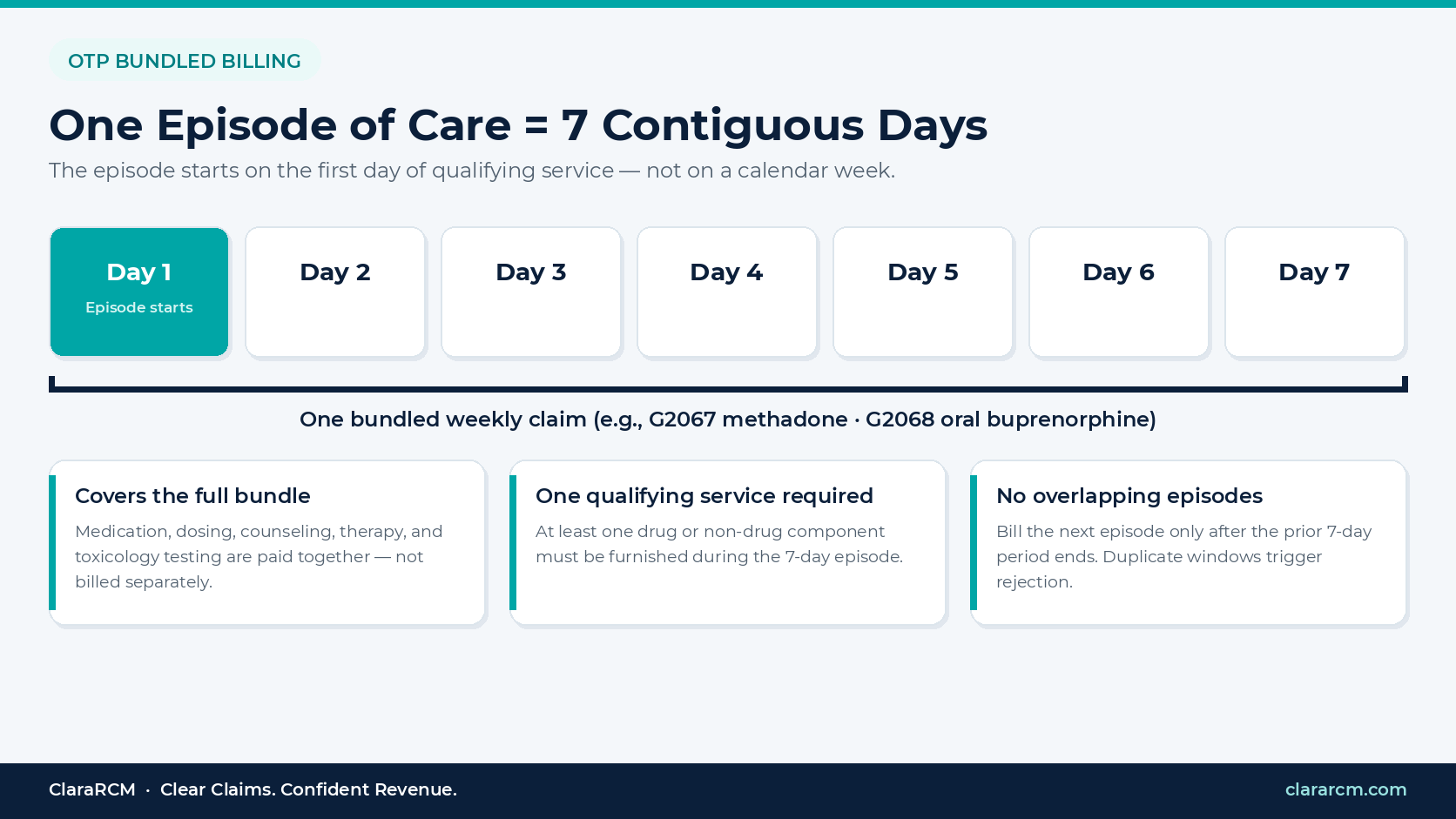
OTP bundled billing pays methadone and buprenorphine clinics one weekly rate per patient episode, covering medication, dosing, and counseling together, instead of billing each service separately. Medicare defines a standard episode as a seven-day cycle that begins on the first day of qualifying service, and at least one drug or non-drug component must be furnished during that week for the claim to be payable.
The weekly bundle is the single most misunderstood mechanic in opioid treatment program billing. Clinics that treat it like fee-for-service — one claim per visit, one code per service — generate duplicate-window rejections, missed add-ons, and underpaid episodes. This guide explains how the seven-day episode actually works, what happens when treatment starts mid-week, and how the drug and non-drug components fit together. For the full picture of all three MOUD billing paths, start with our MOUD Billing Guide 2026 .
What Counts as One Episode of Care
A Medicare OTP episode of care is a period of seven contiguous days, billed as one bundled payment. The bundle represents everything the program furnishes during that week: the medication itself, dosing and administration, substance use counseling, individual and group therapy, and toxicology testing. None of those services is billed separately on a standard episode.
The CMS OTP Billing & Payment guidance sets two rules that control every claim. First, the same weekly bundle must not be reported more than once for the same seven-day period. Second, at least one qualifying service — from either the drug component or the non-drug component — must be furnished during the week represented by the claim. A week in which the patient received nothing is not billable, even if the patient remains enrolled in the program.
The Base Bundle Codes
The base bundle is selected by medication and formulation, not by the services delivered that week. A methadone patient and an oral buprenorphine patient who receive identical counseling in the same week are still billed under two different G-codes, because the medication drives the bundle.
| HCPCS | Medication pathway | Billing frequency rule |
|---|---|---|
| G2067 | Methadone weekly episode | Once per seven-day period |
| G2068 | Oral buprenorphine weekly episode | Once per seven-day period; applies to buprenorphine-only and buprenorphine/naloxone products |
| G2069 | Monthly injectable buprenorphine bundle | Follows the product’s monthly schedule; not used for weekly injectable buprenorphine |
| G0533 | Weekly injectable buprenorphine bundle | Separate code from the original G2067–G2075 range |
| G2073 | Naltrexone bundle | Limited by CMS to once every four weeks |
| G2074 | Weekly non-drug bundle | Used when no medication is furnished but a qualifying non-drug service is provided |
| G2075 | Medication not otherwise specified | Reserved for an applicable new FDA-approved OUD medication not described by another bundle |
Formulation check: The most common base-code error is billing G2068 (oral) when the patient switched to an injectable product, or billing the monthly injectable bundle for a weekly product. Confirm the current formulation at the start of every episode — ClaraRCM’s medical coding support builds this check into the pre-bill review.
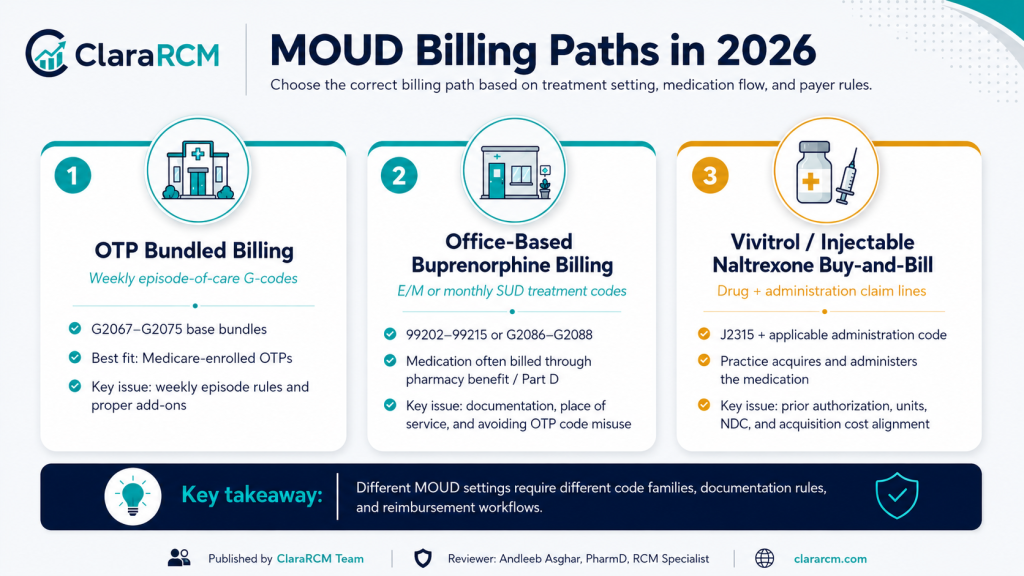
These bundles apply only inside a Medicare-enrolled OTP. Office-based practices prescribing buprenorphine follow a completely different path built on standard E/M codes — explained in our guide to office-based buprenorphine billing after the X-waiver . And practices administering injectable naltrexone outside the OTP bundle bill the drug and administration separately — see the Vivitrol J2315 buy-and-bill walkthrough for that workflow.
Billing a Mid-Week Treatment Start
According to CMS, an OTP can run its weekly billing cycle two ways: a standard cycle that starts every episode on the same day of the week, or patient-specific cycles anchored to each patient’s first day of treatment. Under the standard-cycle approach, the date of service is the first day of the OTP’s billing week; under the patient-anchored approach, an episode that begins on a Wednesday runs through the following Tuesday, and the next episode starts the following Wednesday. Neither approach requires episodes to align to calendar weeks.
A mid-week treatment start is billable under either approach. On a standard cycle, CMS permits billing the applicable code for the partial week if the threshold — at least one qualifying service — is met, and allows modifier 59 with documentation in the limited situations where a bundle must be billed more than once in a seven-day period, such as syncing a new patient to the OTP’s standard cycle or holiday weeks when the program is partially closed. On patient-anchored cycles, per CMS, the date of service for each subsequent consecutive episode is simply the first day after the previous seven-day period ends.
Whichever approach the program uses, it has to be one approach. The classic overlap error happens when the billing system defaults to calendar weeks while the clinical record anchors to admission dates — two conventions producing claims whose date spans eventually collide, and overlapping episodes are a rejection trigger.
- Pick one cycle convention — standard weekly or patient-anchored — and configure both the clinical record and the billing system to it.
- Sequence episodes in back-to-back seven-day blocks with no gaps and no overlaps in the reported date spans, and append modifier 59 with documentation only in the limited sync situations CMS describes.
- Re-anchor only when care re-starts after a true break in treatment — a missed week with no qualifying service is simply not billed, and per CMS the date of service on restart is the first day the patient is seen again.
One more layer sits on top of the Medicare rules: some state Medicaid programs require program-specific modifiers on MOUD claims. Our guide to modifier HF vs. HE in MOUD billing explains how those state-level rules work and how to verify your state’s requirements.
Drug Component vs. Non-Drug Component
Every OTP bundle is built from two components: the drug component (the medication) and the non-drug component (everything else). The non-drug component covers dosing and administration, substance use counseling, individual and group therapy, toxicology testing, intake activities, and periodic assessments.
The split matters for one practical reason: a week without medication can still be billable. When a patient receives counseling or therapy during a week in which no medication is furnished — for example, during a supervised taper or a temporary medication hold — the program reports the weekly non-drug bundle, G2074, rather than skipping the week or forcing a medication bundle the record does not support.
Beyond the base bundles, CMS guidance includes separate add-on codes for services that exceed the standard bundle: G2076 for intake, G2077 for periodic assessment, G2078–G2079 for qualifying take-home medication supplies, and G2080 for counseling that substantially exceeds the amount specified in the patient’s plan of care. Each add-on must reflect documented work — add-ons attached by habit rather than by documentation are a review trigger.
Several of these services — intake, periodic assessment, and counseling — can also be furnished remotely under specific conditions, including an audio-only exception when video technology isn’t available to the patient. Our guide to telehealth billing for buprenorphine and methadone treatment covers when those rules apply and how they differ from standard telehealth billing.
Take-home dates: Take-home supply add-ons describe days that extend beyond the base episode. When take-home dates overlap a week already covered by a base medication bundle, the claim can reject or suspend for review. Map take-home spans against episode spans before claim submission .
Common OTP Billing Mistakes
Most OTP claim problems trace to a handful of repeatable workflow errors. Each one is preventable with a pre-bill check that validates the episode span, the medication pathway, and the documentation behind every add-on.
1. Overlapping Episode Windows
Two bundles whose date spans share even one day will conflict. Sequence episodes in strict seven-day blocks from the anchor date.
2. Wrong Bundle for the Formulation
Oral, weekly injectable, and monthly injectable buprenorphine each map to a different code. Confirm the current product every episode.
3. Billing an Empty Week
No qualifying drug or non-drug service during the seven days means no billable episode — enrollment alone is not a service.
4. Missing the Non-Drug Bundle
Weeks with counseling but no medication are often left unbilled. G2074 exists precisely for that situation.
5. Undocumented Add-Ons
Intake, assessment, extra counseling, and take-home add-ons must match documented work and CMS frequency limits.
6. Claim-Format Errors
OTP claims require POS 58 and an OUD diagnosis code, billed under the OTP’s organizational NPI — not an individual practitioner’s — and filed within Medicare’s 12-month timely filing window.
For the complete picture of why addiction treatment claims fail — including ASAM documentation gaps, prior authorization lapses, and 42 CFR Part 2 conflicts that reach far beyond OTP bundles — see our full guide to why SUD and MOUD claims get denied and how to appeal them .
Programs seeing repeated rejections, suspended claims, or underpaid episodes can use ClaraRCM’s denial management services and accounts receivable follow-up to work the backlog while the pre-bill workflow is corrected. A billing audit and cleanup of past episodes frequently recovers non-drug weeks that were never billed at all.
Frequently Asked Questions About OTP Bundled Billing
How Does OTP Bundled Billing Work?
Medicare pays enrolled opioid treatment programs one bundled rate per patient for each seven-day episode of care. The bundle covers the medication, dosing, counseling, therapy, and toxicology testing furnished that week, selected by the medication pathway — for example, G2067 for methadone or G2068 for oral buprenorphine.
What Is a Billing Episode of Care for Opioid Treatment Programs?
An episode of care is seven contiguous days beginning on the first day of qualifying service. At least one drug or non-drug component must be furnished during the episode, and the same weekly bundle cannot be reported more than once for the same seven-day period.
Can You Bill an OTP Episode If Treatment Starts Mid-Week?
Yes. CMS permits two approaches: a standard billing cycle where every episode starts on the OTP’s chosen day of the week — with the partial week billable if at least one qualifying service was furnished — or patient-anchored cycles where the episode starts the day care begins and each following episode starts the day after the prior seven-day period ends.
What Happens in a Week Where the Patient Gets Counseling but No Medication?
That week is still billable. When a qualifying non-drug service such as counseling or therapy is furnished in a week with no medication, the program reports the weekly non-drug bundle, G2074, instead of a medication bundle.
More in the MOUD Billing Cluster
OTP Revenue Leak Estimator
Enter your program numbers, see your estimated annual revenue gap, then send the results to ClaraRCM for a free personalized audit.
Your estimated annual revenue leak: —
Fill in your details and ClaraRCM will send you a free, personalized OTP billing audit within 1 business day.
Request received — thank you!
ClaraRCM has your OTP billing numbers and will send you a free personalized audit within 1 business day.
Prefer to connect right away?
Book a 30-minute call now
Andleeb Asghar, PharmD
RCM Specialist & Founder, ClaraRCM
Andleeb Asghar is a PharmD, medical billing professional, and revenue cycle management specialist with 7+ years of experience across medical billing, medical coding, clean-claim submission, payer compliance, eligibility verification, denial management, accounts receivable recovery, payment posting, provider enrollment, billing audits, and end-to-end revenue cycle optimization for U.S. healthcare practices. She medically reviews ClaraRCM content for clinical terminology, coding context, regulatory accuracy, payer considerations, and clear communication for healthcare providers and practice leaders.
ClaraRCM provides revenue cycle and medical billing support. This content is for educational purposes and is not legal, clinical, or payer-contract advice.