MOUD Billing Guide 2026: CPT, HCPCS & OTP Codes Explained
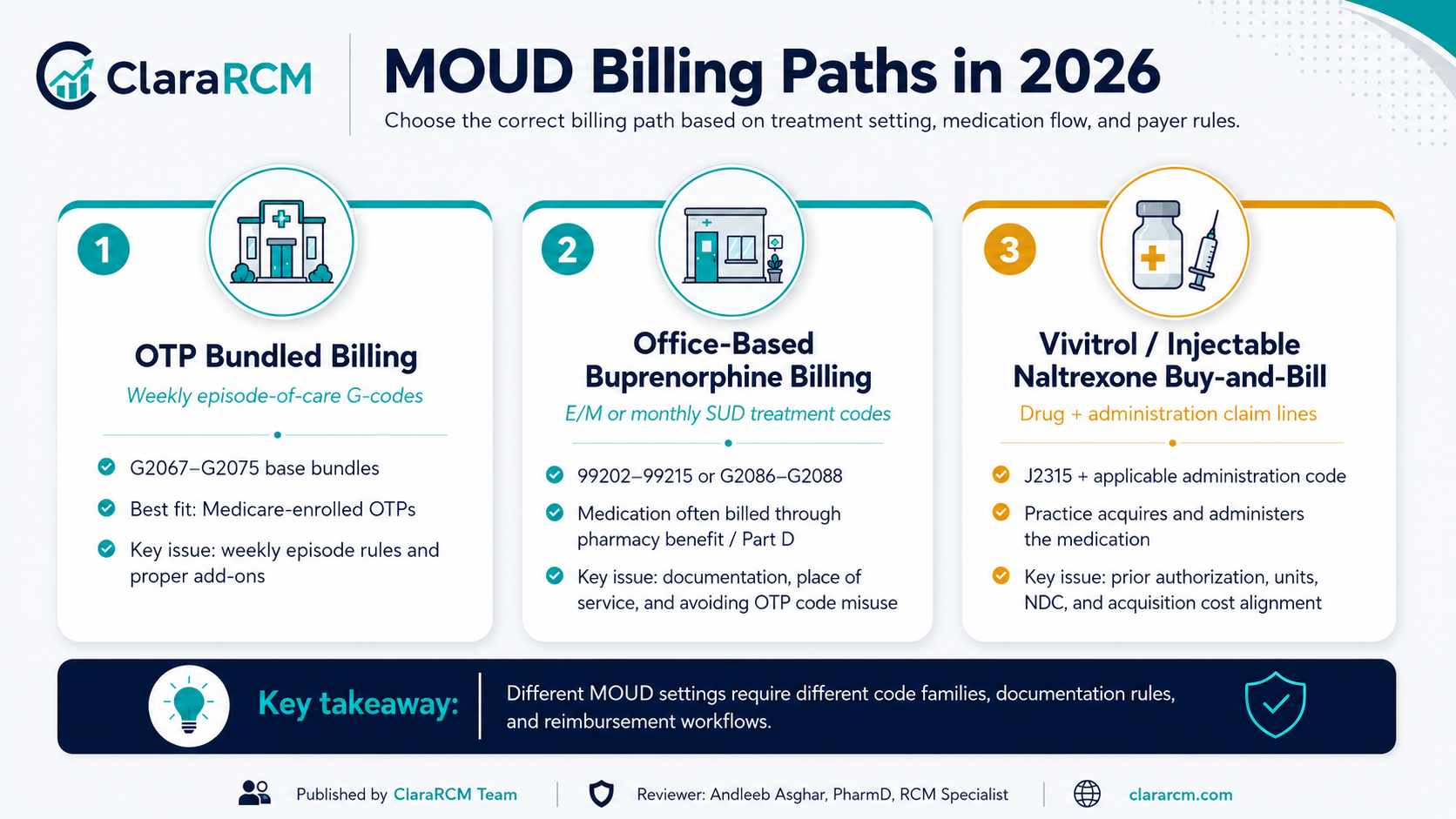
MOUD billing covers three separate paths depending on how treatment is delivered: OTP bundled billing using weekly G-codes, office-based buprenorphine billing using standard E/M or monthly SUD treatment codes, and buy-and-bill for injectable naltrexone such as Vivitrol using J2315. Each path has different provider-enrollment, documentation, frequency, and reimbursement rules.
MOUD claims are unusually sensitive to treatment setting. A code that is correct for a Medicare-enrolled opioid treatment program may be inappropriate for an office-based practice, even when both organizations treat opioid use disorder with the same medication. ClaraRCM’s addiction medicine and MOUD billing services focus on aligning the treatment setting, medication pathway, documentation, payer rules, and claim format before submission.
What Is MOUD Billing, and Why Is It Different From MAT Billing?
MOUD billing is the process of coding and submitting claims for medications and related clinical services used to treat opioid use disorder. The correct claim structure depends on whether care is furnished by a Medicare-enrolled OTP, an office-based practitioner, or a practice purchasing and administering an injectable medication.
The current federal definition in 42 CFR § 8.2 defines medication for opioid use disorder, or MOUD, as FDA-approved medication used in the treatment of OUD. Current treatment pathways commonly involve methadone, buprenorphine, or naltrexone, but the billing mechanism is determined by the site and method of delivery—not the drug name alone.
MAT, or medication-assisted treatment, is an older umbrella term that remains visible in many HCPCS descriptors and payer manuals. MOUD is the more precise current regulatory term for medications used to treat opioid use disorder. The terminology has changed faster than many billing systems, so practices may still see “medication-assisted treatment” on code descriptions even when current clinical and regulatory language uses MOUD.
Three Distinct MOUD Billing Paths
There is no single universal MOUD claim. OTPs generally report weekly episodes, office-based clinicians report E/M services or monthly SUD treatment bundles, and practices administering injectable naltrexone may report a drug code plus the applicable administration service.
| Billing path | Typical setting | Primary code family | Main risk |
|---|---|---|---|
| OTP bundled billing | Medicare-enrolled opioid treatment program | G2067–G2075 base bundles, G0533, and supported add-ons | Wrong bundle, overlapping dates, or unsupported add-ons |
| Office-based treatment | Physician or eligible nonphysician practitioner office | Office/outpatient E/M or G2086–G2088 | Using OTP codes outside an OTP or missing time requirements |
| Vivitrol buy-and-bill | Eligible office or outpatient setting | J2315 plus the payer-appropriate administration code | Incorrect units, authorization, benefit, or acquisition pathway |
Pre-bill decision: Confirm the billing entity, medication source, episode frequency, place of service, payer, and provider enrollment before selecting a code. That sequence prevents more denials than selecting a code first and trying to make the documentation fit later.
OTP Bundled Billing Codes
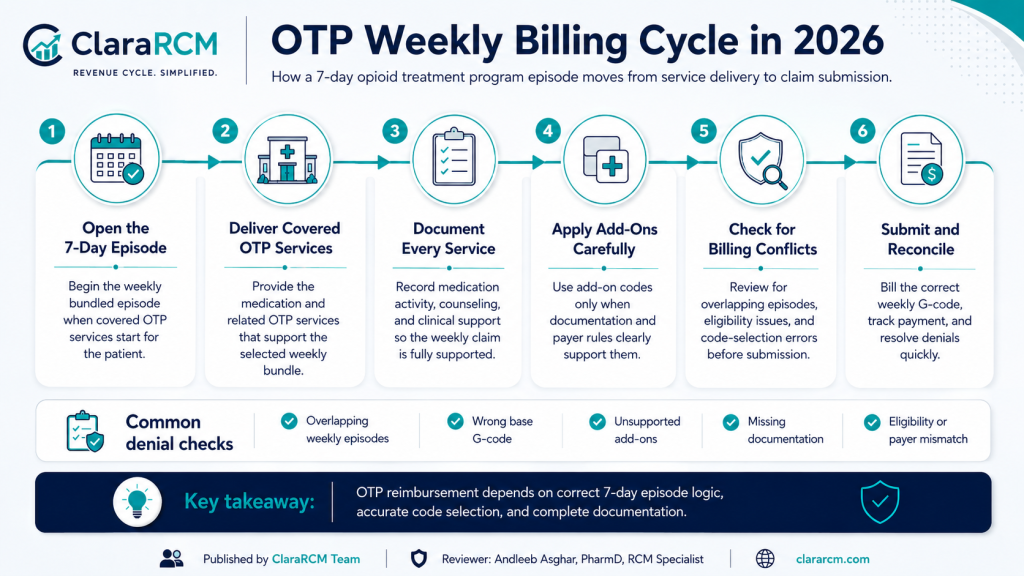
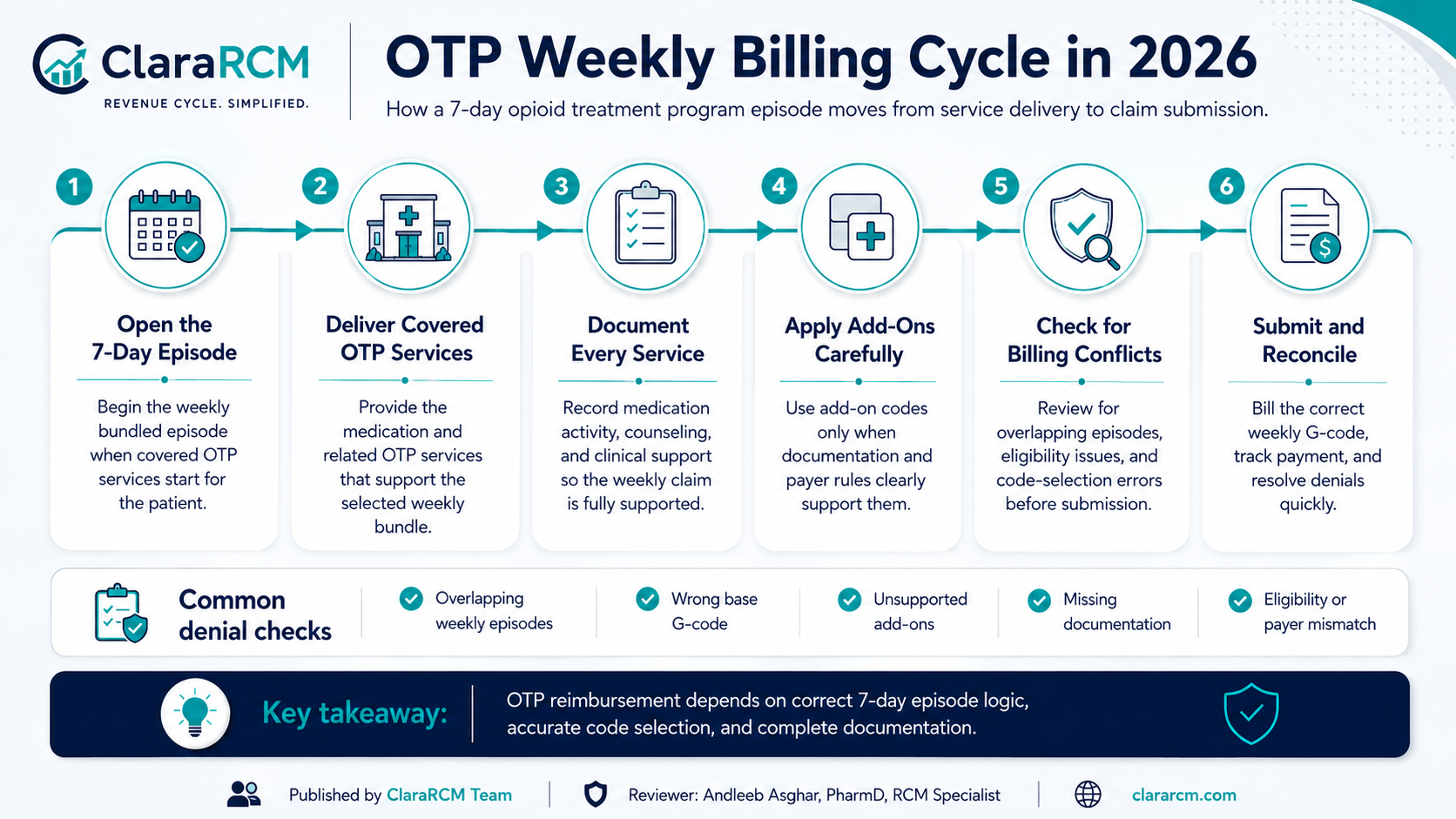
Medicare pays enrolled OTPs through bundled payments based primarily on seven continuous days of care. CMS requires at least one service from the drug or non-drug component during the week represented by the claim.
The current CMS OTP Billing & Payment guidance confirms the main base bundles and frequency rules. The commonly used base codes include:
| HCPCS | General billing use | Key frequency point |
|---|---|---|
| G2067 | Methadone weekly episode | Do not report more than once for the same seven-day period |
| G2068 | Oral buprenorphine weekly episode | May apply to buprenorphine-only or buprenorphine/naloxone products |
| G2069 | Monthly injectable buprenorphine bundle | Do not use for weekly injectable buprenorphine |
| G2073 | Naltrexone bundle | CMS limits use to once every four weeks |
| G2074 | Weekly non-drug bundle | Use when no medication is furnished but a qualifying non-drug service is provided |
| G2075 | Medication not otherwise specified | Reserved for an applicable new FDA-approved OUD medication not described by another bundle |
| G0533 | Weekly injectable buprenorphine bundle | Separate from the original G2067–G2075 base range |
This resolves a common coding confusion: G2067–G2075 is the base OTP range, not one uninterrupted list of codes that are all used the same way. Current CMS guidance also includes separate add-on and newer service codes such as G2076 for intake, G2077 for periodic assessment, G2078–G2079 for qualifying take-home medication supplies, G2080 for additional counseling, G0137 for qualifying intensive outpatient services, and G0534–G0536 for specified coordination, navigation, and peer-support services.
Professional OTP Claim Elements
According to CMS, professional OTP claims generally require POS 58, the applicable OTP HCPCS code, the organizational NPI as billing provider, the prescribing or ordering practitioner’s NPI, and an OUD diagnosis. Institutional claim requirements differ by facility type and may include specific type-of-bill, condition-code, and revenue-code reporting.
Episode-level controls should verify the seven-day billing period, medication pathway, qualifying services, take-home dates, supported add-ons, provider enrollment, diagnosis, place of service, and claim format before claim submission .
Office-Based Buprenorphine Billing
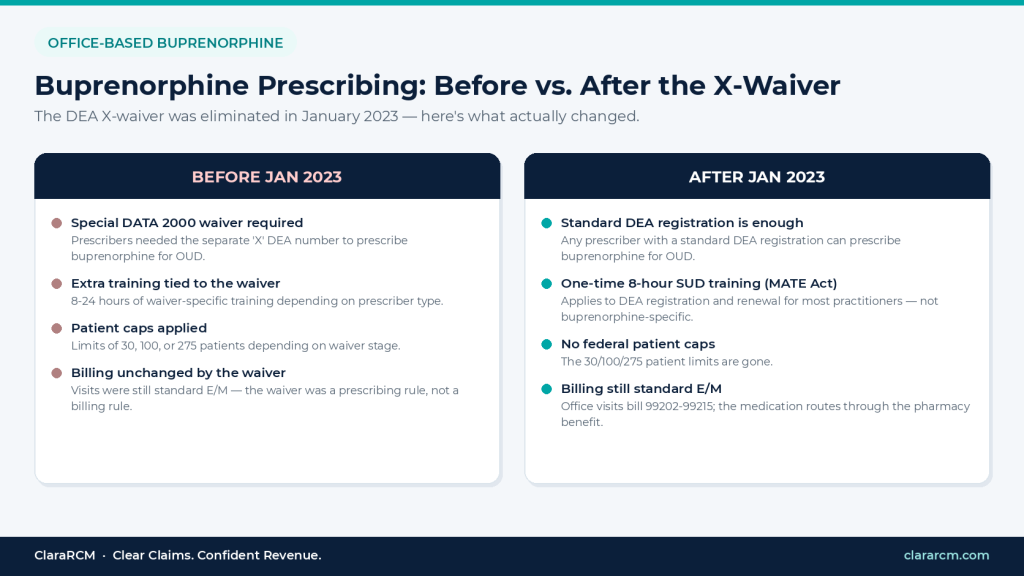
Office-based buprenorphine treatment is not billed with OTP weekly codes. Eligible practitioners generally report the supported office/outpatient E/M service or the monthly office-based SUD treatment codes G2086–G2088 when all service and time requirements are met.
CMS’s current Office-Based SUD Treatment Billing guidance explains that medications prescribed in the office may be covered under the patient’s Medicare Part D plan. The clinical encounter remains a separate billing event under the medical benefit.
| HCPCS | General requirement |
|---|---|
| G2086 | First calendar month of office-based SUD treatment, including treatment-plan development and at least 70 minutes of qualifying services |
| G2087 | Subsequent calendar month with at least 60 minutes of qualifying services |
| G2088 | Each additional 30 minutes, reported with the applicable primary monthly service |
The monthly code should not be selected merely because buprenorphine was prescribed. Documentation must support the care coordination, counseling, psychotherapy, treatment planning, and time represented by the descriptor. ClaraRCM’s medical coding support helps practices review whether the documented service supports the selected code.
Federal removal of the former X-waiver changed prescribing access, but it did not convert office practices into OTPs or authorize OTP code use.
Telehealth adds another layer. The HHS telehealth SUD billing guide notes that Medicare SUD telehealth policy has specific requirements, while Medicaid and commercial reimbursement varies. Practices can review ClaraRCM’s telehealth billing services for broader billing support.
Vivitrol and Naltrexone Buy-and-Bill
Vivitrol buy-and-bill means the practice purchases the medication, administers it, and bills the medical payer for the drug and the supported administration service. The practice therefore carries acquisition, storage, authorization, documentation, and reimbursement risk.
CMS data identifies J2315 as “injection, naltrexone, depot form, 1 mg.” The current FDA prescribing information for Vivitrol identifies a 380 mg intramuscular dose administered every four weeks or monthly. When the payer follows the one-milligram HCPCS unit, a full 380 mg dose is generally represented as 380 units; however, the payer’s current claim-unit, NDC, prior-authorization, and wastage policies must be verified before submission.
The administration may be reported with an applicable therapeutic injection code, commonly 96372 when the service and payer policy support it. Do not assume that every payer processes the same drug, NDC, administration, or specialty-pharmacy arrangement identically.
- Verify both benefits: Use eligibility and benefits verification to determine whether the drug is covered under the medical or pharmacy benefit.
- Confirm authorization: Check dose, frequency, diagnosis, site of care, and servicing-provider requirements.
- Validate acquisition: Confirm whether the payer requires buy-and-bill, specialty-pharmacy shipment, or another distribution model.
- Document administration: Record dose, route, site, product, NDC, lot details when required, and any wastage.
- Reconcile reimbursement: Compare payment with acquisition cost and contracted allowance using accurate payment posting and reconciliation .
Common MOUD Claim Denial Triggers
Most MOUD denials begin with a mismatch between the treatment setting, code family, documented service, medication pathway, and payer rule. The following errors are preventable when the billing workflow validates those elements before claim creation.
1. OTP Codes Used Outside an OTP
Office-based clinicians cannot report OTP weekly bundles simply because they prescribe buprenorphine or naltrexone.
2. Overlapping Episode Dates
Duplicate seven-day bundles or take-home dates overlapping a base medication episode can trigger rejection or review.
3. No Qualifying Weekly Service
CMS requires at least one drug or non-drug component during the billed OTP episode.
4. Unsupported Add-On Codes
Intake, assessment, counseling, navigation, and take-home add-ons must match actual documented work and frequency.
5. Wrong Benefit Pathway
Office-dispensed, pharmacy-dispensed, and buy-and-bill medications do not share one universal claim process.
6. J2315 Unit Mismatch
Reporting one unit for a 380 mg product can understate the drug quantity when the payer uses the one-milligram descriptor.
7. Authorization Gaps
Injectables, higher levels of care, and payer-specific MOUD services may require authorization before treatment.
8. Confidentiality-Documentation Conflict
SUD claims must support coverage while complying with 42 CFR Part 2 and applicable privacy requirements.
Practices with recurring rejections, underpayments, or payer delays can use ClaraRCM’s denial management services and accounts receivable follow-up to investigate unpaid or incorrectly processed claims.
Billing accuracy note: CPT, HCPCS, payer, and regulatory requirements can change. Verify current CMS instructions, state Medicaid manuals, commercial payer policies, and code descriptors for the patient’s date of service. This article is educational and does not replace payer-specific coding advice.
Complete MOUD Billing Resource Library
Each post below covers a specific MOUD billing topic in depth. Use them alongside this guide for end-to-end coverage of every billing path.
MOUD Billing Path Finder
Answer 3 quick questions to identify which MOUD billing path applies to your practice — and your single biggest denial risk right now.
Q1: What type of facility or practice are you?
This determines which code family applies to you.
ClaraRCM will review your MOUD billing setup and send you a free, personalized audit within 1 business day.
Your billing path: —
Request received — thank you!
ClaraRCM has your MOUD billing details and will send you a free personalized audit within 1 business day.
Prefer to connect right away?
Book a 30-minute call nowFrequently Asked Questions About MOUD Billing
What Is MOUD Billing?
MOUD billing is the coding and reimbursement process for medications and clinical services used to treat opioid use disorder. The main claim pathways are OTP weekly bundles, office-based E/M or monthly SUD treatment services, and buy-and-bill for injectable medications such as naltrexone.
What Is the Difference Between MAT Billing and MOUD Billing?
MAT is an older umbrella term that still appears in some billing-code descriptors. MOUD is the more precise current term for FDA-approved medications used to treat opioid use disorder, but the terminology change does not alter the need to choose codes by treatment setting and payer rules.
How Is OTP Billing Different From Office-Based Buprenorphine Billing?
A Medicare-enrolled OTP reports qualifying treatment through weekly bundled HCPCS codes and supported add-ons. An office-based practitioner generally reports E/M services or G2086–G2088 and cannot use OTP codes merely because buprenorphine is prescribed.
What Code Is Used to Bill Vivitrol?
Vivitrol is commonly reported with J2315, which represents one milligram of depot naltrexone, plus the payer-appropriate administration code. A full 380 mg dose is generally 380 J2315 units when the payer follows that unit definition, but authorization and billing-unit rules must be verified.

Andleeb Asghar, PharmD
RCM Specialist & Founder, ClaraRCM
Andleeb Asghar is a Pharmacist, medical billing professional, and revenue cycle management specialist with 7+ years of experience across medical billing, medical coding, clean-claim submission, payer compliance, eligibility verification, denial management, accounts receivable recovery, payment posting, provider enrollment, billing audits, and end-to-end revenue cycle optimization for U.S. healthcare practices. She medically reviews ClaraRCM content for clinical terminology, coding context, regulatory accuracy, payer considerations, and clear communication for healthcare providers and practice leaders.
ClaraRCM provides revenue cycle and medical billing support. This content is for educational purposes and is not legal, clinical, or payer-contract advice.