Negotiating Behavioral Health Fee Schedules: When Your Contract Pays Below Market
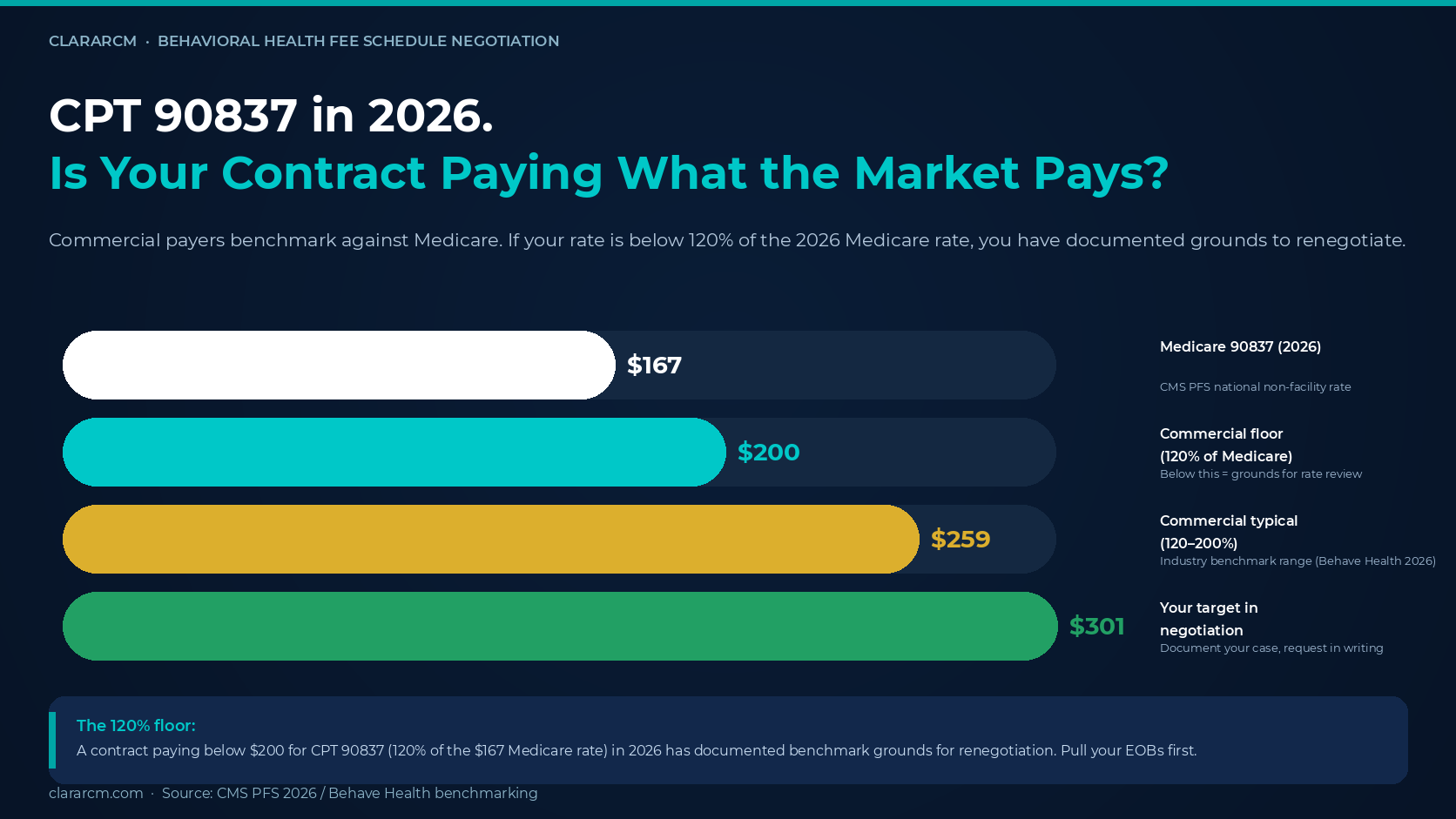
Commercial payers typically reimburse behavioral health services at 120% to 200% of the Medicare Physician Fee Schedule rate for the same code, and payer contract negotiations commonly reference the CMS conversion factor directly. A practice whose contracted rate falls below roughly 120% of the current Medicare rate for its core codes has a documented benchmark to support a negotiate therapy reimbursement rates request — and the 2026 Medicare rate recovery, with CPT 90837 rising to $167.00, gives practices the strongest benchmarking position in several years.
Negotiating therapy reimbursement rates is not aggressive or unusual — it is the standard operating procedure for any behavioral health practice serious about revenue cycle management, and most practices that haven’t done it are leaving measurable money on the table. Most accepted their first payer contract without negotiating and never looked at it again. The result is rates that haven’t moved while Medicare benchmarks have — and a growing gap between what the market pays and what the contract says. This guide covers the Medicare anchor that makes the math possible, how to benchmark your current contract, and how to structure a rate-review request that gets a response. For the broader behavioral health billing context, see ClaraRCM’s behavioral health revenue cycle management guide. For carve-out-specific rate issues, see our guide to billing Optum, Carelon, and Magellan carve-out plans.
The Medicare Anchor: How Commercial Rates for Behavioral Health Are Actually Set
Commercial payers do not set behavioral health reimbursement rates in a vacuum — they benchmark against the CMS Physician Fee Schedule, which means understanding the Medicare rate for any code is the starting point for any negotiate therapy reimbursement rates conversation. BCBS contract negotiations explicitly reference the CMS Conversion Factor when setting fee schedules. When Medicare increases, BCBS rates follow with a lag of 6 to 18 months.
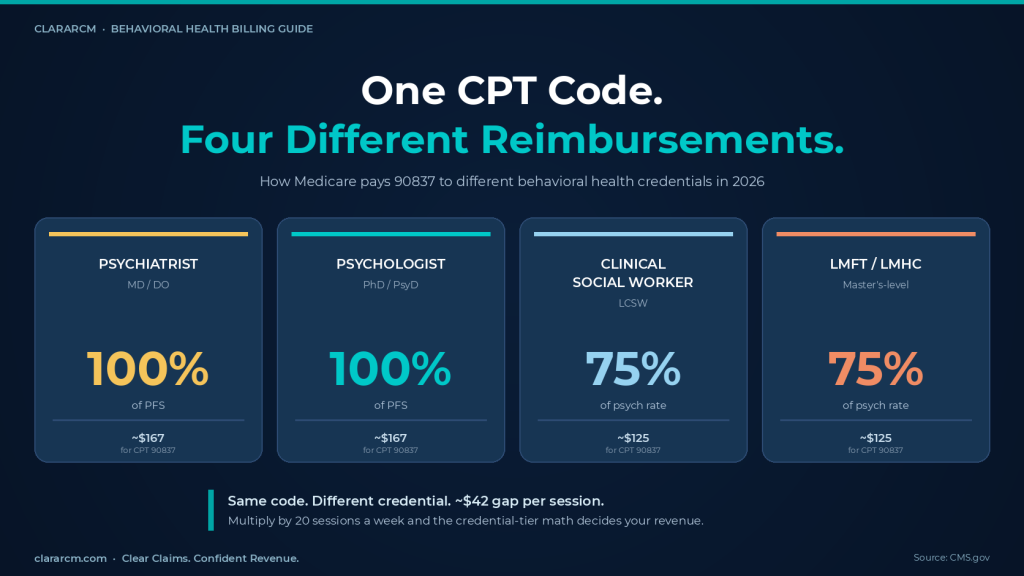
The 2026 CMS Physician Fee Schedule is the strongest benchmarking anchor in recent years. The conversion factor rose from $32.35 in 2025 to $33.40 in 2026 for non-QPP reporting practices, according to CMS PFS national RVU files reviewed in 2026. The result: CPT 90837 (individual psychotherapy, 53+ minutes) rose from $154.29 in 2025 to $167.00 in 2026 at the national non-facility rate. CPT 90834 rose to $113.90 and 90791 to $173.35.
That Medicare rate recovery matters for negotiate therapy reimbursement rates strategy because commercial contracts that were set during the 2025 low-rate period now sit further below the updated benchmark. A contract locked at 115% of the old $154.29 Medicare rate pays $177.43 per 90837 session. The same 115% applied to the 2026 $167.00 Medicare rate would pay $192.05. The practice is effectively getting a pay cut every year the contract isn’t updated — even though the percentage looks the same.
Benchmarking Your Contract: The Negotiate Therapy Reimbursement Rates Starting Point
The benchmarking exercise for negotiating behavioral health fee schedules is a simple calculation: divide your contracted rate for each code by the current Medicare rate for that code, and express the result as a percentage of Medicare. Practices whose commercial contracts pay below 120% of the 2026 Medicare rate for any CPT codes for psychotherapy have documented grounds to request a fee schedule review.
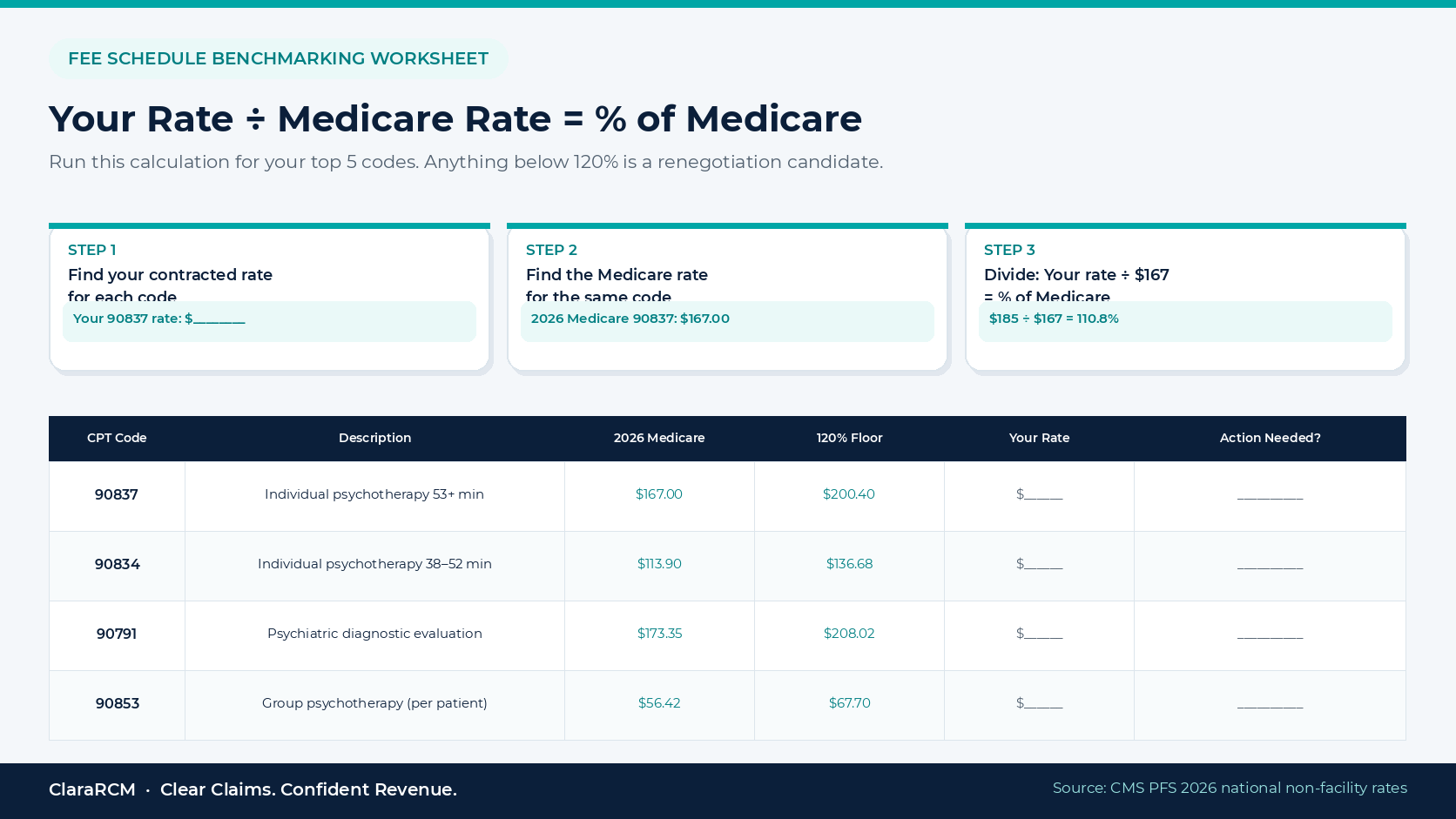
To run the benchmark, you need two numbers per code: your contracted rate (find this in your fee schedule addendum — the document attached to your provider agreement when you credentialed) and the current Medicare rate. Look up the Medicare rate on the CMS PFS Look-Up Tool, selecting your geographic locality. Divide your contracted rate by the Medicare rate and multiply by 100. The American Medical Association’s payer negotiation guidance recommends running this calculation annually for every core code — not just when a contract comes up for renewal.
| CPT | Description | 2026 Medicare rate | 120% floor | Typical commercial range |
|---|---|---|---|---|
| 90837 | Individual psychotherapy, 53+ min | $167.00 | $200.40 | $200–$334 (120–200%) |
| 90834 | Individual psychotherapy, 38–52 min | $113.90 | $136.68 | $137–$228 |
| 90791 | Psychiatric diagnostic evaluation | $173.35 | $208.02 | $208–$347 |
| 90853 | Group psychotherapy, per patient | $56.42 | $67.70 | $68–$113 |
Rate sources: All Medicare rates from the CMS Physician Fee Schedule Look-Up Tool, 2026 national non-facility rates per CMS PFS RVU files. Commercial ranges per Behave Health benchmarking data (2026). Verify your geographic locality rate before any negotiation conversation.
Building the Rate-Review Request
A rate-review request that produces a result has five components: a clear identification of the codes in question, the benchmarking calculation, a target rate expressed as a percentage of Medicare, supporting data, and a specific ask with a response deadline. Letters that say “our rates are too low” go nowhere. Letters that say “our current 90837 rate of $X represents 108% of the 2026 Medicare rate, below the 120% minimum documented threshold; we are requesting an increase to 130%, effective [date]” get a response.
- Identify the codes. Pull your top five billed codes by volume from your practice management system. These are the codes where a rate change has the most dollar impact.
- Run the calculation. For each code: your rate ÷ Medicare rate × 100 = % of Medicare. Flag anything below 120%.
- Set your target. Request a specific percentage of Medicare — 130% or 140% is a reasonable opening position for behavioral health services where demand exceeds supply. Anchor to the commercial range (120–200%) so you’re citing documented industry benchmarks, not a number you invented.
- Add the parity angle if applicable. If your behavioral health contracted rates run below the plan’s medical/surgical rates as a percentage of Medicare, that is a MHPAEA parity issue. The Department of Labor’s MHPAEA enforcement page and CMS’s mental health parity resource both confirm that plans must apply comparable financial requirements to behavioral health and medical/surgical benefits. Naming this in your letter — referencing 42 CFR § 146.136 and noting your preference to resolve in renegotiation rather than file a parity complaint — significantly elevates the urgency of the payer’s response.
- Request a response deadline. “We request a written response by [date 30 days out].” A deadline signals you are tracking this, not just filing a complaint that will sit unread.
Get your fee schedule first. Many practices can’t find their fee schedule addendum because they never received it or filed it without reading it. If you don’t have it, contact the payer’s Provider Relations line and request your current contracted fee schedule in writing. You can also check the Availity portal or your payer’s provider portal — most publish contracted rates there. Do not negotiate without knowing your baseline.
Leverage Points: Panel Scarcity, Outcomes, Access
Negotiating behavioral health fee schedules works best when the data argument is paired with one of three leverage points that make you harder to replace: panel scarcity in your geographic area or specialty, documented patient outcomes, or demonstrated access metrics the payer can use to report network adequacy.
Panel scarcity is the most immediate leverage point in 2026. Behavioral health provider shortages are documented across the United States, with wait times for in-network therapists and psychiatrists running months in many markets. A payer that drops or loses a behavioral health practice faces network adequacy complaints and potential regulatory scrutiny — especially under MHPAEA’s network composition requirements. Knowing how many in-network providers the payer has in your specialty and geography, and how many are accepting new patients, gives you a quantified version of that leverage.
Outcomes data shifts the conversation from cost to value. PHQ-9 improvement rates, session completion rates, and patient satisfaction scores documented over 12 months turn a rate negotiation into a conversation about ROI for the plan. Payers that are moving toward value-based arrangements respond well to this framing.
Access metrics matter because payers are required to report network adequacy to state regulators. If your practice accounts for a meaningful share of the plan’s behavioral health access in a geographic area — especially if you accept Medicaid, Medicare, and commercial plans simultaneously — that data makes you harder to replace and easier to justify paying more.
ClaraRCM’s behavioral health billing services include annual contract reviews that identify codes running below the 120% Medicare benchmark, flag parity issues, and prepare the rate-review documentation package. Our billing audit and cleanup services establish the baseline — the actual rates your claims are paying versus your contracted rates — which is essential before any negotiation, because underpayment and low contracted rates are two different problems with two different solutions.
Frequently Asked Questions About How to Negotiate Therapy Reimbursement Rates
How Do I Ask an Insurance Company for Higher Therapy Rates?
Submit a written rate-review request to the payer’s Provider Relations or Contract Management team — not a claims rep. The request should name the specific CPT codes, show your current rate as a percentage of Medicare (your rate ÷ Medicare rate × 100), state your target percentage with a specific dollar amount, cite the 120–200% commercial benchmark range, and request a written response by a specific date. Letters that cite documented benchmarks and a specific target get responses; general complaints rarely do.
What Percentage of Medicare Should Commercial Behavioral Health Plans Pay?
Across behavioral health services, commercial payers typically reimburse at an estimated 120–200% of Medicare rates for psychotherapy CPT codes, according to industry benchmarking data. A contract below 120% of Medicare is a documented benchmark case for a rate-review request. The exact achievable rate depends on your specialty, geography, panel availability, and the payer’s network adequacy situation in your area.
How Do I Find the Medicare Rate for My CPT Codes?
Use the CMS Physician Fee Schedule Look-Up Tool at cms.gov. Search by CPT code, select your geographic locality (MAC jurisdiction), and choose the non-facility setting for outpatient psychotherapy. The tool returns the 2026 Medicare-allowed amount for your specific location, which is the denominator in your benchmarking calculation. National non-facility rates for 2026: 90837 = $167.00; 90834 = $113.90; 90791 = $173.35.
Can I Use the Parity Law to Negotiate Higher Behavioral Health Rates?
Yes — if the payer’s behavioral health rates run below the same plan’s medical/surgical rates as a percentage of Medicare, that gap may represent a MHPAEA parity violation under 42 CFR § 146.136. Identifying this in your rate-review letter and stating a preference to resolve through renegotiation rather than file a parity complaint with the state insurance commissioner typically accelerates the payer’s response. This tactic is most effective for fully insured plans regulated by state insurance departments.

Andleeb Asghar, PharmD
RCM Specialist & Founder, ClaraRCM
Andleeb Asghar is a PharmD, medical billing professional, and revenue cycle management specialist with 7+ years of experience across behavioral health billing, payer contract management, fee schedule negotiation, denial management, and end-to-end RCM for U.S. mental health practices.
ClaraRCM provides revenue cycle and medical billing support. This content is for educational purposes and is not legal, clinical, or payer-contract advice.