Office-Based Buprenorphine Billing After the X-Waiver: What Changed
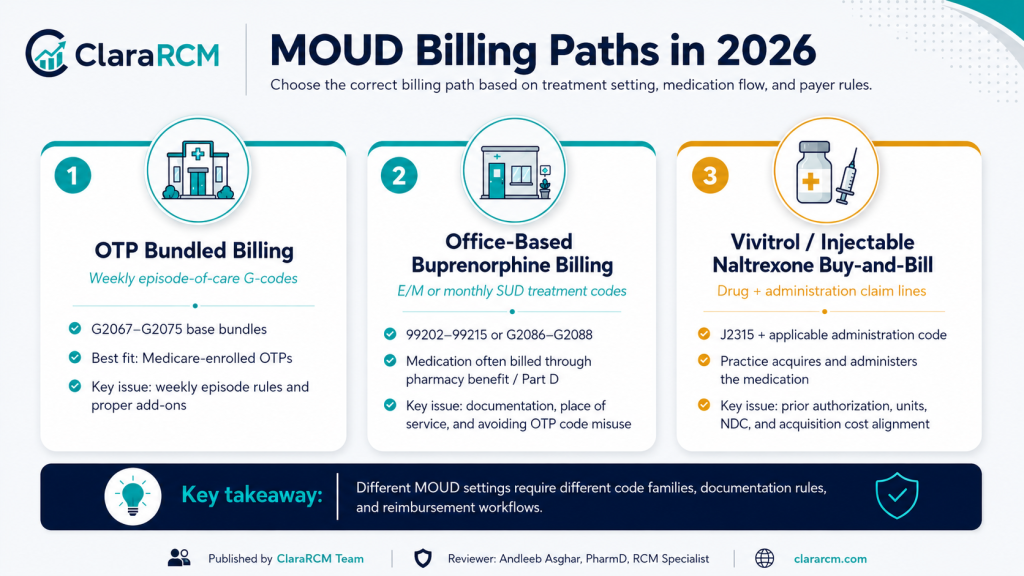
Office-based buprenorphine is billed using standard evaluation and management codes (99202–99215), not bundled OTP codes. The medication itself is billed separately through the patient’s pharmacy benefit, not through the medical claim. Since the DEA X-waiver requirement was eliminated in January 2023, any provider with a standard DEA registration can prescribe buprenorphine for opioid use disorder without a separate waiver.
Three years after the X-waiver disappeared, many practices still bill, credential, and document as if it exists — and others assume its removal changed billing rules that it never touched. This guide separates what the elimination actually changed from what stayed exactly the same. For how office-based billing fits alongside OTP bundles and injectable naltrexone, start with our MOUD Billing Guide 2026 .
What the X-Waiver Elimination Actually Changed
The X-waiver was a prescribing requirement, and its elimination changed prescribing access — not billing mechanics. Under the former DATA 2000 framework, prescribing buprenorphine for opioid use disorder required a separate waiver (the “X” number), waiver-specific training, and federal patient caps of 30, 100, or 275 patients.
Congress removed that framework effective January 2023. According to SAMHSA’s guidance on the waiver elimination , any practitioner with a current DEA registration that includes Schedule III authority may now prescribe buprenorphine for OUD where state law allows, and the federal patient caps no longer apply. What replaced the waiver training is broader: under the MATE Act, a one-time, eight-hour training requirement on treating substance use disorders now applies to practitioners at DEA registration and renewal — it is tied to the DEA registration itself, not to buprenorphine specifically, and per DEA it applies to all registrants except those who are solely veterinarians.
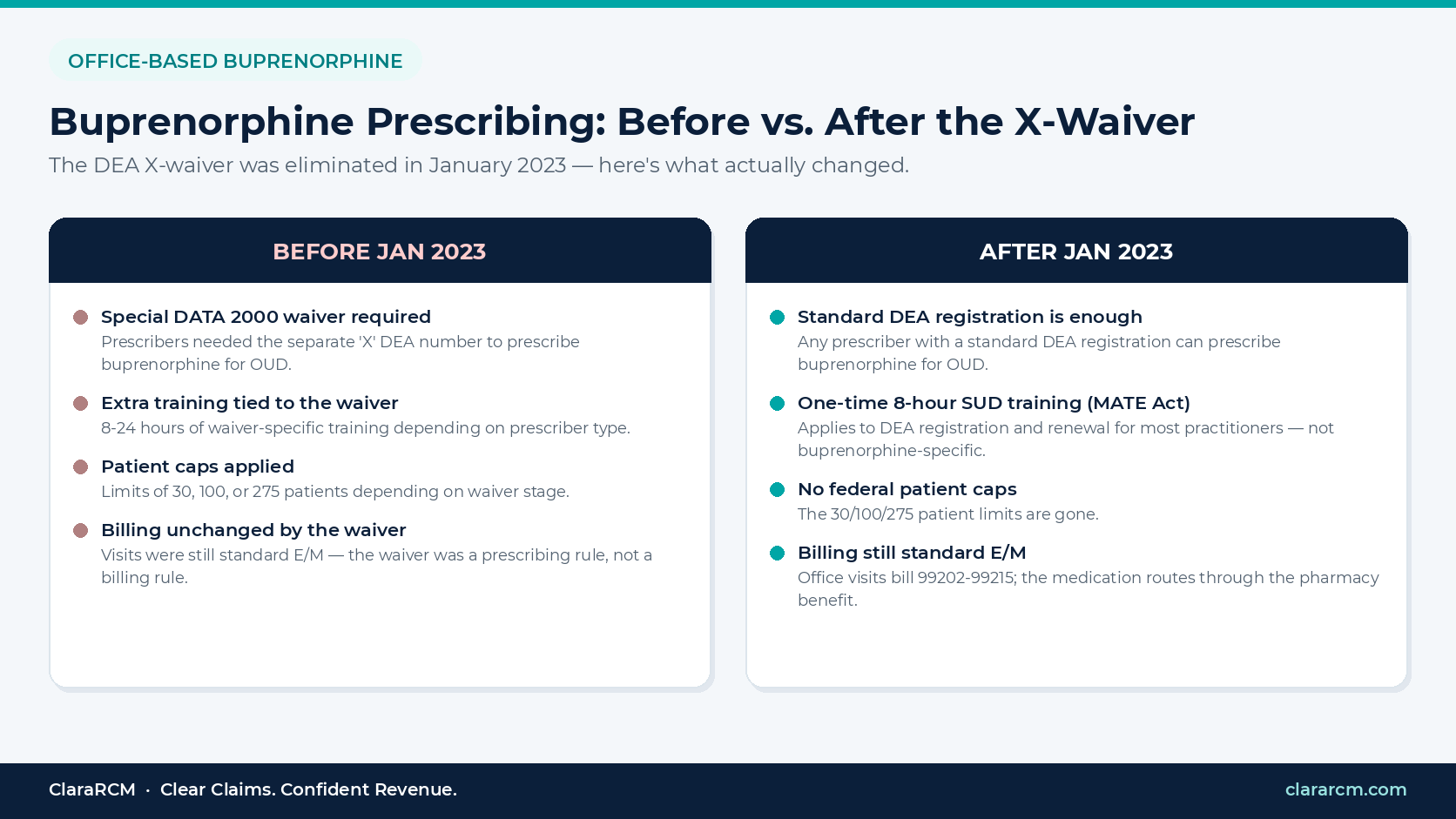
Just as important is what did not change. The elimination did not convert office practices into opioid treatment programs, did not authorize office-based use of OTP weekly bundles, and did not alter how the office visit itself is billed. Practices billing OTP bundled G-codes outside a Medicare-enrolled OTP will see those claims denied regardless of prescribing rules.
How Office-Based Buprenorphine Billing Works Today (E/M Codes)
The office visit bills as a standard evaluation and management service, leveled by medical decision-making or total time. New patients bill 99202–99205; established patients bill 99212–99215, with 99213 and 99214 the most common levels for ongoing buprenorphine management. Induction visits, dose adjustments driven by reviewed data, and visits managing withdrawal symptoms or co-occurring conditions frequently support moderate-complexity leveling when the documentation reflects that work.
The medication follows a different track entirely. Buprenorphine prescribed in the office is dispensed by the pharmacy and covered under the patient’s pharmacy benefit — Medicare Part D for Medicare patients — so the drug does not appear on the medical claim at all. The two claims travel separately: the E/M service to the medical payer, the prescription through the pharmacy. Confirming both benefits up front through eligibility and benefits verification prevents the most common surprise: an office visit that pays while the prescription stalls at the pharmacy over a formulary or prior authorization issue.
The exception on the medication side is injectable treatment administered in the office. Practices furnishing injectable naltrexone follow the buy-and-bill model instead — covered in our Vivitrol J2315 billing walkthrough .
The Monthly G2086–G2088 Option
When a practice delivers structured, time-intensive office-based SUD treatment, Medicare offers monthly bundled codes as an alternative to visit-by-visit E/M billing. G2086 covers the first calendar month, including treatment-plan development and at least 70 minutes of qualifying services; G2087 covers subsequent months with at least 60 minutes; and G2088 adds each additional 30 minutes beyond the monthly base.
The monthly bundle is earned by documented care coordination, counseling, psychotherapy, and treatment planning — not by the prescription alone. When the documented time and services don’t support the bundle, the correct claim is the E/M service for the visits that occurred. ClaraRCM’s medical coding support reviews whether each month’s record supports the bundle before the claim goes out.
Telehealth layer: Many office-based buprenorphine visits are furnished remotely, and audio-only rules add another decision point. Our guide to telehealth billing for buprenorphine and methadone treatment covers when remote visits are billable and how the audio-only exception works in 2026.
Credentialing Confusion That Still Persists
The most expensive lingering myth is that prescribers still need “something extra” on file to bill buprenorphine visits. Three years on, the confusion shows up in predictable places:
- Stale payer enrollment records. Some payer credentialing files still carry X-waiver fields or flags from before 2023. When enrollment data is outdated or inconsistent, claims can suspend for provider-eligibility review even though the prescribing was fully lawful.
- The MATE Act training mix-up. The one-time eight-hour training requirement belongs to DEA registration and renewal — it is not a buprenorphine credential, and payers do not adjudicate claims against it. Practices sometimes delay hiring or paneling decisions over a requirement that has nothing to do with billing.
- New prescribers assumed ineligible. NPs, PAs, and physicians who never held an X-waiver can prescribe under a standard DEA registration, but their payer enrollment must still be complete and current before their visits are billable under their own NPI.
The fix is administrative, not clinical: audit payer enrollment records for every prescriber treating OUD, clear out legacy waiver fields, and confirm each prescriber’s effective dates. ClaraRCM’s provider credentialing services handle that cleanup and keep enrollment current as the team grows. And when older claims denied over enrollment or documentation issues, our guide to why SUD and MOUD claims get denied walks through the appeal path.
Frequently Asked Questions
Do You Still Need an X-Waiver to Prescribe Buprenorphine?
No. The X-waiver requirement was eliminated in January 2023. A standard DEA registration is sufficient to prescribe buprenorphine for opioid use disorder, with no federal patient caps. A separate one-time, eight-hour training on substance use disorders now applies to most practitioners at DEA registration and renewal.
How Is Office-Based Buprenorphine Treatment Billed?
The office visit bills as a standard E/M service — 99202–99205 for new patients, 99212–99215 for established patients — and the medication routes separately through the patient’s pharmacy benefit. When documented monthly services meet the time thresholds, the G2086–G2088 monthly bundles are an alternative to visit-by-visit billing.
What CPT Codes Are Used for Buprenorphine Office Visits?
Most ongoing buprenorphine management visits bill 99213 or 99214, depending on the complexity and time documented. Induction and dose-adjustment visits often support moderate-complexity leveling. Structured monthly treatment can instead bill G2086 for the first month, G2087 for subsequent months, and G2088 for each additional 30 minutes.
Can an Office Practice Bill OTP G-Codes for Buprenorphine?
No. The weekly bundled G-codes belong to Medicare-enrolled opioid treatment programs. An office-based practice prescribing buprenorphine bills E/M services or the G2086–G2088 monthly codes — OTP bundles billed outside an OTP are denied.

Andleeb Asghar, PharmD
RCM Specialist & Founder, ClaraRCM
Andleeb Asghar is a PharmD, medical billing professional, and revenue cycle management specialist with 7+ years of experience across medical billing, medical coding, clean-claim submission, payer compliance, eligibility verification, denial management, accounts receivable recovery, payment posting, provider enrollment, billing audits, and end-to-end revenue cycle optimization for U.S. healthcare practices. She medically reviews ClaraRCM content for clinical terminology, coding context, regulatory accuracy, payer considerations, and clear communication for healthcare providers and practice leaders.
ClaraRCM provides revenue cycle and medical billing support. This content is for educational purposes and is not legal, clinical, or payer-contract advice.