Behavioral Health Supervision Billing Rules: HO Modifier, Incident-To, and Pre-Licensed Clinicians
Behavioral health supervision billing rules determine whether a practice may submit a supervised clinician’s service, whose NPI belongs on the claim, and whether a modifier such as HO is required. As of 2026, Medicare permits general supervision for qualifying behavioral health services furnished by auxiliary personnel incident to a physician’s or other listed practitioner’s professional service, but Medicare, Medicaid, and commercial payer rules are not interchangeable. A group practice must verify the clinician’s license level, state scope of practice, payer contract, supervision standard, and claim configuration before billing.
Behavioral health supervision billing is the process of determining whether services furnished by an associate, intern, trainee, or other auxiliary clinician may be billed under an enrolled supervising practitioner and what claim identifiers, modifiers, documentation, and supervision level the payer requires. This ClaraRCM operational guide focuses on the claim decisions that create the most risk for mental health group practices: confusing general supervision with automatic billability, treating the HO modifier as a universal rule, billing pre-licensed clinicians under a supervisor without payer permission, and failing to align the clinical record with the rendering and billing information sent on the claim.
This article is a focused spoke within ClaraRCM’s behavioral health revenue cycle management guide. It does not repeat the full revenue-cycle framework; it answers one operational question: how should a behavioral health practice decide whether a supervised service is billable and configure the claim without creating repayment exposure?
What Is the Behavioral Health Supervision Billing Decision Rule?
A supervised behavioral health service is billable only when five conditions align: the service is within state scope of practice, the payer recognizes the clinician or supervised-billing arrangement, the required supervision occurred, the claim identifies the correct billing and rendering parties, and the documentation supports both the service and supervision. A supervisor’s signature alone does not make a claim payable, and a payer’s general supervision policy does not automatically authorize billing for every unlicensed clinician.
| Decision check | Question to verify | Evidence to retain | Risk if skipped |
|---|---|---|---|
| State authority | May this clinician furnish the service under the applicable license, associate status, or training rule? | License or registration, scope rule, supervision agreement | Service may be outside legal scope |
| Payer permission | Does the payer enroll the clinician, recognize supervised billing, or require another pathway? | Provider manual, contract, written payer response | Denial or post-payment recovery |
| Supervision level | Is direct, general, on-site, or another supervision standard required? | Schedule, availability record, supervision note | Claim fails supervision conditions |
| Claim identity | Which NPI belongs in billing, rendering, supervising, or ordering fields? | Enrollment file, roster, claim map | NPI mismatch or false rendering record |
| Documentation | Does the note identify the actual clinician, service, time, plan, and required oversight? | Signed clinical note and supervision record | Medical-necessity denial or recoupment |
ClaraRCM operational rule: do not build a supervised-billing workflow from a modifier list alone. Start with the payer’s provider-recognition rule, then map supervision, NPI placement, modifier use, and documentation around that rule.
How Does Medicare Incident-To Billing Work for Behavioral Health in 2026?
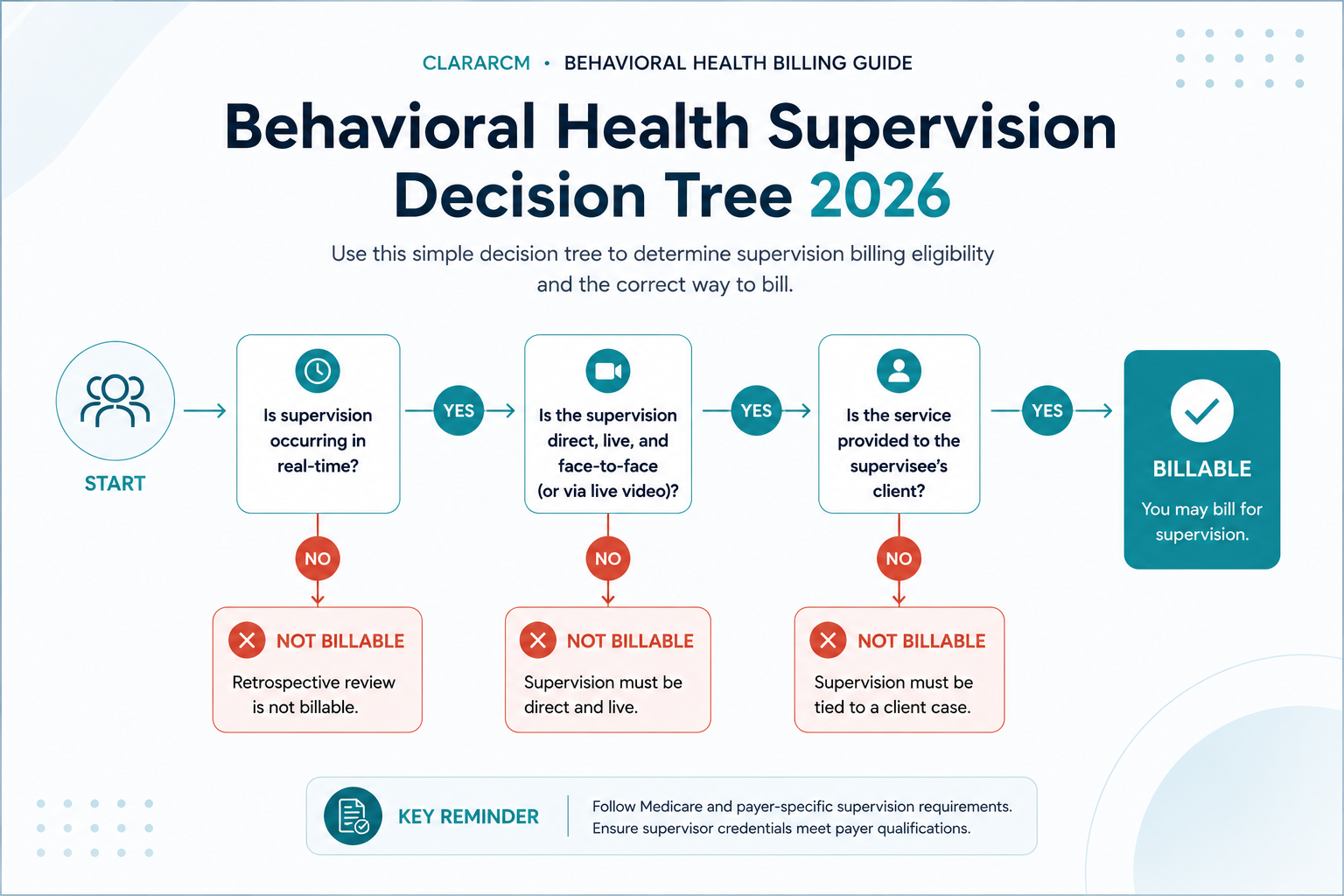
Medicare requires general supervision for behavioral health services furnished by auxiliary personnel incident to the professional services of a physician or other listed practitioner. According to the Centers for Medicare & Medicaid Services, the supervising practitioner must remain responsible and available under the general-supervision standard, but does not have to be physically present in the office solely because the service is behavioral health.
General supervision solves only the physical-presence question. It does not erase the other incident-to requirements. CMS states that the service must be an integral part of the patient’s normal course of treatment, follow an initial professional service, occur while the physician or other listed practitioner remains actively involved, represent an expense to the billing practice, and be furnished in the office or clinic setting under the applicable incident-to framework.
General supervision does not mean automatic billing under any supervisor
A practice should not translate “general supervision is allowed” into “every associate session can be billed under the owner.” The auxiliary person must still qualify under Medicare rules and state law, the billing practitioner must be eligible to bill the service, and the treatment relationship must satisfy the incident-to conditions. The note must identify the clinician who actually furnished the service; it should never make the supervisor appear to have personally performed care that another person delivered.
Primary-source checkpoint: review CMS’s current Incident To Services & Supplies guidance and the Medicare Benefit Policy Manual, Chapter 15 before configuring a Medicare workflow.
When Does the HO Modifier Apply in Behavioral Health Billing?
The HO modifier identifies a master’s-degree-level clinician, but its required use and payment meaning depend on the payer, program, state, service, and clinician enrollment status. It is not a universal Medicare supervision modifier, and adding HO does not independently authorize a practice to bill services furnished by an uncredentialed or pre-licensed clinician.
CMS maintains the national HCPCS Level II modifier system, while individual Medicaid agencies and commercial plans publish claim-specific instructions. For example, Colorado’s state behavioral health billing materials use HO in defined circumstances, and Anthem Colorado announced a distinct HO policy for certain supervised, unlicensed behavioral health services after independently enrollable LMFTs and LPCs became eligible for Medicare. Those are documented examples, not nationwide rules.
| Payer type | How to treat HO | What to verify | Do not assume |
|---|---|---|---|
| Original Medicare | Do not use HO as a substitute for incident-to eligibility or enrollment. | Incident-to conditions, practitioner eligibility, NPI fields | That HO makes a pre-licensed service payable |
| State Medicaid | Follow the state billing manual and managed-care contract. | Provider type, service code, modifier order, authorization | That another state’s rule applies |
| Commercial plan | Use only when the provider manual or written payer guidance requires it. | Credentialing tier, supervised-provider policy, fee schedule | That HO guarantees payment |
| Behavioral carve-out | Check the carve-out administrator, not only the medical plan. | Separate network rules and claim-routing instructions | That the medical carrier controls the rule |
The safest workflow is to store a payer-level rule for HO rather than applying the modifier globally. ClaraRCM recommends maintaining a matrix by payer, product, state, clinician type, service code, rendering-NPI rule, and effective date. This prevents a change made for one Medicaid program from contaminating every commercial claim in the practice management system.
Can a Practice Bill for Pre-Licensed Therapists, Associates, Interns, or Students?
A practice may bill a pre-licensed clinician’s service only when state law permits the service and the patient’s payer expressly recognizes the supervised-billing arrangement. Pre-licensed associates, interns, and students generally cannot be treated as independently enrolled Medicare practitioners merely because they work under an LMFT, LPC, psychologist, or physician.
The answer changes by payer. One commercial plan may credential registered associates, another may allow billing under a supervising clinician with specific modifiers, and another may exclude the service entirely. Medicaid policies may define eligible rendering types at the state level. Medicare incident-to rules may apply in limited configurations, but they are not a blanket substitute for independent enrollment.
Use a payer-by-payer clinician-status matrix
| Clinician status | Likely enrollment position | Billing question | Required proof |
|---|---|---|---|
| Fully licensed and enrolled | May render under own NPI, subject to contract | Is the clinician linked to the group and location? | Approval, roster, reassignment, effective date |
| Fully licensed, not enrolled | Not automatically billable to that payer | Can claims be held, backdated, or supervised? | Written payer policy and enrollment status |
| Registered associate | Payer-specific | Does the payer recognize associates or supervisor billing? | State registration and payer instruction |
| Intern or student | Usually restricted | Is the service covered under a defined training exception? | Program, site, supervision, and payer requirements |
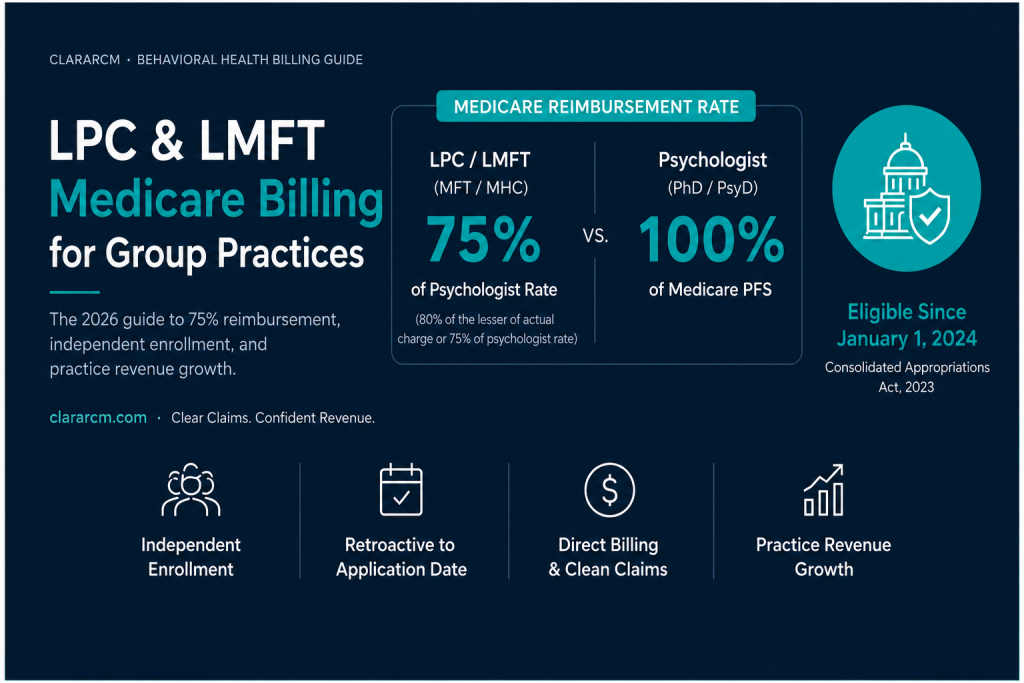
Fully licensed LPCs and LMFTs should also be evaluated for independent Medicare enrollment rather than left indefinitely in a supervised-billing workflow. ClaraRCM’s guide to LPC and LMFT Medicare billing for group practices explains individual enrollment, reassignment to a group, payment methodology, and effective-date controls.
What Claim Workflow Prevents Supervision Billing Denials?
The safest workflow resolves clinician eligibility before the visit, validates the payer-specific billing path before claim creation, and audits the final claim against the clinical note before submission. Supervision billing should be configured as a controlled exception, not handled through manual guesswork after a denial arrives.
- Classify the clinician. Record license, associate or trainee status, NPI, taxonomy, state, supervisor, and expiration dates.
- Verify the patient’s exact plan. Confirm whether behavioral health is administered by the medical payer or a separate carve-out.
- Confirm provider recognition. Determine whether the clinician is individually enrolled, rostered through the group, recognized as an associate, or eligible only under a specific supervised pathway.
- Map the supervision requirement. Record whether the payer requires general, direct, on-site, immediately available, or documented periodic supervision.
- Configure claim identity. Set the correct billing, rendering, supervising, referring, and service-facility fields rather than copying one NPI into every position.
- Apply modifiers only when required. Store HO or other payer-required modifiers at the payer-product level.
- Audit the note-to-claim match. The note should identify who furnished the service and support the time, modality, diagnosis, plan, and supervision represented on the claim.
Internal-link workflow: verify the clinician’s participation through provider credentialing, confirm the patient’s product through eligibility and benefits verification, and then apply the payer-specific claim configuration before submission.
Which Supervision Billing Errors Trigger Denials or Recoupments?
The highest-risk errors are billing an ineligible clinician under a supervisor, misrepresenting who rendered the service, using HO without payer authority, failing the required supervision level, and producing documentation that does not match the claim. These errors may initially pay because the claim passes automated edits, then surface during credential, utilization, or medical-record review.
Wrong rendering NPI
The claim names the supervisor as renderer even though payer rules require the actual clinician or do not recognize the supervised configuration.
Invisible clinician
The note does not clearly identify who performed the session, creating a mismatch between the record and the claim.
Modifier overreach
HO is added globally even where the payer does not require it or where it cannot cure enrollment ineligibility.
Expired status
An associate registration, supervisor agreement, payer roster, or license expires while claims continue under the old configuration.
Supervision not evidenced
The practice cannot show that the required supervisor was available, involved, or documented for the relevant date of service.
Cross-payer copying
A Medicaid or commercial configuration is copied to Medicare or another payer without verifying the separate rule.
When a payer requests records, do not automatically rebill every service under a different code or NPI. First isolate the affected payer, clinician, dates, products, modifiers, and claim fields. ClaraRCM’s denial management services can identify whether the issue is documentation, enrollment, routing, supervision, or claim identity, while billing audit and cleanup services can quantify historical exposure before the payer expands its review.
Behavioral Health Supervision Billing Questions From Practice Owners
Can I bill Medicare for sessions performed by a pre-licensed therapist?
Not automatically. The service must satisfy state law and every applicable Medicare incident-to requirement, including the treatment relationship, eligible billing practitioner, auxiliary-personnel status, supervision, setting, expense, and documentation conditions.
Does general supervision mean the supervisor can work from another location?
General supervision means the service is furnished under the supervisor’s overall direction and control without requiring physical presence during the service. The practice must still satisfy CMS rules, state law, payer conditions, and any availability or documentation requirements.
Do I add the HO modifier whenever a master’s-level therapist provides care?
No. HO is payer- and program-specific; use it only when the applicable manual, contract, or written payer guidance requires it for that clinician and service. It does not replace enrollment or authorize an otherwise non-billable arrangement.
Should the supervisor or the associate appear as the rendering provider?
The correct rendering field depends on the payer’s claim instructions and whether it recognizes the associate or requires a supervised-billing configuration. The clinical note should always identify the person who actually furnished the service.
Can I use one supervision billing setup for every insurance company?
No. Medicare, each state Medicaid program, commercial networks, and behavioral health carve-outs can use different enrollment, supervision, modifier, NPI, and documentation rules. Build and maintain a payer-product matrix instead of a universal configuration.
What should I audit before hiring pre-licensed clinicians?
Audit state scope rules, supervisor qualifications, payer recognition, enrollment pathways, fee schedules, claim-field requirements, modifier rules, authorization limits, and documentation standards. Complete that review before forecasting revenue from the clinician’s caseload.

Andleeb Asghar, PharmD
RCM Specialist & Founder, ClaraRCM
Andleeb Asghar is a PharmD and revenue cycle management specialist with 7+ years of experience in medical billing, behavioral health claim workflows, provider credentialing, denial management, accounts receivable recovery, coding context, payer compliance, and billing audits for U.S. healthcare practices.
ClaraRCM provides revenue cycle and medical billing support. This educational content is not legal advice, payer-contract advice, or a substitute for current payer manuals and state licensing rules.