Denial Management in Medical Billing: The 8-Step Process
Denial management in medical billing is the structured process of receiving an adjudicated denial, interpreting the remittance, prioritizing the account, finding the root cause, selecting the correct recovery action, following the payer response, verifying payment, and preventing recurrence. The sequence matters because not every denial should be appealed or resubmitted.

A practice does not have a denial management process merely because someone checks an ERA and resubmits unpaid claims. Effective claim denial management creates a controlled record of what happened, who owns the next action, when the deadline expires, which evidence is required, whether the payer changed its decision, and whether the final payment posted correctly.
This article owns the operational workflow and sequence. For code lookup, use ClaraRCM's medical billing denial code glossary. Practices that need the work performed for them can review our denial management services.
What Is Denial Management in Medical Billing?
Denial management is the part of revenue cycle management that resolves claims already adjudicated differently than expected and converts their root causes into preventive controls. It begins with the payer's remittance or formal status and ends only when payment or final disposition is verified and the responsible workflow owner receives the finding.
| Account status | What happened | Correct operational queue |
|---|---|---|
| Rejected claim | The claim failed front-end validation or transmission and did not complete payer adjudication. | Correct the data or format error and resubmit through the claim-submission workflow. |
| Denied claim or line | The payer adjudicated the claim or service line and applied a nonpayment or adjustment reason. | Review the group code, CARC, RARC, policy, claim history and documentation before choosing the action. |
| Underpayment | The claim paid, but the allowance or payment appears lower than the expected contract or policy amount. | Send to payment-variance or contractual review rather than treating it as a routine denial. |
| Unpaid or pending claim | No final adjudication has been confirmed. | Check claim status first; do not label every unpaid balance a denial. |
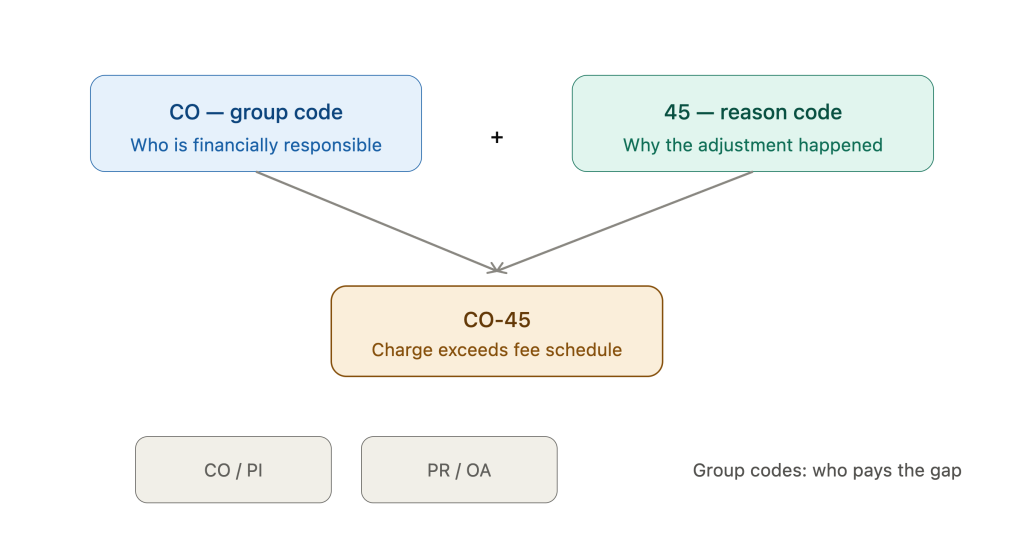
Standards context: X12 says CARCs describe why a claim or service line was paid differently than billed, and group codes generally assign responsibility for adjustment amounts. CMS explains that an ERA or SPR can contain the group code, CARC and RARC. Use the current X12 CARC list, X12 RARC list, and CMS remittance guidance.
The 8 Steps in the Medical Billing Denial Management Process
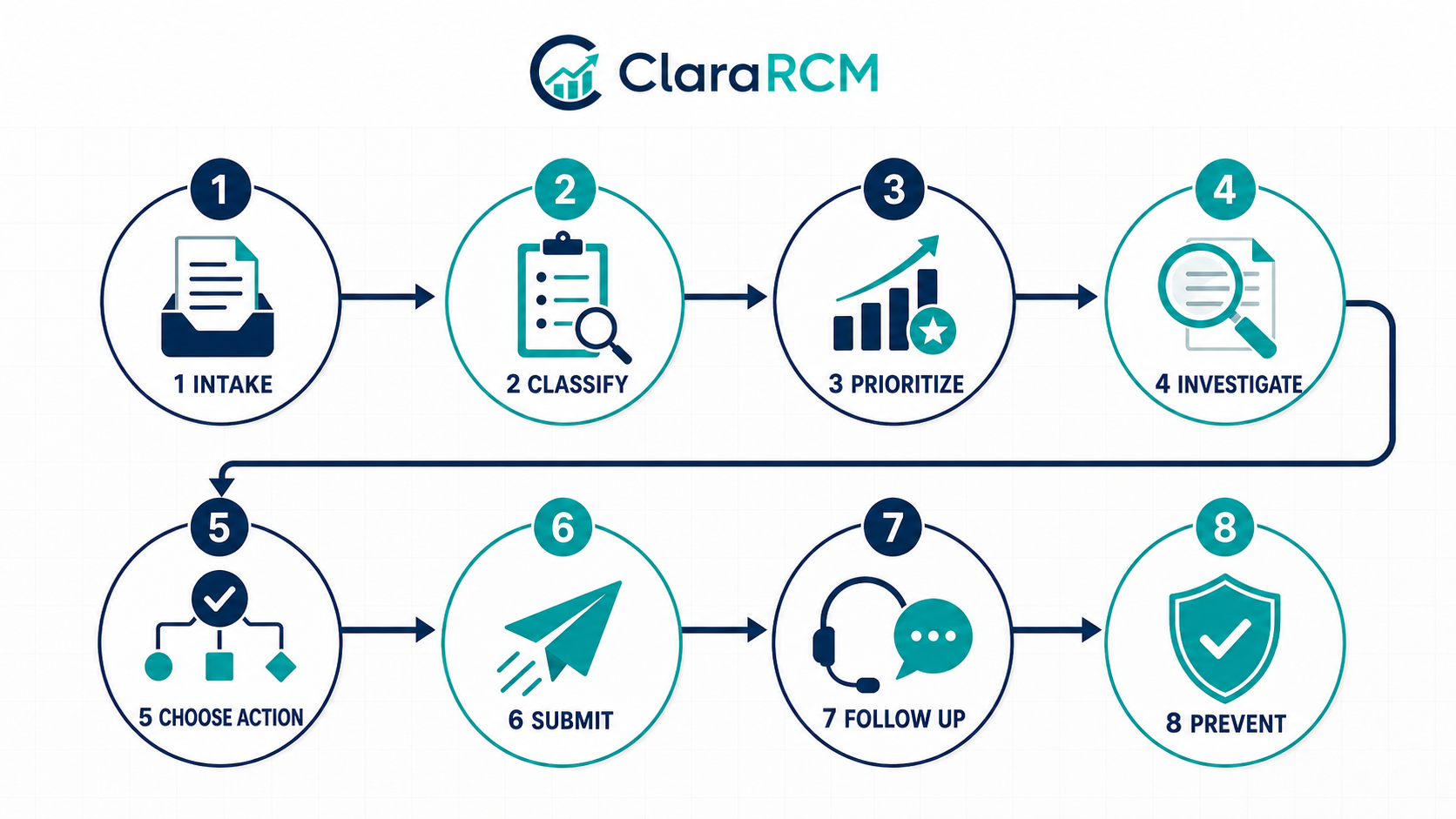
The eight steps are intake, classification, prioritization, root-cause investigation, action selection, submission, follow-up with payment verification, and prevention feedback. Each stage should produce a defined output before the account moves forward.
Intake
Create one complete denial record from the remittance and claim history.
Classify
Separate denials, rejections, adjustments, underpayments and pending claims.
Prioritize
Order work by deadline, value, age, recoverability and recurrence.
Investigate
Find the real cause across patient, provider, coding, documentation and payer data.
Choose Action
Select correction, inquiry, reconsideration, appeal, records response or closure.
Submit
Send the right transaction or evidence through the payer's required channel.
Follow Up
Track receipt, response, escalation and actual payment posting.
Prevent
Assign the root cause and corrective control to the upstream owner.
Intake the Denial From the Authoritative Source
Start with the ERA, SPR, EOB, payer portal or finalized claim-status response—not a vague workqueue label. Capture enough information for another team member to reproduce the decision: payer, patient account identifier, claim-control number, date of service, billed and allowed amounts, group code, CARC, RARC, affected line, adjudication date, filing or appeal deadline, and current owner.
Link the denial to the original claim, clearinghouse acceptance, authorization record, eligibility response, documentation and prior payer correspondence. If one of those records is missing, record that gap as part of the work rather than guessing.
Classify the Denial Before Assigning the Fix
Classification determines which workflow should own the account. Separate front-end rejection, adjudicated denial, patient responsibility, contractual adjustment, underpayment, duplicate, pending claim, documentation request and final nonrecoverable balance. Then interpret the group code, CARC and every associated RARC together.
Do not let the CARC alone dictate the remedy. CO-16 requires the related remark code to identify what is missing. CO-234 says a procedure was not paid separately, but the remark and payer policy identify whether packaging, bundling, an edit or another rule caused it. Use the ClaraRCM denial code glossary for concise code definitions.
Prioritize by Deadline, Value, Recoverability and Pattern
Workqueues should protect appeal rights and cash—not simply process the oldest account first. Rank each denial using the earliest action deadline, expected reimbursement, aging, probability of correction, documentation availability and whether the same error is affecting many claims.
A low-dollar denial can deserve immediate attention when it is the first sign of a systemwide configuration defect. A high-dollar balance may need to wait briefly for records or credentialing evidence. Create separate queues for imminent deadlines, high-value claims, recurring payer patterns, records requests and accounts blocked by missing information.
Investigate the Root Cause Across the Revenue Cycle
The payer's reason is the starting point; the root cause is the workflow failure that produced it. Compare the remittance with the claim, documentation, eligibility response, authorization, provider enrollment, contract and payer policy.
Eligibility and COB
Coverage date, member match, benefit administrator, payer order and other insurance. See eligibility verification.
Authorization
Approved service, provider, code, units, dates, setting, notification and concurrent review.
Coding and Documentation
CPT/HCPCS, ICD-10-CM, modifiers, units, medical necessity and record support. See medical coding support.
Provider and Location
Enrollment, network effective date, taxonomy, NPI, rendering provider, location and reassignment. See provider credentialing.
Claim Construction
Payer ID, frequency code, control number, place of service, dates, attachments and clearinghouse history.
Contract and Payer Processing
Expected allowance, bundling, policy version, network tier, payment methodology and possible payer error.
Choose the Correct Recovery Action
Do not appeal every denial and do not resubmit every claim. The correct action depends on payer instructions, claim status, evidence and the reason payment differed from expectation.
| Finding | Likely action path | Critical control |
|---|---|---|
| Front-end rejection or unadjudicated error | Correct and resubmit through the claim-submission workflow. | Confirm the replacement reached and was accepted by the payer. |
| Correctable adjudicated claim data | Submit a corrected or replacement claim according to payer instructions. | Use the required frequency code and payer claim-control number. |
| Payer processing or payment error | Claim inquiry, reopening, reconsideration or contractual dispute. | State the expected result and attach contract or processing evidence. |
| Medical necessity or coverage dispute | Formal appeal with policy-specific clinical and administrative support. | Address the actual criterion; do not send a generic appeal template. |
| Records or information requested | Submit the required records through the designated channel. | Track page count, confirmation, deadline and request reference. |
| Wrong payer or COB sequence | Correct coverage order and bill the responsible payer. | Preserve proof of original timely submission when relevant. |
| Valid contractual adjustment | Post or correct the contractual adjustment; investigate only if the allowance is wrong. | Do not bill a CO amount to the patient without a valid basis. |
| Valid patient responsibility | Transfer the balance only after adjudication, secondary coverage and posting are validated. | Follow the plan, contract and applicable patient-billing rules. |
Appeal scope: payer processes differ. For example, Original Medicare Part A and Part B appeals begin with MAC redetermination, while Medicare Advantage and commercial plans use different pathways. Verify the instructions and deadline on the determination. See the current CMS Original Medicare appeals overview.
Submit the Correction, Response or Appeal Completely
Build the submission around the payer's required channel and the specific defect. Include the claim-control number, member and provider information, dates of service, affected lines, requested outcome, factual timeline, policy or contract support, documentation index and proof of timely filing when relevant.
For corrected claims, confirm whether the payer requires a replacement frequency code, original control number or portal-specific workflow. For appeals, explain why the initial decision should change; do not attach a generic letter and unrelated records. ClaraRCM's claim submission service supports the upstream claim-build and transmission controls.
Follow Up Until Final Disposition and Verify Payment
A submitted appeal is not a resolved denial. Track payer receipt, reference numbers, status, additional requests, decision, next escalation date and final adjudication. Use portal or electronic claim-status tools when available; CMS notes that Medicare supports electronic 276 claim-status requests and 277 responses.
When the payer overturns or reprocesses the claim, confirm that the expected payment appears on the remittance and posts to the correct account. Check the new adjustment codes, contractual amount and remaining patient balance. Connect this work with payment posting and AR follow-up so “approved” cases do not remain unpaid.
CMS describes the 276/277 claim-status request and response process as an electronic method for obtaining and posting Medicare claim-status information.
Feed the Root Cause Back Into Prevention
The denial management process is incomplete until the upstream defect has an owner and control. Aggregate results by payer, CARC/RARC, code, provider, location, authorization, claim editor, dollar value and recurrence. Then assign a concrete correction: an eligibility field, authorization tracker, coding edit, documentation prompt, credentialing checkpoint, claim-build rule or payer escalation.
Measure whether the same pattern falls after the change. Closing claims without measuring recurrence creates recovery activity but not process improvement. For multi-payer or inherited backlogs, a billing audit and cleanup can separate systemic defects from isolated claim errors.
Metrics That Show Whether Denial Management Is Working
Track both recovery and recurrence. A team can close many accounts while preventable denials continue entering the queue. Define every denominator consistently before comparing periods.
Initial Denial Rate
Claims denied on initial adjudication divided by all claims adjudicated in the same period. Exclude pending claims.
Denied Dollars
Expected reimbursement affected by initial denials, segmented by payer, cause, provider, service and age.
Time to First Action
Elapsed time from denial receipt to the first documented, appropriate corrective or appeal action.
Recovery Rate
Recovered dollars divided by the recoverable denial inventory—not billed charges and not all contractual adjustments.
Decision Outcome
Paid, partially paid, upheld, pending, records requested, redirected, patient responsibility or finally closed.
Repeat-Denial Rate
Frequency of the same validated root cause after its corrective control was implemented.
Management rule: do not publish one denial percentage without showing payer mix, dollar impact, top root causes, aging and the definition used. A lower rate can still conceal high-value denials or held claims that never reached adjudication.
Common Denial Management Workflow Failures
- Combining rejections, denials, underpayments and pending claims in one queue.
- Reading the CARC without the group code, RARC, paid amount and payer policy.
- Prioritizing only by age while ignoring appeal deadlines and recurring defects.
- Appealing correctable claim errors or resubmitting claims that require formal review.
- Using generic appeal letters that do not address the payer's stated criterion.
- Marking a denial resolved when an appeal is submitted rather than when payment or final disposition is verified.
- Posting valid patient responsibility without checking secondary coverage and adjudication.
- Recovering individual claims without assigning the repeat root cause to an upstream owner.
Ask ClaraRCM to Review Your Denial Workflow
Tell us where denials are getting stuck. ClaraRCM will identify the first report, remittance sample or workflow your practice should examine.
Your workflow review request was received.
ClaraRCM will review your information and identify the first denial-management workflow your practice should investigate.
Book a 30-Minute CallFrequently Asked Questions About Denial Management in Medical Billing
What is denial management in medical billing?
Denial management in medical billing is the structured process of receiving an adjudicated denial, interpreting the remittance, prioritizing the account, finding the root cause, choosing and submitting the correct action, following the payer response, verifying payment or final disposition, and preventing recurrence.
What are the eight steps in the denial management process?
The eight steps are denial intake, classification, prioritization, root-cause investigation, action selection, submission, payer follow-up with payment verification, and prevention feedback. Each step should produce a documented output before the account moves forward.
What is the difference between a rejected claim and a denied claim?
A rejected claim generally fails front-end validation or transmission before payer adjudication. A denied claim or service line has been adjudicated and returned with a nonpayment or adjustment reason. Rejections typically return to claim correction; denials require remittance and claim-context review.
Should every denied claim be appealed?
No. Depending on the cause and payer instructions, the correct action may be a corrected claim, claim-status inquiry, reopening, reconsideration, records response, formal appeal, contractual review, patient-liability validation, or final closure.
How long does denial management take?
Time varies by denial type, payer, documentation availability, correction or appeal channel, and review level. Measure internal time to first action separately from payer decision time, and track the deadline and next follow-up date for every account.
How should a practice measure denial management success?
Track initial denial rate, denied dollars, time to first action, recovery against recoverable inventory, decision outcomes, deadline compliance, payment verification and repeat-denial rate. Define each denominator consistently and segment results by payer and root cause.

Andleeb Asghar, Pharmacist
RCM Specialist & Founder, ClaraRCM
Andleeb Asghar is a Pharmacist, medical billing professional, and revenue cycle management specialist with experience in denial management, remittance interpretation, payer follow-up, coding review, credentialing and end-to-end RCM for U.S. healthcare practices.
Last updated: August 20, 2026. ClaraRCM provides medical billing and revenue cycle management support. This article is educational and is not legal, clinical, coding or payer-contract advice. CARCs, RARCs, code sets, payer policies, appeal rights, filing limits, contracts and documentation requirements can change. Verify the current remittance, payer instructions, contract, official code list and applicable rules before correcting a claim, billing a patient or filing an appeal.