
CPT 99203 and 99053 Explained: New Patient & After-Hours Billing
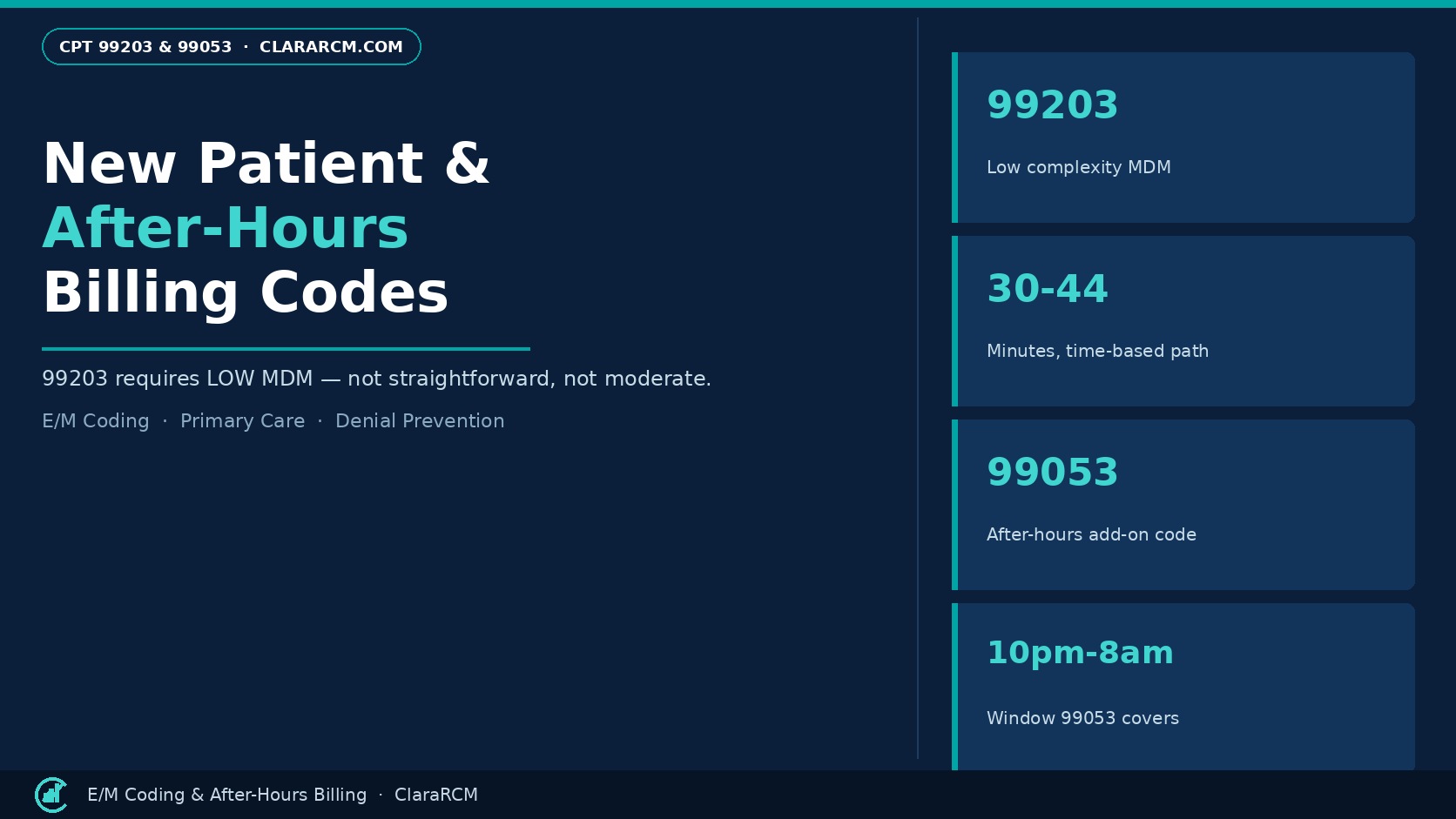
CPT 99203 requires low complexity medical decision making (MDM) — not "straightforward to moderate," as some AI search summaries currently and incorrectly state. Straightforward MDM is 99202. Moderate MDM is 99204. 99203 sits specifically in between, at low complexity, or alternatively 30–44 minutes of total time on the date of the encounter. CPT 99053 is a separate, unrelated add-on code for services provided between 10pm and 8am at a facility otherwise closed, billed in addition to the primary service — never on its own.
These two codes get searched together constantly but describe completely unrelated things — CPT 99203 is a new-patient evaluation and management level, while CPT 99053 is an after-hours add-on that can attach to almost any primary service. This guide covers both precisely, corrects a documented AI-summary error on CPT 99203's MDM requirement, and explains exactly how the two codes combine for an after-hours new patient visit. For broader E/M and primary care billing support, see our primary care billing services, and for the official code language itself, see the AMA's CPT code resource and the AMA's Evaluation and Management coding hub.
CPT 99203 Explained
CPT 99203 is defined by the AMA as an office or outpatient visit for the evaluation and management of a new patient, requiring a medically appropriate history and/or examination and a low level of medical decision making — or, when time is used for code selection instead, 30–44 minutes of total time spent on the date of the encounter.
Correcting a live AI Overview error: some automated search summaries currently describe 99203 as requiring "straightforward to moderate" MDM. That's wrong. Straightforward MDM is the threshold for 99202. Moderate MDM is the threshold for 99204. 99203 requires low complexity specifically — its own distinct tier, not a blend of the two neighboring codes.
"New patient" has a precise definition under CPT guidelines: the patient hasn't received a professional service from the same physician, or another physician of the same specialty in the same group practice, within the past three years. Billing 99203 for a patient who technically doesn't meet this definition — even if they've never seen this specific provider — is a common, avoidable denial trigger.
Where 99203 Sits in the E/M Ladder
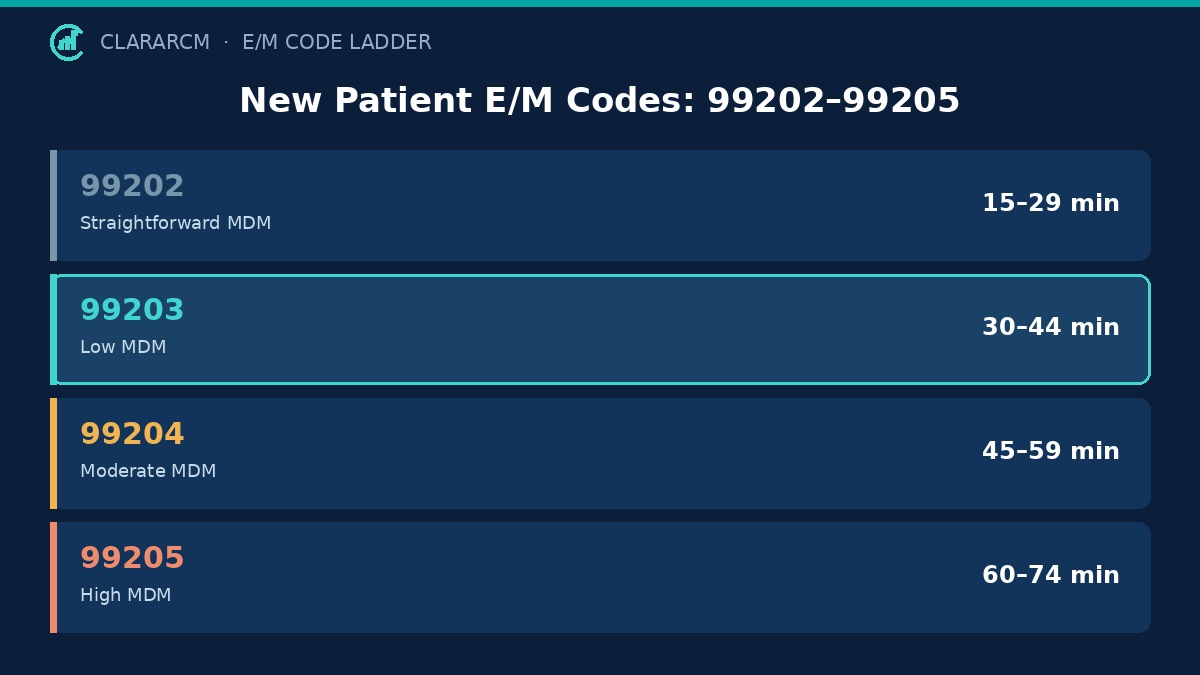
The new patient E/M series runs from 99202 through 99205, with each level defined by either MDM complexity or total time — 99203 is the second level, requiring low MDM or 30–44 minutes.
| Code | MDM complexity | Time (if used instead) |
|---|---|---|
| 99202 | Straightforward | 15–29 minutes |
| 99203 | Low | 30–44 minutes |
| 99204 | Moderate | 45–59 minutes |
| 99205 | High | 60–74 minutes |
Documentation must fully support whichever path — MDM or time — was used to select the code. Coding 99203 when the note only supports straightforward (99202) complexity is undercoding by omission if time also wasn't met; coding it when the note actually supports moderate (99204) complexity is a missed level, and revenue left uncollected.
CPT 99053 Explained
CPT 99053 is an add-on code describing a service provided between 10pm and 8am at a 24-hour facility, billed in addition to the basic service performed — it cannot be billed on its own, because it doesn't describe a service by itself, only the timing surcharge on top of one. 99053 is one of a small family of time-of-service and facility-status add-on codes (alongside codes covering weekend/holiday service and non-24-hour facility after-hours service) that some payers recognize and others don't reimburse separately at all.
Verify payer acceptance before relying on 99053 for revenue: unlike core E/M codes, after-hours add-on codes are inconsistently recognized across payers. Some commercial plans reimburse them at a modest add-on rate; others bundle the after-hours premium into the primary code's contracted rate and don't pay 99053 separately at all.
Billing 99203 and 99053 Together
When a new patient is seen after-hours at a qualifying 24-hour facility, 99203 is billed as the primary E/M code and 99053 is added as a second line for the same encounter — never billed as a replacement for 99203, only alongside it. The documentation must independently support both: the MDM or time threshold for 99203, and the actual time-of-service (10pm–8am) and facility-status qualification for 99053.
Common Denial Triggers
Patient doesn't meet "new" definition
Billed as new when the same-specialty group has seen the patient within 3 years. Fix: verify patient status in the EHR before coding.
MDM level mismatch
Documentation supports straightforward (99202) or moderate (99204), not low. Fix: confirm two of three MDM elements meet the low-complexity threshold, or use the time pathway instead.
Billed standalone
99053 submitted without a primary service code on the same claim. Fix: 99053 is always an add-on — verify a base code is present.
Payer doesn't recognize the code
Not every payer separately reimburses after-hours add-ons. Fix: verify the specific payer's policy before counting on 99053 as separate revenue.
ClaraRCM's medical coding support team verifies MDM level and new-patient status before E/M claims go out, and our claim submission process catches missing add-on codes like 99053 before the claim leaves the practice. For denials that have already occurred, our denial code glossary explains how to read the specific rejection reason, and our AR follow-up team works aged E/M-related denials before timely filing windows close.
Which New Patient E/M Code Applies?
Answer 2 quick questions and we'll identify the likely correct code for your visit.
Q1: How was the code selected — MDM complexity or total time?
Q2: What level, or how many minutes?
ClaraRCM will review your E/M coding setup and follow up within 1 business day.
Request received
A ClaraRCM specialist will follow up within 1 business day.
Frequently Asked Questions
What is CPT code 99203?
CPT 99203 is a new patient office or outpatient E/M visit requiring low complexity medical decision making, or alternatively 30–44 minutes of total time on the date of the encounter. It's the second level in the new patient series (99202–99205).
What does 99053 mean in medical billing?
CPT 99053 is an add-on code for a service provided between 10pm and 8am at a facility that operates 24 hours. It's billed alongside the primary service code, not on its own, and represents an after-hours timing surcharge rather than a standalone service.
Can 99203 and 99053 be billed together?
Yes, when a new patient is seen after-hours at a qualifying 24-hour facility. 99203 is billed as the primary E/M code and 99053 is added as a second line for the same encounter, provided documentation supports both independently.
What's the difference between 99202 and 99203?
99202 requires straightforward MDM or 15–29 minutes of total time. 99203 requires low complexity MDM (one level higher) or 30–44 minutes of total time. The two are not interchangeable, and documentation must support whichever code is billed.

Andleeb Asghar, Licensed Pharmacist
RCM Specialist & Founder, ClaraRCM
Andleeb Asghar is a licensed Pharmacist, medical billing professional, and revenue cycle management specialist with 7+ years of experience across E/M coding, medical decision making documentation, denial management, and end-to-end RCM for U.S. healthcare practices across all specialties.
Last updated: August 8, 2026. ClaraRCM provides revenue cycle and medical billing support. This content is for educational purposes and is not legal or payer-contract advice. CPT codes and descriptors are maintained by the AMA and update periodically. Verify current codes and payer-specific reimbursement policies before applying to claims.