S9083 Code: Meaning, Billing, Reimbursement & Denial Guide
S9083 is the HCPCS code described as “Global fee urgent care centers.” It is used when an applicable payer contract or policy reimburses an urgent care encounter through a global or case-rate methodology rather than paying every service separately. The most important billing rule is not to assume S9083 works the same for every payer: current payer policies differ materially, so contract terms, place of service and payer-specific instructions must be checked before submission.
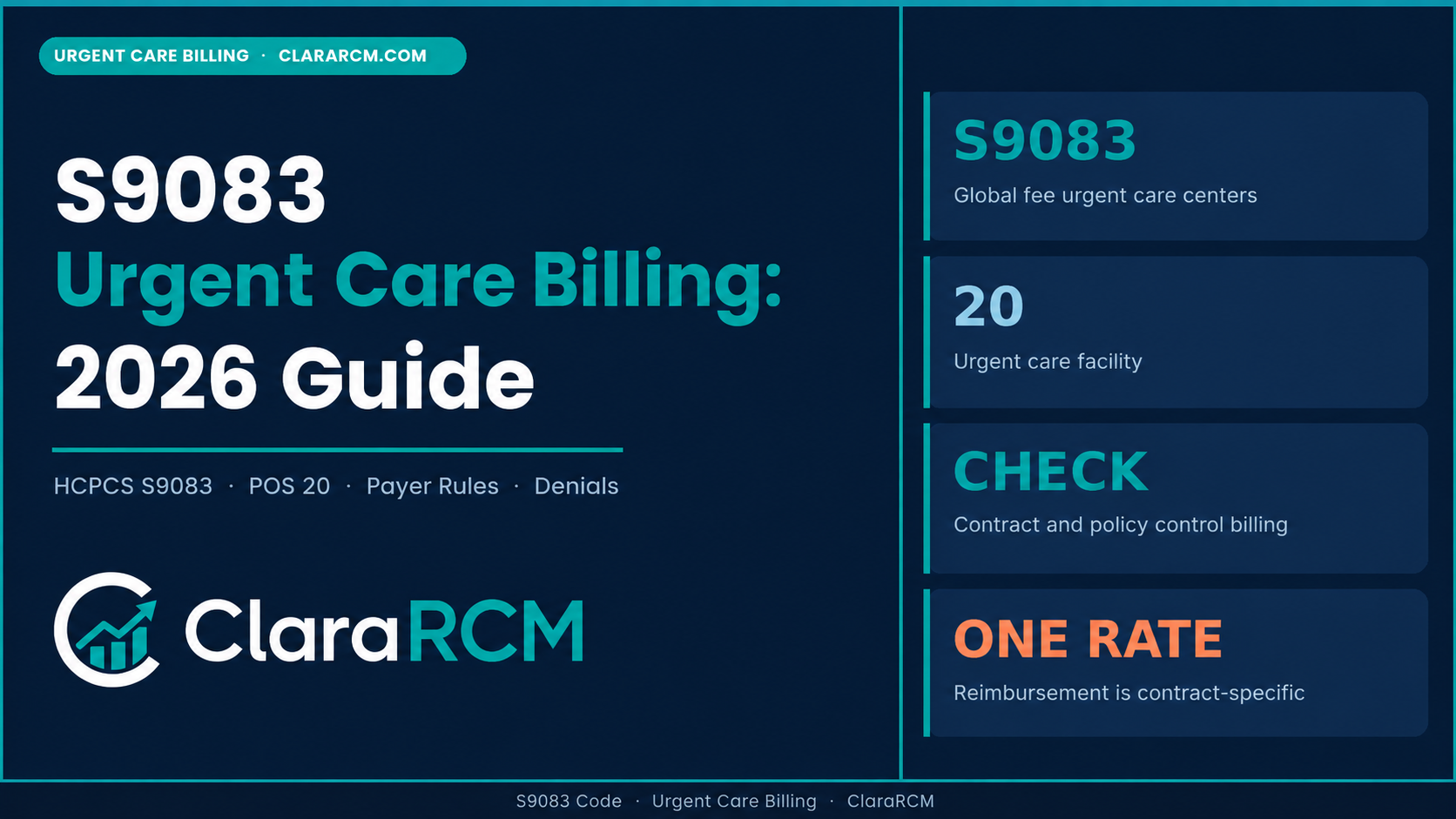
If you searched for an S9083 CPT code description, an important terminology point comes first: S9083 is an HCPCS Level II code, not a CPT code. The descriptor identifies a global-fee urgent care service, but the descriptor alone does not tell a practice whether a particular payer will reimburse it, what dollar amount applies, which services are included in the case rate, or whether another coding method is required.
That distinction is where many urgent care billing problems begin. One payer may contract around S9083 as a global encounter code. Another may require specific E/M and procedure codes. A third may recognize S9083 only under defined place-of-service rules. This guide explains how to make that decision without turning a payer-specific code into a universal billing rule.
What Is HCPCS Code S9083?
HCPCS S9083 identifies a global fee for urgent care centers. In practical revenue-cycle terms, it can function as a case-rate billing mechanism when the payer's contract or reimbursement policy instructs the urgent care center to use it. Instead of assuming that every individual service will be separately reimbursed, the practice must understand what the applicable global arrangement includes and excludes.
Authoritative descriptor: AAPC's HCPCS reference lists S9083 as “Global fee urgent care centers.” The code is therefore best understood as an urgent-care global-fee code—not as a substitute for clinical documentation and not as a universal instruction for every payer.
The operative phrase is global fee. A global or case-rate arrangement usually means reimbursement is tied to the encounter under contract terms rather than simply adding up the fee schedule for each service. Whether laboratory testing, imaging, medications, supplies or procedures are separately reimbursable depends on the contract and payer policy. Do not infer carve-outs from the S9083 descriptor itself.
S9083 Code: Quick Facts
| Question | Practical answer |
|---|---|
| What does S9083 mean? | Global fee urgent care centers. |
| Is S9083 CPT or HCPCS? | HCPCS Level II. Searchers often call it a CPT code, but technically it is HCPCS. |
| Is S9083 always payable? | No. Reimbursement is payer- and contract-specific. |
| What place of service is associated with urgent care? | POS 20 identifies an urgent care facility. A payer may specifically require POS 20 for S9083. |
| Is S9083 the same as S9088? | No. S9083 is the global-fee code; S9088 has a different urgent-care add-on/informational function and payer treatment can differ. |
| Can S9083 be billed with an E/M code? | Do not assume so. Follow the payer contract and reimbursement policy. A global-fee arrangement may replace separate E/M reimbursement. |
| Is there one national S9083 reimbursement rate? | No universal rate should be assumed. Contract terms and payer methodology control payment. |
When Should an Urgent Care Center Use S9083?
Use S9083 only when the applicable payer contract, provider manual or reimbursement policy supports that billing method for the encounter. Do not select it simply because the patient was seen at an urgent care center.
Before coding the claim, verify four things:
- Payer acceptance: Does this payer recognize and reimburse S9083 for your product and network?
- Contract methodology: Is your urgent care agreement global/case-rate, fee-for-service, or a hybrid with negotiated carve-outs?
- Site requirement: Does the payer require POS 20 or another facility/location condition?
- Bundling rules: Which services are included in the global reimbursement, and which—if any—may be separately reported?
A practice that skips this sequence can create two opposite errors. It may submit S9083 to a payer that does not reimburse the code, causing avoidable denials. Or it may submit separate fee-for-service lines to a payer whose contract expects a global encounter code, causing incorrect adjudication or unnecessary rework.
Do not build an S9083 rule from another payer's behavior. A policy that is correct for one insurer, state product or network is not automatically valid for another.
Why S9083 Billing Is Payer-Specific in 2026
The clearest way to understand S9083 is to compare actual payer policies. Current 2026 payer guidance shows that the same HCPCS code can be treated differently across health plans.
| Payer example | Published S9083 treatment | Operational lesson |
|---|---|---|
| Ambetter Health — selected 2026 state notices | Multiple Ambetter state notices say S9083 became reimbursable on the stated 2026 effective date when billed with POS 20; claims with another place of service are denied under those notices. | POS can be a hard reimbursement edit. Verify the state/product notice and its effective date. |
| UnitedHealthcare Commercial / Individual Exchange | UnitedHealthcare's urgent care reimbursement policy lists S9083 and S9088 as non-reimbursable and directs providers to report the E/M and/or procedure codes describing the services, with an appropriate POS. | A code recognized by one payer may be expressly non-reimbursable by another. |
This is why a good S9083 workflow starts with the payer contract and current reimbursement policy—not a generic code list. Eligibility alone does not answer the question either. A patient can be eligible for coverage while the urgent care still bills the encounter incorrectly under its provider contract.
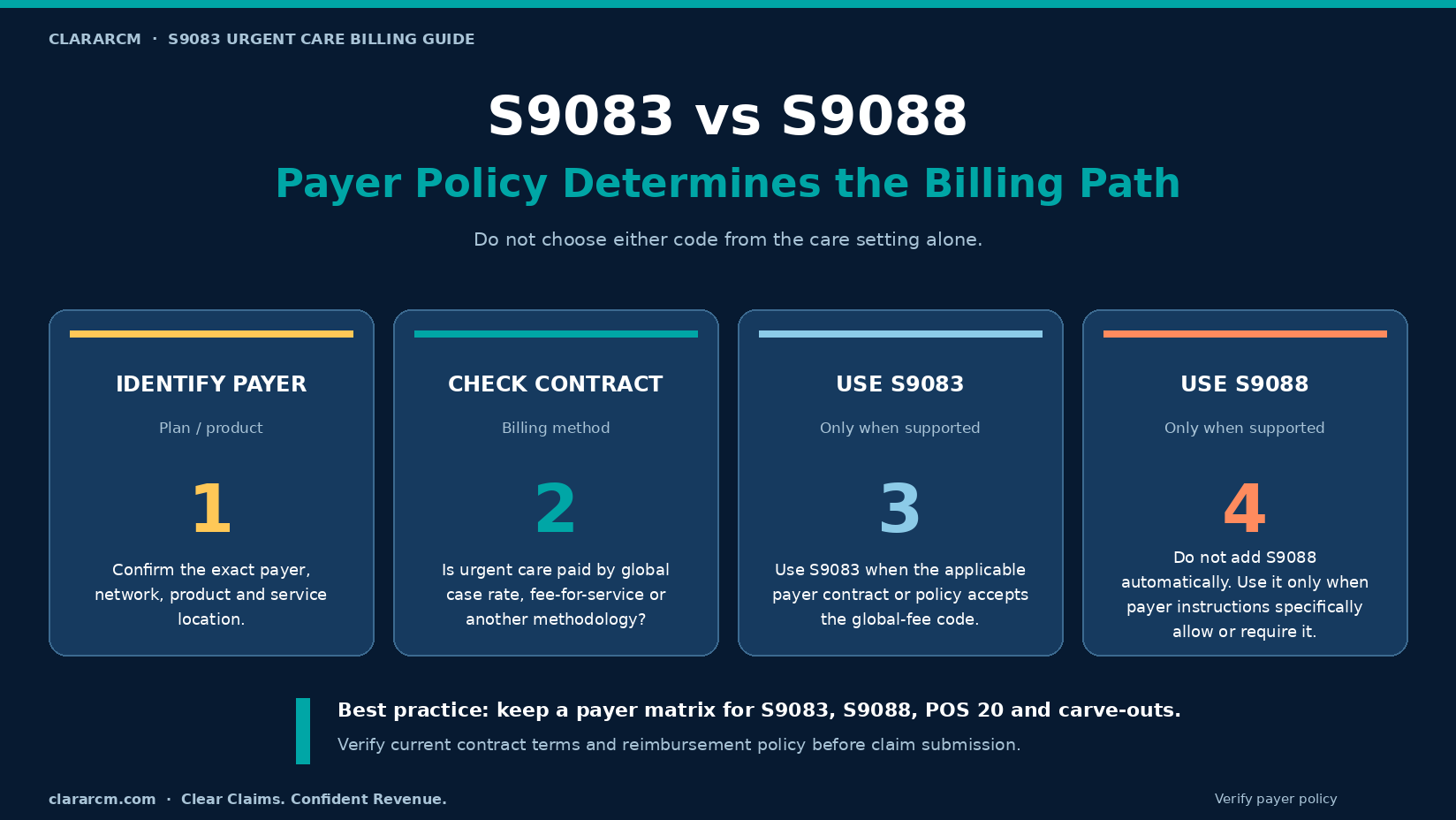
For practices managing multiple commercial plans, create a payer matrix that records the accepted billing model for each product: global S9083, fee-for-service E/M/procedure coding, S9088 treatment, POS requirement, carve-outs, claim form, timely filing and reconsideration/appeal pathway.
What Place of Service Is Used With S9083?
POS 20 is the CMS place-of-service code for an urgent care facility. For S9083, however, the practical question is whether the payer specifically requires POS 20 for reimbursement.
Current Ambetter 2026 notices provide a useful example: the notices state that S9083 and S9088 are reimbursable when billed with place of service 20 and that claims submitted with another place of service will be denied under the announced policy. That makes POS more than a descriptive field—it can directly affect payment.
Example: If an applicable payer policy requires S9083 + POS 20, submitting the same code with POS 11 because the practice's EHR defaulted to “office” can trigger a preventable denial. The correction is not to add random modifiers; it is to validate the actual service location, credentialing and payer requirement and then correct the claim only if the original POS was wrong.
If your organization provides both traditional office visits and urgent care encounters, make sure the EHR location master, claim rules and payer enrollment data do not automatically assign the same POS to every site.
S9083 vs S9088: What Is the Difference?
S9083 represents a global fee for an urgent care center, while S9088 identifies services provided in an urgent care center as an add-on/informational urgent-care code under payer-specific rules. They should not be treated as interchangeable.
| Feature | S9083 | S9088 |
|---|---|---|
| Core concept | Global fee / case-rate urgent care billing. | Urgent-care add-on or informational code used with another reported service when payer rules support it. |
| Primary billing question | Does the payer contract reimburse the visit globally? | Does the payer allow or require S9088 in addition to the underlying service? |
| Relationship to E/M | A global arrangement may replace separate reimbursement for the E/M portion. | Often discussed as an additional code, but payer policy controls whether it is accepted or paid. |
| Payer treatment | Varies. Some policies recognize it; others do not reimburse it. | Also varies and should never be assumed from the code description alone. |
| Main risk | Using global-fee billing when the payer expects specific services—or separately billing services already included in the global rate. | Adding it when the payer does not recognize/reimburse it or when contract rules do not support it. |
For a broader look at urgent-care claim construction, visit ClaraRCM's urgent care billing services and workflow page.
Can You Bill S9083 With 99202–99215 or Other E/M Codes?
There is no safe universal answer; the payer contract determines whether an E/M code is separately reportable when S9083 is used. Because S9083 represents a global-fee concept, separately reporting an E/M service to a case-rate payer may conflict with the contract if that professional service is included in the global payment.
By contrast, UnitedHealthcare's published commercial policy takes a different route: it lists S9083 as non-reimbursable and instructs providers to report the specific E/M and/or procedure codes that describe the services performed, together with the appropriate place of service.
Use this decision rule:
Before Choosing S9083 or an E/M Code
- Identify the exact payer and product.
- Open the provider contract, amendment, fee schedule and current reimbursement policy.
- Confirm whether urgent care is paid as a global/case rate or fee-for-service.
- If global, identify what the rate includes and any negotiated carve-outs.
- If fee-for-service, code the documented services under the payer's normal rules.
- Confirm POS, rendering/billing provider enrollment and any payer-specific code edits.
- Document the billing rule in your payer matrix so the decision is reproducible.
If your team frequently has to guess which code path applies, the issue is usually not a lack of coding knowledge—it is missing contract configuration. ClaraRCM's medical coding support and eligibility and benefits verification workflows should be connected to payer-specific billing rules rather than treated as isolated tasks.
How Much Does S9083 Reimburse?
There is no single national S9083 reimbursement amount that an urgent care center should assume. Payment can depend on the payer, network, contract, product, geographic market, negotiated case rate and whether additional services are carved out or included.
This is an important content gap in many S9083 explanations. A website may quote an “average” reimbursement figure, but that number is not a substitute for your signed agreement or payer fee schedule. Two urgent care centers can submit the same code and receive different allowed amounts because their contracts are different.
How to determine your actual S9083 rate
- Locate the applicable payer contract and fee schedule.
- Confirm whether the rate is tied to S9083, a case-rate appendix or another reimbursement methodology.
- Check the effective date and product/network applicability.
- Review whether labs, imaging, injections, supplies or procedures are included or carved out.
- Compare expected reimbursement with the ERA/EOB after adjudication.
- Investigate recurring payment variance rather than automatically adjusting it off.
If the payer repeatedly pays below the contracted amount, that belongs in a payment-variance and AR follow-up workflow, not simply a denial queue.
How to Bill S9083: A Payer-Aware Claim Workflow
The safest S9083 billing workflow begins before claim submission. Contract configuration, location setup and encounter documentation should determine the code path automatically whenever possible.
| Step | What to verify | Why it matters |
|---|---|---|
| 1. Identify payer/product | Member plan, network, delegated administrator and product line. | The same insurer can have different rules across products. |
| 2. Check contract methodology | Global/case rate vs fee-for-service; effective date; amendments. | Determines whether S9083 is even the correct billing path. |
| 3. Validate location | Actual site of service, POS, credentialed location and payer enrollment. | Incorrect POS can trigger denial and may not reflect where care occurred. |
| 4. Review documentation | Services actually performed and medical record completeness. | A global code does not remove documentation obligations. |
| 5. Check included services | What is bundled vs separately billable under the contract. | Prevents duplicate or lost reimbursement. |
| 6. Build the claim | S9083 or service-specific coding, POS, provider, diagnosis, modifiers and required lines. | Claim construction must follow the payer's reimbursement model. |
| 7. Submit and monitor | Clearinghouse acceptance, payer receipt and claim status. | A clean transmission does not guarantee correct adjudication. |
| 8. Compare payment | ERA allowed amount, CARC/RARC, contract expectation and patient responsibility. | Detects denials, underpayments and setup errors quickly. |
For upstream claim controls, see ClaraRCM's claim submission services. For recurring code and payer-rule problems, review billing audit and cleanup services.
Why S9083 Claims Get Denied
S9083 denials commonly trace back to payer acceptance, place of service, contract configuration, provider/location setup or a mismatch between the payer's required global-vs-fee-for-service billing method. The denial code itself is only the starting point.
| Potential problem | What to check first | Corrective direction |
|---|---|---|
| Payer does not reimburse S9083 | Current reimbursement policy and contract. | Do not repeatedly resubmit the same code. Determine the payer's required service-specific coding method. |
| Wrong place of service | Actual encounter location, EHR location mapping, payer POS rule. | Correct only if the original POS was inaccurate and payer correction rules permit it. |
| Urgent-care location not properly configured/enrolled | NPI, taxonomy, service location and payer enrollment. | Resolve provider/location enrollment or claim setup before resubmission. |
| Global fee conflicts with separately billed lines | Contract inclusion/carve-out language. | Determine whether the additional lines are contractually separately reimbursable. |
| Fee-for-service payer received S9083 | Payer code policy and claim history. | Review whether specific documented E/M/procedure coding is required. |
| Expected case rate did not pay | ERA codes, contract rate, effective date and product. | Treat possible payment variance separately from a coding denial. |
When the claim is formally denied, read the group code, CARC, RARC and payer message together. Do not use a generic “S9083 appeal template” without identifying the actual reason. ClaraRCM's denial code glossary can help interpret adjustment codes, while the denial management service is the commercial pathway for practices that need end-to-end follow-up.
S9083 Billing Examples
Example 1: Payer contract uses an urgent-care case rate
An urgent care center's contract explicitly instructs the provider to bill S9083 for qualifying in-person urgent-care encounters and defines the global reimbursement methodology. The billing team verifies the correct payer product, location and POS, then follows the contract's rules for any separately reimbursable carve-outs. Key point: S9083 is being used because the contract supports it—not merely because the patient visited urgent care.
Example 2: Payer policy does not reimburse S9083
A commercial payer's reimbursement policy lists S9083 as non-reimbursable and requires the specific E/M and/or procedure services instead. The coder reports only the services supported by the record under the payer's rules and uses the correct POS. Key point: copying another payer's S9083 workflow would create an avoidable denial.
Example 3: POS mismatch
The payer recognizes S9083 only when billed with POS 20, but the claim was submitted with POS 11 due to an incorrect location mapping. The team verifies where the service actually occurred, checks the payer correction process and corrects the claim if appropriate. It also fixes the EHR mapping so the error does not recur. Key point: correcting the individual claim without repairing the upstream configuration leaves the denial pattern intact.
Example 4: Payment is lower than the expected case rate
The claim adjudicates and pays, but the allowed amount is below the contract's current S9083 case rate. This is not automatically a coding denial. The billing team compares the contract effective date, product, ERA and fee schedule and routes the account to payment-variance follow-up. Key point: paid does not always mean paid correctly.
S9083 Pre-Submission Checklist
- Confirm the exact payer and product.
- Confirm the urgent-care site is correctly enrolled and configured.
- Verify whether the payer accepts S9083 for this contract/product.
- Confirm the reimbursement methodology: global/case rate or fee-for-service.
- Verify POS requirements, including whether POS 20 is mandatory.
- Check what the global rate includes and what is carved out.
- Do not separately report services included in the global rate unless the contract permits it.
- Do not assume S9088 should be added to S9083.
- Do not assume an E/M code is separately payable with S9083.
- Validate documentation for all services performed even when payment is global.
- Compare adjudicated payment against the expected contractual amount.
- Feed recurring denials or underpayments back into payer-specific claim rules.
Authoritative Sources Used for This S9083 Guide
This article intentionally prioritizes payer and code-source evidence over generic billing blogs because S9083 rules vary by payer.
- AAPC Codify — HCPCS S9083: descriptor “Global fee urgent care centers.”
- Ambetter Health 2026 S9083/S9088 notice: example of 2026 reimbursement tied to POS 20 under the notice's applicable plan/state conditions.
- UnitedHealthcare Commercial / Individual Exchange Urgent Care Policy: example of a payer policy listing S9083/S9088 as non-reimbursable and directing service-specific coding.
- CMS Place of Service Codes: official POS reference; verify current CMS definitions and payer-specific use.
Unsure Whether Your Payer Wants S9083 or Fee-for-Service Billing?
Tell ClaraRCM where the issue is occurring. We can help identify the first payer rule, claim sample or workflow your urgent care should review.
Thank you — your request was received.
ClaraRCM will review the information and identify the first urgent-care billing workflow to examine.
Frequently Asked Questions About S9083
What is S9083?
S9083 is an HCPCS Level II code described as “Global fee urgent care centers.” It is used under payer-specific reimbursement arrangements in which an urgent care encounter is handled through a global or case-rate methodology. Whether it should be billed depends on the payer contract and current policy.
Is S9083 a CPT code?
No. S9083 is an HCPCS Level II code. People frequently search for “S9083 CPT code,” but technically the code belongs to HCPCS rather than the CPT code set.
What is the place of service for S9083?
POS 20 identifies an urgent care facility. Some payer policies specifically require S9083 to be billed with POS 20. Always verify the applicable payer rule because reimbursement requirements are not identical across health plans.
Can S9083 be billed with an E/M code?
Do not assume an E/M code is separately billable with S9083. Because S9083 represents a global-fee concept, the payer contract may include the E/M service in the case rate. Other payers may reject S9083 entirely and require the specific E/M and procedure codes instead.
What is the difference between S9083 and S9088?
S9083 represents a global fee for an urgent care center. S9088 is an urgent-care add-on/informational code used with another service when payer rules support it. They are not interchangeable, and payer acceptance should be verified before either code is submitted.
How much does S9083 reimburse?
There is no single universal S9083 reimbursement amount. Payment can vary by payer, provider contract, product, market and negotiated case-rate terms. Use the applicable contract and fee schedule rather than relying on an online “average” rate.

Andleeb Asghar, Pharmacist
Founder & RCM Specialist, ClaraRCM
Andleeb Asghar is a Pharmacist and revenue cycle management professional with experience in U.S. medical billing, denial management, payer follow-up, coding review, eligibility, credentialing and end-to-end RCM workflows.
Last updated: August 24, 2026. This article is educational and does not replace payer contracts, current reimbursement policies, coding guidance or legal advice. S9083 rules can vary by payer, state, product, network and effective date. Verify the current payer policy, provider agreement, fee schedule, place-of-service requirement and documentation before submitting or correcting a claim.