
Chiropractic Billing Services Built Around the AT Modifier, 98940 to 98942, and Medicare's Strictest Documentation Rules
Chiropractic billing is the process of coding and submitting claims for chiropractic manipulative treatment using CPT codes 98940 to 98942, applying the AT modifier to distinguish active corrective care from non-covered maintenance therapy, and documenting a spinal subluxation to support medical necessity under Medicare's chiropractic benefit. Medicare's chiropractic coverage is one of the narrowest in the entire program — it pays only for active manipulation to correct a documented subluxation, and CMS reports that insufficient documentation drives 95.5% of chiropractic improper payments. ClaraRCM builds AT modifier compliance and subluxation documentation review directly into the coding workflow for chiropractic practices across all 50 states.
ClaraRCM handles chiropractic coding, AT modifier compliance, subluxation documentation review, and denial management for chiropractic practices across all 50 states, so active care claims get paid and maintenance care never gets billed as active by mistake.
U.S.-based billing and coding team. No offshore operations.
✓ Last updated: July 2026Get a Free Chiropractic Billing Audit
See exactly where AT modifier errors and documentation gaps are putting your Medicare claims at risk.
What Is Chiropractic Billing, and Why Does Medicare Deny So Much of It?
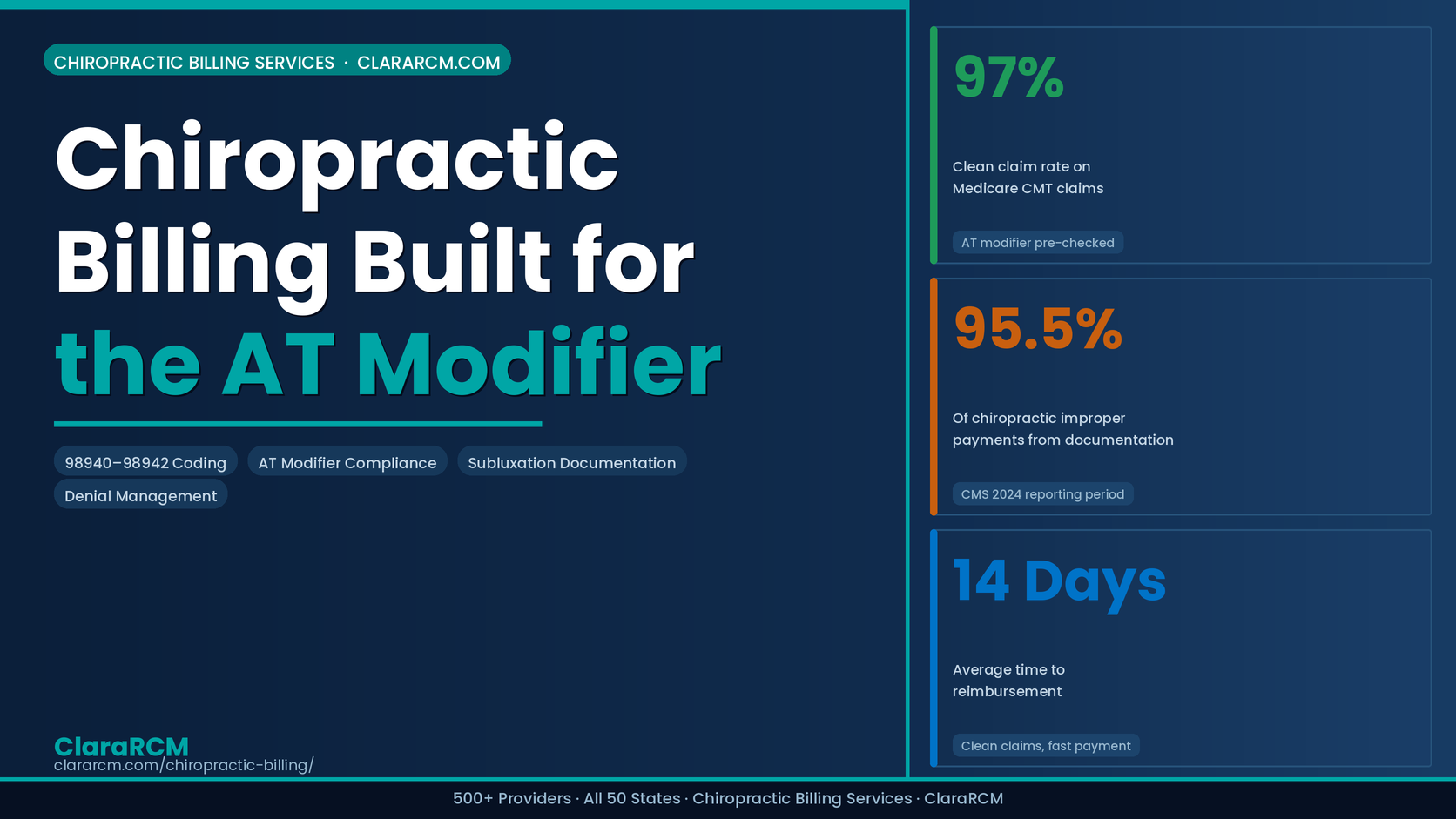
ClaraRCM's chiropractic billing services build AT modifier compliance and subluxation documentation review directly into the coding workflow, addressing the leading cause of chiropractic claim denials.
Chiropractic billing is the process of coding and submitting claims for chiropractic manipulative treatment using CPT codes 98940 to 98942, applying the AT modifier to distinguish active corrective care from non-covered maintenance therapy, and documenting a spinal subluxation to support medical necessity under Medicare's chiropractic benefit.
Medicare's chiropractic benefit is one of the most restrictive in the entire program. It covers only manual manipulation of the spine to correct a subluxation, billed under CPT 98940, 98941, or 98942, and only when care is active and corrective rather than maintenance. Everything else a chiropractor commonly performs, including exams, X-rays, and therapy modalities, is excluded from Medicare coverage when billed by a chiropractor.
Because of that narrow benefit and the AT modifier requirement, chiropractic has historically carried one of the highest improper payment rates of any Medicare Part B specialty. Our team builds documentation review directly into the coding workflow so active treatment claims are defensible before they are ever submitted.
| Problem | ClaraRCM Fix |
|---|---|
| AT modifier missing on an active treatment claim | Automated claim scrubbing blocks 98940 to 98942 submission without AT when active care is documented |
| AT modifier applied to maintenance care | Coders cross-check SOAP notes against Medicare's active vs. maintenance criteria before submission |
| Spinal region count does not match the billed code | Region-by-region documentation review confirms 98940 vs. 98941 vs. 98942 selection |
| Subluxation level missing from primary diagnosis | ICD-10 subluxation coding checked against P.A.R.T. exam documentation |
| Non-covered services billed to Medicare without an ABN | GA/GY modifier workflow and CMS-R-131 ABN tracking built into intake |
AT Modifier and Documentation Risk Calculator
CMS reports that insufficient documentation drives the large majority of chiropractic improper payments. Estimate what a similar error rate could be exposing in your own Medicare CMT claims.
This estimate is directional, based on your own inputs and CMS's published national improper payment findings for chiropractic services. It is not a substitute for a claims audit of your actual charts.
Get This Analysis Run on Your Actual Claims
Send us your calculator inputs and we will run a real documentation and AT modifier review against a sample of your recent claims.
Chiropractic CPT Codes: 2026 Reference Table
Updated for 2026 CMS policy. Dollar figures are national non-facility Medicare averages and will vary by locality under the Medicare Physician Fee Schedule. Always verify against the CMS PFS Look-Up Tool or your MAC before billing. Last updated: July 2026.
| Code | Description | Approx. Medicare Reimbursement | Coverage Notes |
|---|---|---|---|
| 98940 | Chiropractic manipulative treatment, spinal, 1 to 2 regions | ~$34 to $36 (national non-facility avg.) | Requires AT modifier for active/corrective treatment |
| 98941 | Chiropractic manipulative treatment, spinal, 3 to 4 regions | ~$38.41 (national non-facility avg.) | Requires AT modifier for active/corrective treatment |
| 98942 | Chiropractic manipulative treatment, spinal, 5 regions | ~$41 to $43 (national non-facility avg.) | Requires AT modifier for active/corrective treatment |
| 98943 | Chiropractic manipulative treatment, extraspinal | Statutorily non-covered by Medicare | Bill patient directly or with an ABN on file |
| AT modifier | Active/corrective treatment indicator | N/A (modifier) | Mandatory on 98940 to 98942 for Medicare payment; omission causes automatic denial |
| GA / GY modifiers | ABN on file / statutorily excluded service | N/A (modifier) | Used to shift non-covered services to patient responsibility |
| 97110 (with modifier 59) | Therapeutic exercise, when billed alongside CMT | ~$28.79 per unit (national non-facility avg.) | Requires modifier 59 or an X-modifier to avoid NCCI bundling with 98940 to 98942 |
Sources: CMS Medicare Provider Compliance Tips for Chiropractic Services; CMS Physician Fee Schedule national averages; CMS Medicare Benefit Policy Manual, Chapter 15, Section 240.
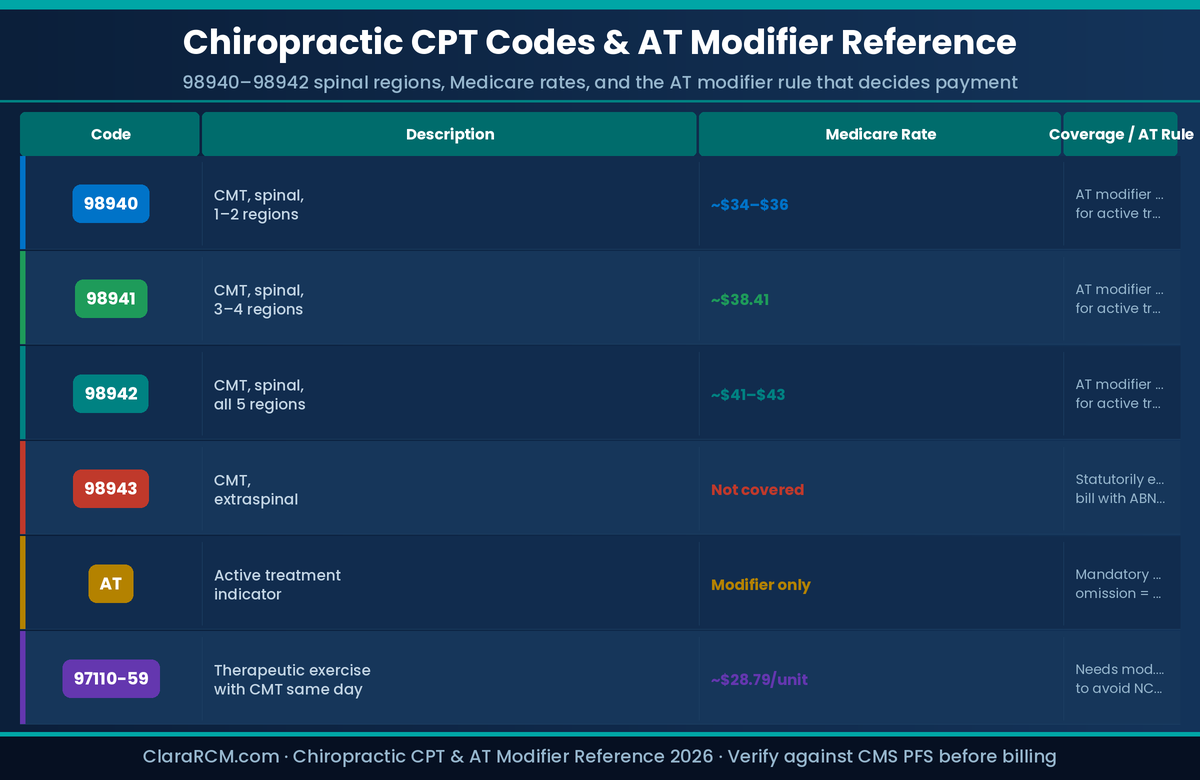
Chiropractic CPT codes 98940 through 98943, the AT modifier requirement, GA/GY modifiers, and the modifier 59 rule for same-day therapeutic exercise. Verify all rates against the current CMS Physician Fee Schedule before billing.
How ClaraRCM Handles Your Chiropractic Billing
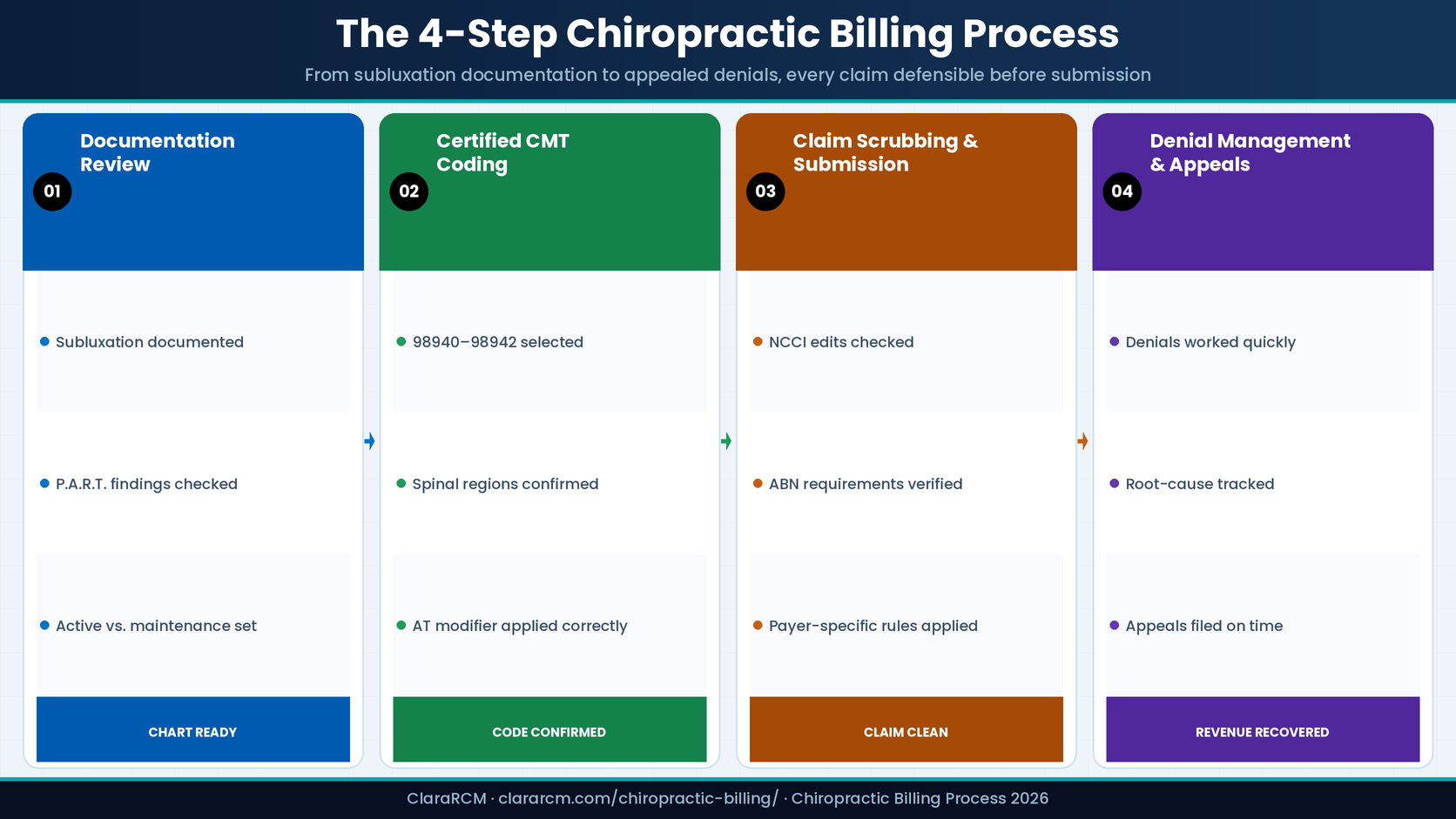
ClaraRCM's four-step chiropractic billing process: documentation review, certified CMT coding, claim scrubbing and submission, and denial management with appeals.
Documentation Review
We check every chart for a documented subluxation, P.A.R.T. findings, and a clear active vs. maintenance determination before coding begins.
Certified CMT Coding
Certified coders select 98940, 98941, or 98942 based on documented spinal regions and apply the AT modifier only when active treatment is supported.
Claim Scrubbing & Submission
Every claim is scrubbed against NCCI edits, ABN requirements, and payer-specific rules before electronic submission.
Denial Management & Appeals
Denied or recouped claims are worked and appealed quickly, with root-cause tracking so the same documentation gap does not repeat visit after visit.
Why Chiropractic Practices Choose ClaraRCM
AT Modifier Compliance Built In
We check active versus maintenance status on every visit so the AT modifier is applied correctly, not automatically.
97% Clean Claim Rate
Documentation review and pre-submission scrubbing keep first-pass acceptance high on a specialty with one of Medicare's highest historical error rates.
14-Day Average Reimbursement
Clean claims and disciplined follow-up mean chiropractic practices get paid faster instead of waiting out audit-driven delays.
U.S.-Based Certified Coders
Our entire coding and billing team operates in the United States. No offshore handoffs on subluxation documentation review.
All 50 States, Every Payer Mix
We currently support 500-plus providers nationwide, including multi-provider chiropractic groups with mixed Medicare and commercial panels.
35% Average AR Reduction
Proactive denial workflows and aging-bucket follow-up bring accounts receivable down instead of letting recoupment risk stack up.
Before ClaraRCM vs. After ClaraRCM
| Metric | Before | After ClaraRCM |
|---|---|---|
| Clean claim rate | Below industry benchmark, frequent AT modifier denials | 97% clean claim rate |
| Collection ratio | Inconsistent, documentation gaps caught after denial | 98.5% collection ratio |
| Accounts receivable | Aging past 60 to 90 days on appealed claims | 35% average AR reduction |
| Days to reimbursement | 30-plus days on reworked claims | 14 days average |
| AT modifier and documentation errors | Caught only after CERT-style post-payment review | Checked pre-submission, before the claim ever leaves the office |
Figures reflect ClaraRCM's aggregate client performance metrics across specialties. Individual results vary by payer mix and starting baseline.
Chiropractic Billing vs. Physical Therapy Billing: What's Actually Different
Chiropractic and physical therapy billing are frequently confused because both treat musculoskeletal conditions, but Medicare covers and codes them under entirely different rules.
| Factor | Chiropractic | Physical Therapy |
|---|---|---|
| Core codes | 98940 to 98942 (CMT), payer dependent on 98943 | 97110, 97140, 97530, and related therapy codes |
| Medicare coverage scope | Manual spinal manipulation only, active treatment only | Broader coverage of therapeutic exercise, manual therapy, and modalities under a plan of care |
| Required modifier | AT modifier for active/corrective treatment | GP modifier for outpatient physical therapy claims |
| Maintenance care | Not covered by Medicare under any circumstance | May be covered under a maintenance program with physician certification |
| Diagnosis requirement | Subluxation must be the primary diagnosis | Functional impairment tied to the plan of care |
Billing Services for Related Specialties
Related ClaraRCM Services
Denial Management & AR Recovery
Root-cause denial resolution and aged AR recovery for AT modifier and documentation-driven denials.
Learn more →MIPS/QPP/Value-Based Care Billing
Quality reporting support for chiropractic practices participating in value-based contracts.
Learn more →Telehealth & Virtual Care Billing
For multidisciplinary practices pairing chiropractic care with telehealth visit intake.
Learn more →RPM & CCM Billing
For chiropractic groups expanding into remote monitoring and chronic care management service lines.
Learn more →Chiropractic Billing: Frequently Asked Questions
Does Medicare cover chiropractic maintenance therapy?
No. Medicare covers only active or corrective treatment to correct a subluxation. Once a patient's condition has stabilized and no further clinical improvement is expected, continued care is classified as maintenance therapy and is not covered, regardless of whether the AT modifier is applied.
What is the AT modifier in chiropractic billing?
The AT (Active Treatment) modifier tells Medicare that CPT codes 98940, 98941, or 98942 represent active or corrective treatment of an acute or chronic subluxation rather than maintenance care. Without it, Medicare treats the claim as maintenance therapy and denies it automatically.
What is the difference between CPT 98940, 98941, and 98942?
The three codes are distinguished by the number of spinal regions manipulated during the visit. 98940 covers 1 to 2 regions, 98941 covers 3 to 4 regions, and 98942 covers all 5 recognized spinal regions. The region count must match what is documented in the chart.
Is CPT 98943 covered by Medicare?
No. CPT 98943, extraspinal manipulation, is statutorily non-covered by Medicare regardless of documentation or modifiers. Practices should collect an Advance Beneficiary Notice and bill the patient directly, or bill a secondary payer if applicable.
What is the most common reason chiropractic claims are denied?
According to CMS, insufficient documentation accounted for 95.5% of improper payments for chiropractic services during the 2024 reporting period, far outweighing incorrect coding or medical necessity issues combined. Documentation quality is the leading denial driver in this specialty.
How is chiropractic billing different from physical therapy billing?
Chiropractic billing centers on manual spinal manipulation (98940 to 98942) with the AT modifier, and Medicare covers only active treatment. Physical therapy billing covers a broader range of therapeutic exercise and modality codes under a certified plan of care, using the GP modifier.
What diagnosis code is required for chiropractic manipulation claims?
Medicare requires the primary diagnosis to reflect a documented spinal subluxation at a specific level, supported by physical exam findings or X-ray. A secondary diagnosis describing the neuromusculoskeletal condition necessitating treatment must also be included.
Does Medicare limit the number of chiropractic visits allowed?
Medicare does not set a hard visit cap, but every claim must demonstrate ongoing medical necessity and documented improvement. High utilization patterns can trigger review by the Medicare Administrative Contractor even when each individual claim appears otherwise compliant.
Can 97110 be billed on the same day as a chiropractic adjustment?
Yes, but modifier 59 or an appropriate X-modifier is required to show the therapeutic exercise was a distinct, separately identifiable service from the manipulation. Without the modifier, the payer bundles both services and pays only for the CMT code.
What happens if the AT modifier is used on a maintenance visit?
Applying the AT modifier to a visit that is actually maintenance care is a compliance violation, not just a coding error. It can trigger post-payment recoupment, audit, and in repeated patterns, referral for further review, separate from the denial risk of omitting AT on active care.
What documentation does an Advance Beneficiary Notice cover in chiropractic billing?
An ABN, using CMS form CMS-R-131, notifies a Medicare patient in advance that a service, such as maintenance care or extraspinal manipulation under 98943, is not expected to be covered, allowing the practice to bill the patient directly with the GA modifier on the claim.
Is outsourcing chiropractic billing worth it for a small practice?
For most small chiropractic practices, outsourcing removes the burden of tracking AT modifier rules, subluxation documentation standards, and NCCI bundling edits in-house, while typically improving clean claim rates given how narrowly Medicare defines the covered chiropractic benefit.