
Urgent Care Billing Services Built for High-Volume Revenue Cycles
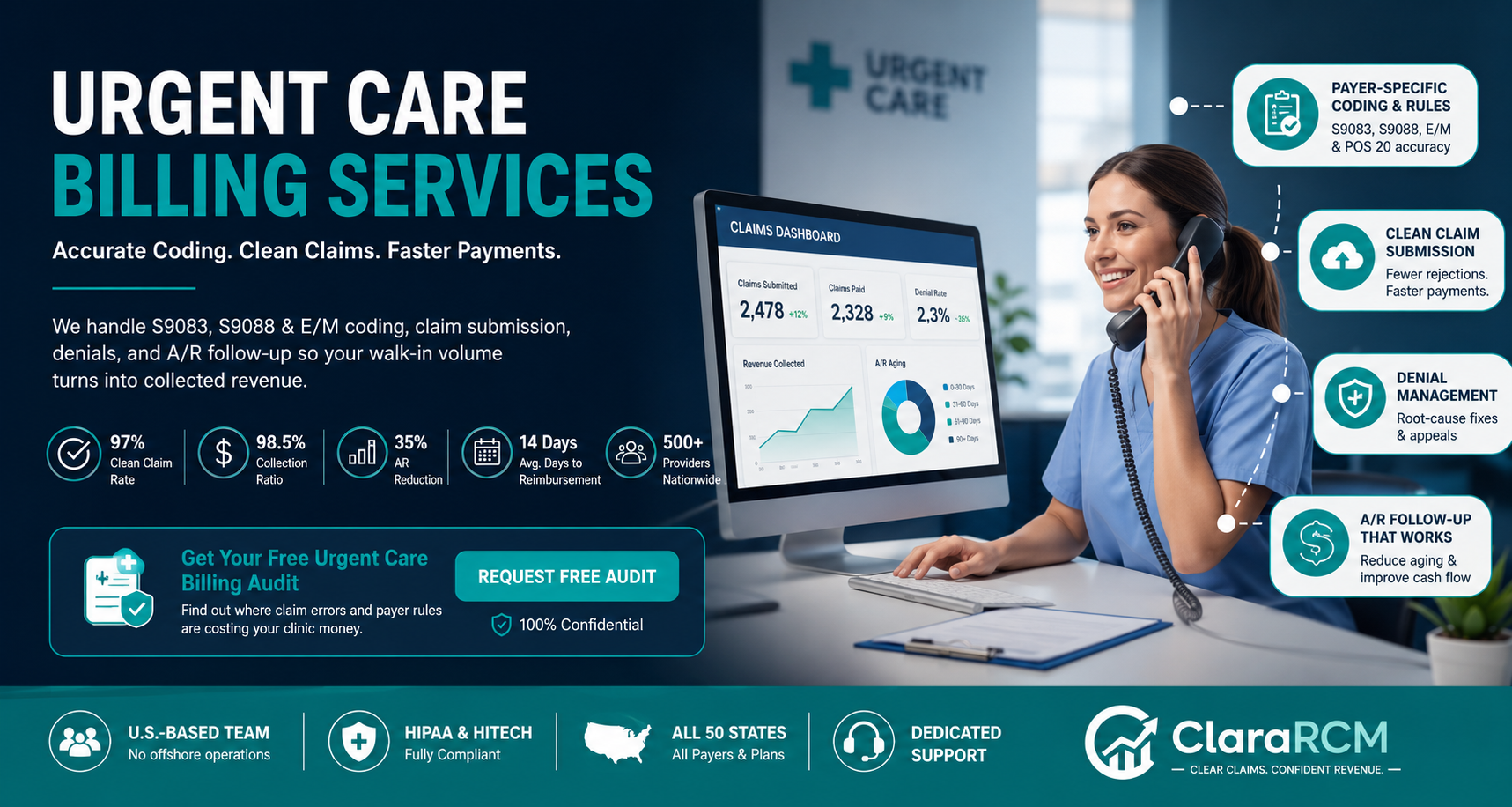
ClaraRCM provides end-to-end urgent care medical billing services for walk-in clinics and multi-location urgent care groups. We manage eligibility, coding, charge capture, claim submission, payment posting, denials, and A/R follow-up while applying payer-specific urgent care billing rules before claims leave your queue.
If you are comparing an urgent care billing company, start with the numbers that matter: clean claims, collections, A/R aging, denial root causes, and days to payment. Our free billing audit shows where your revenue cycle is leaking and what can be corrected first.
U.S.-based billing and coding team. No offshore operations.
Get a Free Urgent Care Billing Audit
We will review the revenue-cycle issues most likely to affect collections: payer rules, coding patterns, denials, aging A/R, and claim workflow gaps.
What Are Urgent Care Billing Services?
Urgent care billing services manage the financial workflow that turns an urgent care encounter into collected revenue, from insurance eligibility and coding through claim submission, payment posting, denial resolution, and accounts receivable follow-up. The workflow must also account for high walk-in volume, mixed payer contracts, POS 20 requirements, E/M coding, procedures, and payer-specific S-code rules.
For urgent care centers, revenue-cycle performance depends on more than submitting claims quickly. A single shift can include new and established E/M visits, labs, imaging, laceration repairs, splinting, occupational medicine, self-pay patients, Medicare, Medicaid managed care, and commercial plans. Each encounter has to move through the correct payer and coding pathway without slowing the front desk or creating avoidable rework downstream.
ClaraRCM builds the billing workflow around your payer mix, locations, providers, documentation patterns, and existing EHR/PM system. The goal is simple: cleaner claims, faster follow-up, fewer preventable denials, and a revenue cycle your leadership team can actually see and manage.
| Revenue-Cycle Risk | How ClaraRCM Handles It |
|---|---|
| Walk-in registration errors | Eligibility and demographic checks before claim submission |
| Payer-specific urgent care rules | Contract-aware claim logic and payer-specific billing workflows |
| Missed procedures or ancillary charges | Charge review against documented services before claims are released |
| E/M, modifier, or POS issues | Documentation-supported coding review and claim scrubbing |
| Recurring denials | Root-cause tracking so the same error is corrected upstream |
| Aging A/R | Prioritized payer follow-up by balance, age, denial reason, and next action |
What Our Urgent Care Medical Billing Services Include
ClaraRCM can own the full urgent care revenue cycle or take over the parts creating the most operational drag. That makes the service suitable for single-location clinics, growing urgent care groups, and organizations that need specialty billing support without replacing their existing systems.
Eligibility & Benefits Verification
Coverage, active status, patient responsibility, and payer requirements are checked early so preventable front-end errors do not become back-end denials.
Eligibility services →Urgent Care Coding & Charge Review
We review E/M levels, documented procedures, modifiers, POS, and payer-specific urgent care billing rules before claim release.
Claim Submission
Claims are scrubbed and submitted with the required payer, provider, coding, and claim-format information to reduce avoidable rejections.
Claim submission services →Payment Posting
ERA/EOB payments, contractual adjustments, and patient balances are posted accurately so A/R starts from a reliable account balance.
Denial Management & Appeals
We identify denial reasons, correct claim or documentation issues, appeal when appropriate, and track root causes by payer and workflow.
Denial management →Accounts Receivable Follow-Up
Open balances are worked by aging, payer, balance, status, and next action rather than left in generic aging reports.
A/R follow-up services →Credentialing Support
Provider enrollment and credentialing support helps reduce avoidable payment delays caused by participation or enrollment issues.
Credentialing services →Billing Audit & Cleanup
We review aging A/R, denials, posting problems, claim patterns, and workflow gaps to build a prioritized recovery plan.
Billing audit & cleanup →Already using another billing company?
You do not need to switch first. Start with an audit of denials, aging A/R, coding patterns, and payer workflow. We will show you where the current revenue cycle is breaking before you decide what to change.
How ClaraRCM Manages Urgent Care Billing From Visit to Payment
A high-volume urgent care revenue cycle works best when front-end, coding, claims, denials, and A/R are treated as one connected workflow instead of separate departments.
Verify & Prepare
Eligibility, demographics, payer information, provider enrollment, and visit data are checked before billing work begins.
Code & Capture Charges
Documentation is reviewed for E/M level, procedures, modifiers, site of service, and payer-specific urgent care billing requirements.
Scrub & Submit
Claims are checked for preventable errors and submitted electronically with payer-specific claim construction where required.
Post, Resolve & Follow Up
Payments are posted, denials are worked, and unpaid claims are actively followed until the account reaches the appropriate resolution.
Why Urgent Care Billing Breaks Differently From Standard Office Billing
Urgent care is a high-throughput outpatient setting with little time to correct registration, coverage, and documentation issues before the next patient arrives. That makes seemingly small billing errors expensive when they repeat across dozens or hundreds of encounters.
- Mixed payer methodologies: the same clinical visit may require a different billing approach depending on payer and contract.
- Variable acuity: E/M levels and procedures change from encounter to encounter, increasing charge-capture and coding risk.
- Ancillary services: labs, imaging, injections, supplies, and minor procedures can create additional claim rules and documentation requirements.
- High walk-in volume: eligibility and demographic errors can multiply quickly during peak hours.
- Multi-location complexity: provider enrollment, payer participation, site information, and work queues must stay aligned across locations.
The practical difference: an urgent care billing company should not only know how to submit claims. It should know how to protect charge capture, apply payer-specific rules, prevent repeat denials, and work aging A/R without slowing a high-volume clinical operation.
| What to Measure | Why It Matters |
|---|---|
| Clean claim rate | Shows how much avoidable rework is entering the revenue cycle |
| Denial rate by payer/reason | Reveals whether problems are isolated or systemic |
| A/R over 90 days | Shows how much revenue is aging without resolution |
| Days to payment | Measures cash-flow speed after claim submission |
| Net/collection performance | Shows how much collectible revenue is actually being recovered |
S9083, S9088, E/M, Modifier and POS Rules Still Matter — But They Are Only One Part of RCM
This service page intentionally focuses on the full urgent care revenue cycle. Code-level search intent belongs in ClaraRCM's dedicated guides, while your billing workflow should connect those coding decisions to eligibility, claim submission, payment posting, denials, and A/R follow-up.
| Billing Element | Operational Role | What to Verify |
|---|---|---|
| 99202-99205 / 99211-99215 | Office/outpatient E/M services | Documentation supports the selected level under current E/M rules |
| S9083 | Urgent care global-fee methodology when recognized by the payer | Payer contract and claim-format requirements |
| S9088 | Urgent care center service reported in addition to the underlying service when applicable | Payer policy, contract treatment, and required base service |
| Modifier 25 | Separately identifiable E/M on the same date as another procedure/service | Documentation supports distinct E/M work |
| POS 20 | Urgent care facility place of service | Actual site of service and payer requirements |
For code-level guidance, read ClaraRCM's S9083 code billing and reimbursement guide and S9088 code billing guidelines and reimbursement guide. These two resources remain the dedicated informational pages for S-code search intent.
Estimate Potential Revenue Leakage in Your Urgent Care Billing Workflow
This calculator uses S9083 versus itemized billing as one example of how payer-contract methodology can affect revenue. Use it as a directional estimate, then validate the result against your actual contracts and claims.
Directional estimate only. Actual reimbursement depends on contract terms, payer policy, documentation, coding, case mix, and allowed amounts.
Turn the Estimate Into a Real Claims Review
Send your calculator inputs and request a payer-aware review of actual claim patterns, denials, and A/R.
What to Expect From ClaraRCM as Your Urgent Care Billing Company
Full Revenue-Cycle Ownership
Billing, denials, A/R, eligibility, coding support, and payment workflow are managed as one connected revenue cycle.
Payer-Specific Workflows
Claim construction and follow-up are aligned to payer requirements instead of relying on one generic urgent care workflow.
97% Clean Claim Rate
Front-end checks and pre-submission review help reduce avoidable claim rework.
98.5% Collection Ratio
Collection performance is supported by disciplined posting, denial resolution, and A/R follow-up.
35% Average AR Reduction
Aging balances are prioritized and worked rather than left to accumulate in static reports.
14-Day Average Reimbursement
Clean claims and active follow-up help keep cash moving through the revenue cycle.
Performance figures are ClaraRCM aggregate client metrics across specialties. Individual results vary by payer mix, starting A/R, documentation, contracts, and operational baseline.
When Should an Urgent Care Center Outsource Medical Billing?
Outsourcing is worth evaluating when the cost of billing problems is higher than the value of keeping every revenue-cycle task in-house. The strongest warning signs are operational, not theoretical.
| Signal | What It Usually Means | What to Review |
|---|---|---|
| Denials keep repeating | The root cause is not being fixed upstream | Denial reason trends by payer, code, location, and provider |
| A/R over 90 days keeps growing | Follow-up queues are underworked or poorly prioritized | Aging buckets, status, last action, and payer response |
| Claims are delayed after date of service | Documentation, charge entry, or coding handoffs are slowing submission | Charge lag and claim lag by location/provider |
| Leadership cannot explain collection changes | Reporting is not connecting operational work to financial outcomes | Clean claims, denials, collections, A/R, and payer trends |
| Growth adds staff but not collections | The revenue cycle is not scaling with visit volume | Visits, charges, collections, denial volume, and staffing cost |
Not sure whether the problem is coding, denials, A/R, or payer rules?
That is exactly what the audit is for. We will identify where money is getting delayed or lost before recommending a broader billing change.
Build the Rest of Your Revenue Cycle Around Urgent Care Billing
Urgent Care Billing Services: Frequently Asked Questions
An urgent care billing company can manage eligibility, coding support, charge review, claim submission, payment posting, denials, appeals, and A/R follow-up for urgent care centers. Specialty expertise matters because urgent care combines high walk-in volume, variable visit complexity, procedures, mixed payer rules, and site-of-service requirements.
Urgent care revenue cycle management covers the financial workflow from patient registration and insurance verification through coding, charge capture, claim submission, payment posting, denial management, accounts receivable follow-up, reporting, and patient balance workflows. The exact scope depends on what the clinic keeps in-house versus outsources.
Pricing varies by monthly claim volume, locations, payer mix, services included, current A/R condition, coding scope, and whether the engagement is full RCM or a narrower billing function. ClaraRCM starts with a billing review so scope and pricing can be based on the actual workload rather than a generic quote.
Yes. A/R cleanup can be handled as part of an ongoing billing engagement or as a focused cleanup project. The work typically starts by segmenting balances by age, payer, denial or claim status, last action, and recovery opportunity.
CMS designates POS 20 as Urgent Care Facility. The place of service on a claim should accurately reflect the setting where care was delivered and meet applicable payer requirements. Site configuration and payer rules should be verified rather than assuming one POS for every location.
S9083 is associated with a global-fee urgent care billing methodology when recognized under the payer's contract. S9088 is reported in addition to the underlying service when payer rules support or require it. Because treatment varies by payer and contract, ClaraRCM maintains dedicated S9083 and S9088 guides for the code-level details.
Denial reduction starts before submission. We focus on eligibility, complete claim data, documentation-supported coding, payer-specific claim rules, and claim scrubbing. When a denial still occurs, the reason is tracked so recurring issues can be corrected upstream instead of repeatedly reworked.
Yes. Multi-location work requires consistent provider and location setup, payer enrollment, site-of-service accuracy, work-queue ownership, and reporting that can be reviewed at both location and group level.
The most useful starting data usually includes an A/R aging report, denial report, payer mix, monthly visit or claim volume, and a summary of the current billing workflow. ClaraRCM can confirm the exact files needed before any review begins.