
Billing Audit & Cleanup Services for U.S. Medical Practices
A medical billing audit reviews claims, denials, payments, adjustments, coding, and aging accounts receivable to identify errors and recoverable revenue. Billing cleanup turns those findings into prioritized corrected-claim, appeal, payer-follow-up, posting-correction, and write-off-review queues.
ClaraRCM identifies where revenue was lost, what remains collectible, which action comes next, and which workflow change can prevent the same problem from returning.
Get Your Free Billing Audit
Send your details and ClaraRCM will identify billing cleanup opportunities across claims, denials, AR, payment posting, and payer workflows.
What Is a Medical Billing Audit & Cleanup?
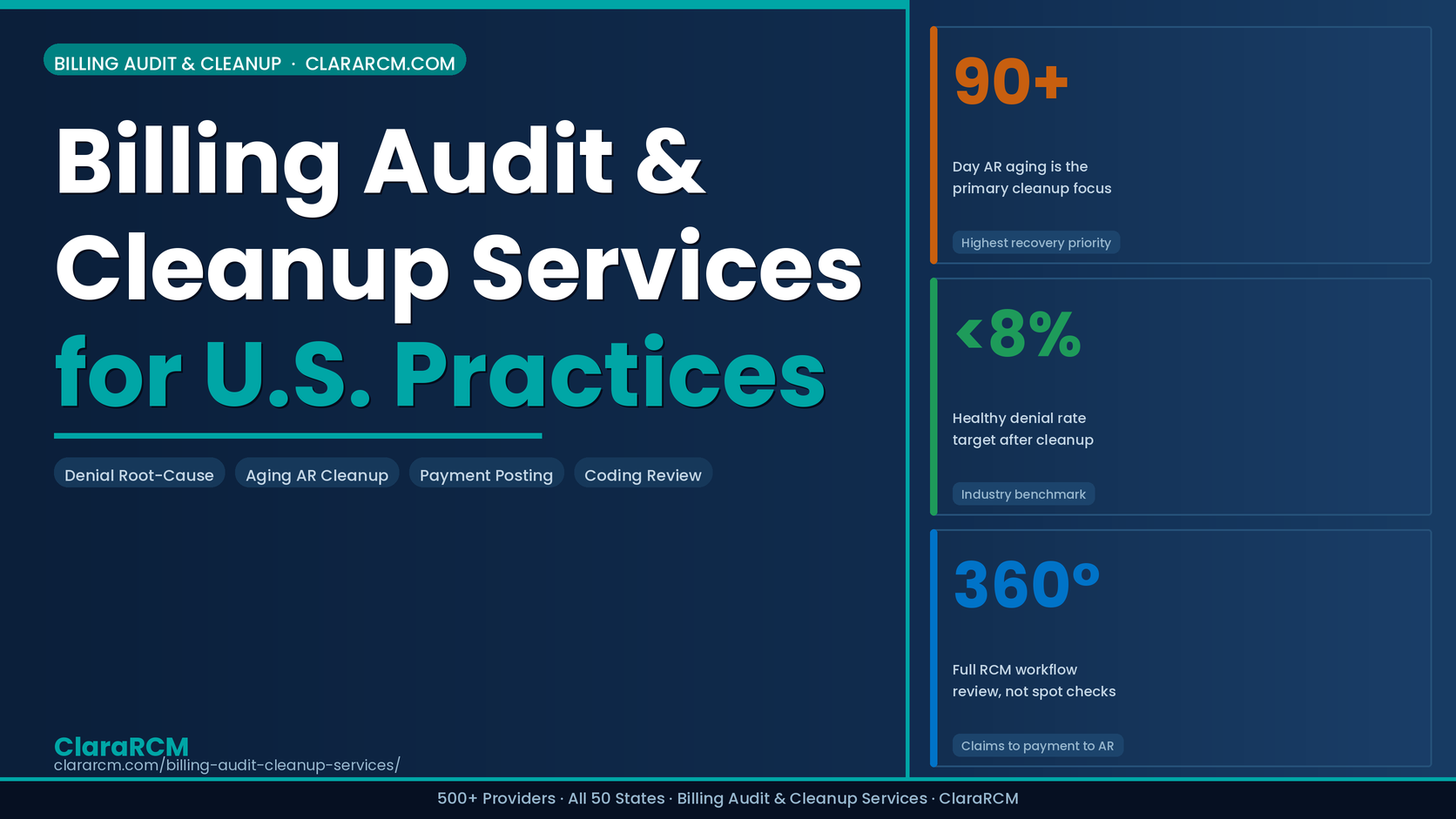
ClaraRCM's billing audit and cleanup services connect denial root-cause analysis, aging AR cleanup, payment posting review, and coding audits into one actionable revenue recovery plan.
A useful audit distinguishes three different questions: whether a balance is accurate, whether it is still collectible, and what action is required before the payer or appeal deadline expires. Cleanup then assigns each valid balance to the correct work queue instead of treating every old claim the same way.
ClaraRCM reviews how claims move from claim submission to payment posting, AR follow-up, medical coding support, and full revenue cycle management. The goal is not just to find old claims; it is to identify why revenue leaked in the first place.
Repeat denial patterns are routed into a structured denial management workflow, while front-end failures are traced back to controls such as eligibility and benefits verification. This connects recovery work to prevention without turning this service page into a denial-code glossary.
ClaraRCM's audit methodology references authoritative U.S. guidance, including HHS OIG compliance guidance and current CMS NCCI edits. Current payer manuals, contracts, remittance details, and filing rules remain the controlling sources for individual claims.
Denial Rate Calculator for Billing Audit & Cleanup
Enter total claims submitted, total claims denied, total AR, and AR over 90 days. Your denial rate and aging AR percentage calculate instantly with no reload.
Planning tool only. Thresholds are ClaraRCM internal review ranges, not national benchmarks or a prediction of recovery.
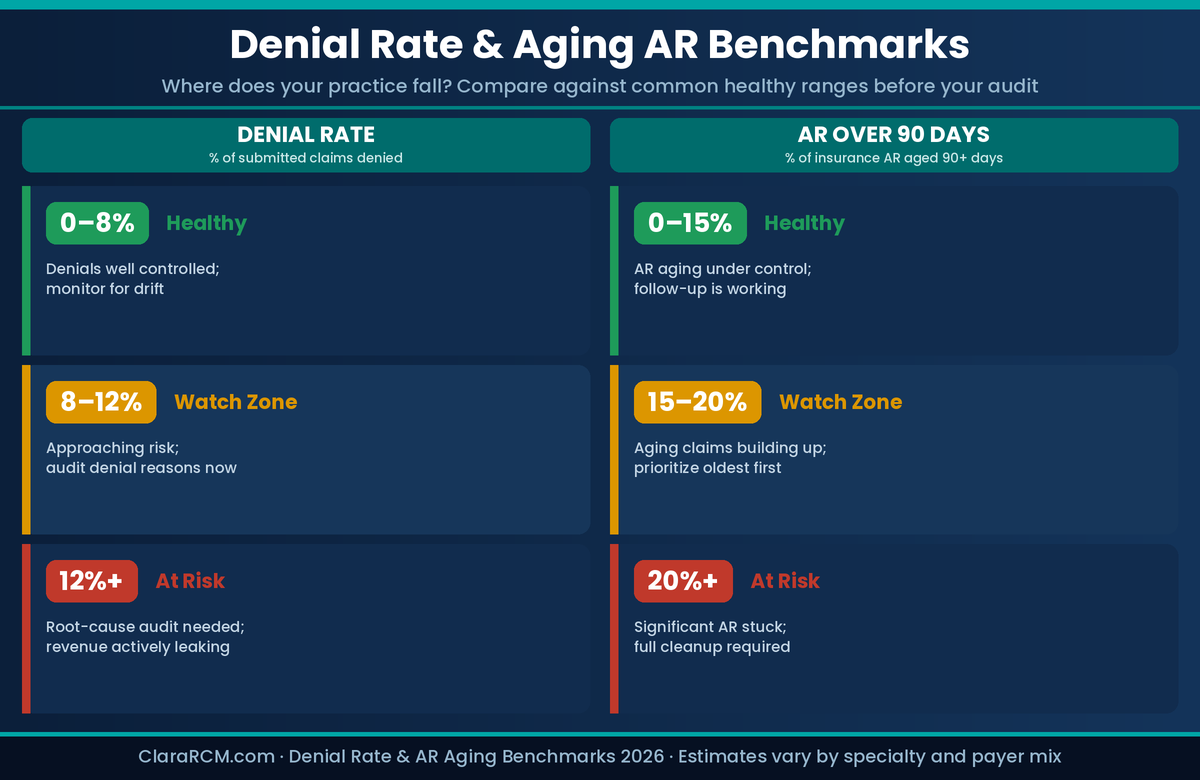
Use these ClaraRCM internal planning thresholds to decide where a deeper claim-level review may be useful. They are not national benchmarks.
Want ClaraRCM to Review These Audit Numbers?
Send your calculator results and our team will follow up with a free billing audit and cleanup review.
Our Billing Audit & Cleanup Process, Step by Step
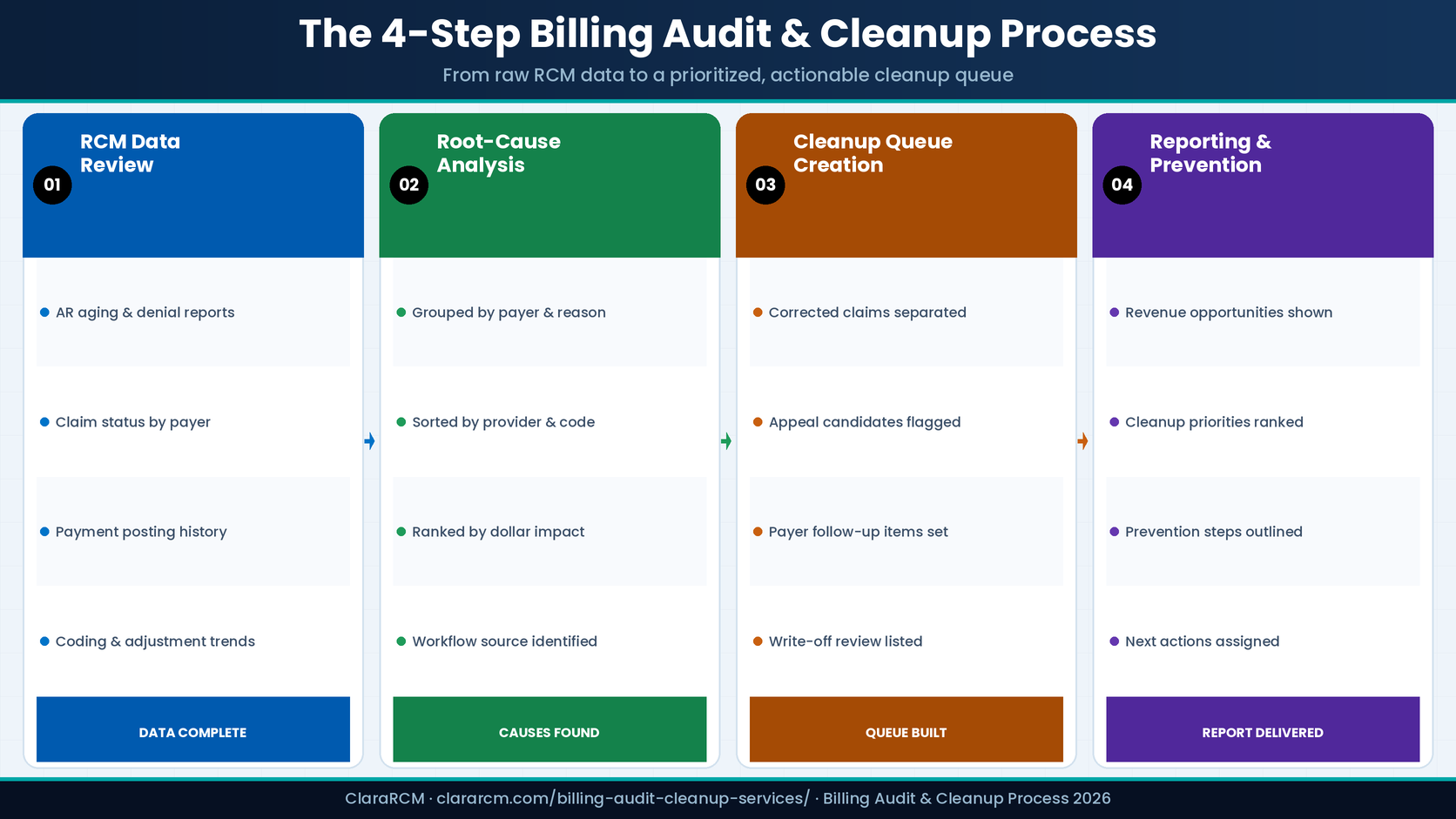
ClaraRCM's four-step billing audit and cleanup process: RCM data review, root-cause analysis, cleanup queue creation, and reporting with prevention recommendations.
RCM Data Review
We review AR aging, denial reports, claim status, payment posting, payer trends, coding patterns, and adjustment/write-off activity.
Root-Cause Analysis
Findings are grouped by payer, provider, specialty, code, denial reason, workflow step, and dollar impact so cleanup is targeted.
Cleanup Queue Creation
We separate corrected claims, appeal candidates, payer follow-up items, posting fixes, patient balance corrections, and write-off review.
Reporting & Prevention
You receive a practical audit report with revenue opportunities, cleanup priorities, prevention recommendations, and next actions.
Billing Audit & Cleanup Built for Real Revenue Recovery
Denial and AR Reviewed Together
We connect denied claims, no-response claims, unpaid balances, underpayments, and posting issues instead of auditing in silos.
U.S. Payer-Focused Audit Logic
Our cleanup approach reflects Medicare, Medicaid, Medicare Advantage, and commercial payer workflows, not generic billing checklists.
Actionable Cleanup Priorities
Every issue is ranked by collectability, deadline risk, payer friction, dollar value, and likely recovery path.
Coding, Posting and Claims Insight
We inspect the full path from coding and claim submission to payment posting, patient balance transfer, denial, and AR follow-up.
Compliance-Aware Review
Audit findings are framed with payer documentation, coding edit, write-off, and adjustment risks in mind.
Prevention After Cleanup
We do not just clean up old claims; we identify workflow changes that prevent the same billing backlog from returning.
What Changes After ClaraRCM Audits and Cleans Up Billing
These improvements reflect what U.S. practices typically target when they move from scattered billing cleanup to structured RCM audit work.
| Metric | Before | After ClaraRCM |
|---|---|---|
| Denial Root Causes | Known only claim by claim | Grouped by payer, reason, code, provider, and workflow |
| Aging AR Cleanup | Old claims sit in 90+ and 120+ day buckets | Prioritized by collectability and next action |
| Payment Posting Errors | Hidden inside adjustments and patient balances | Flagged for correction and reconciliation |
| Revenue Leakage | Unclear source and uncertain recovery | Mapped to specific billing workflow fixes |
Actual results vary by payer mix, specialty, claim volume, documentation quality, system access, and age of the backlog.
Internal Billing Cleanup vs. ClaraRCM Audit & Cleanup
Internal teams often know there is a backlog, but they may not have time to isolate root causes while still handling daily billing work.
Internal Cleanup Only
- Focuses on the oldest claims without checking collectability first
- Works denials one by one without root-cause grouping
- May miss payment posting errors and underpayments
- Backlog returns because workflow prevention is not addressed
ClaraRCM Billing Audit & Cleanup
- Prioritizes cleanup by payer, age, dollar value, deadline, and likelihood of recovery
- Connects denials to coding, eligibility, authorization, documentation, and submission issues
- Reviews AR, posting, adjustments, write-offs, and patient balances together
- Builds prevention steps so the same billing problems do not keep returning
Billing Audit & Cleanup by Specialty
Billing cleanup patterns vary by documentation requirements, payer rules, procedure mix, and patient responsibility. ClaraRCM adapts the audit to your specialty.
Billing Audit & Cleanup FAQ
What are billing audit & cleanup services?
Billing audit & cleanup services review claims, denials, aging AR, payment posting, coding patterns, adjustments, write-offs, and patient balances to find errors and recoverable revenue.
When should a medical practice request a billing audit?
A practice should request a billing audit when denials are rising, AR over 90 days is growing, collections feel inconsistent, posting errors are common, or reports do not clearly explain lost revenue.
What does ClaraRCM review during billing cleanup?
ClaraRCM reviews denial reason codes, payer trends, AR aging, claim status, payment posting, patient balances, coding patterns, authorization issues, eligibility errors, and write-off activity.
Can a billing audit reduce claim denials?
Yes. A billing audit can reduce denials by identifying repeat causes such as missing authorization, coding mismatches, eligibility errors, documentation gaps, payer-specific rules, and claim submission issues.
How is billing cleanup different from AR follow-up?
AR follow-up works unpaid claims. Billing cleanup is broader because it reviews why claims aged, why denials repeated, whether payments posted correctly, and what workflow changes are needed.
Does billing audit include Medicare and Medicaid claims?
Yes. ClaraRCM reviews Medicare, Medicaid, Medicare Advantage, and commercial payer claims using U.S. payer terminology, claim status logic, and documentation expectations.
What is a healthy denial rate after cleanup?
ClaraRCM uses an initial denial rate below 8% as an internal operating review threshold, not a national benchmark. A useful target must account for specialty, payer mix, claim volume, clinical complexity, and whether the denominator counts claims or claim lines.
Can billing cleanup find underpayments?
Yes. Cleanup can reveal underpayments when allowed amounts, payer payments, contractual adjustments, and posted balances do not match expected reimbursement.
Is billing audit & cleanup a one-time project or ongoing service?
It can be either. Some practices need a one-time cleanup after a backlog, while others benefit from ongoing audit checks inside a broader RCM engagement.
What information do I need for a free billing audit?
A recent AR aging report, denial report, payment posting report, claim sample, or billing system export is enough for ClaraRCM to begin identifying cleanup opportunities.